Kenshi: How Autonomous Characters Shape the Game World
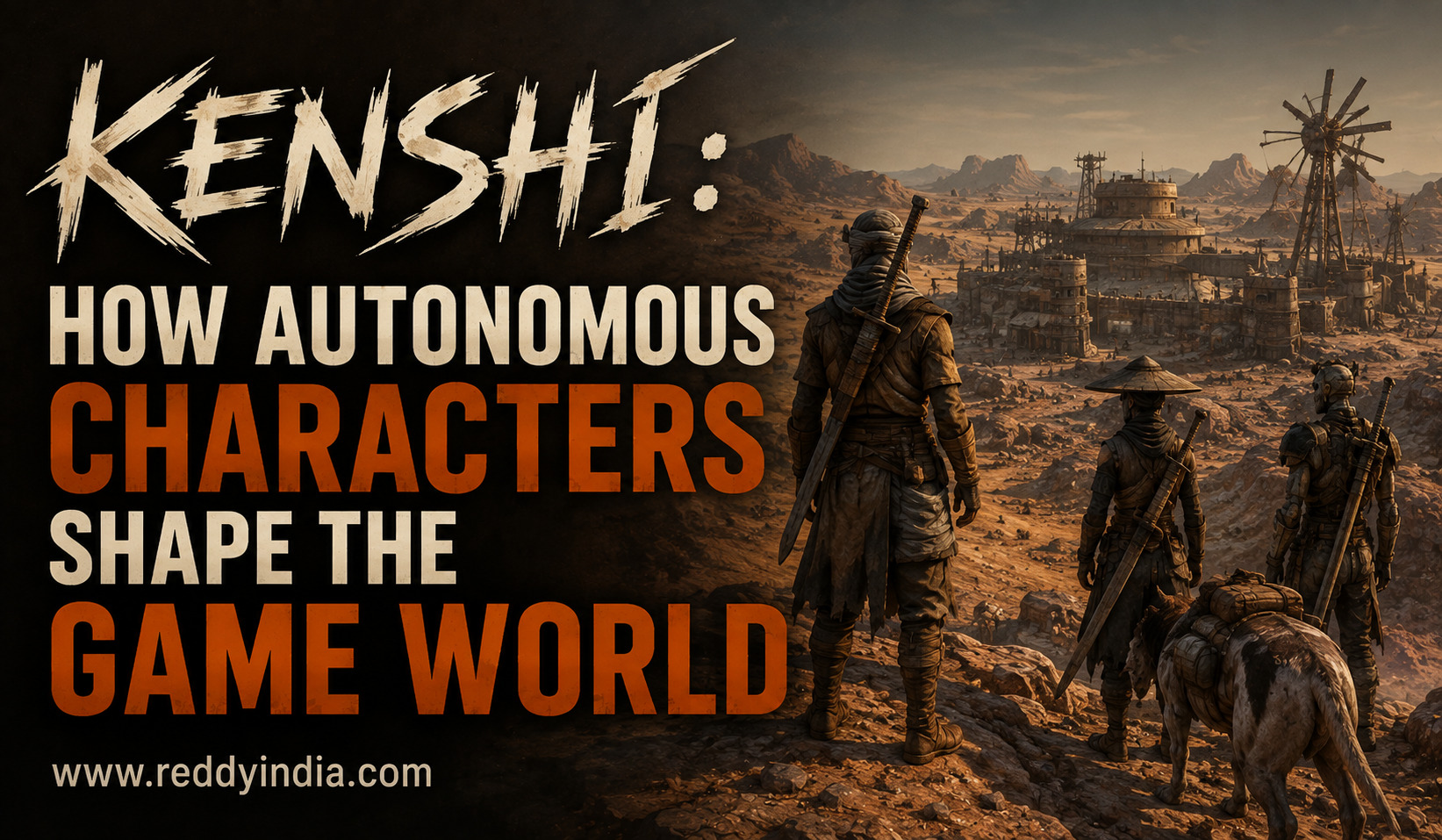
Open-world games often give players enormous maps to explore, but few make the world feel as independent as Kenshi. Developed by Lo-Fi Games, Kenshi is a sandbox RPG that places players in a harsh post-apocalyptic world where survival depends on exploration, strategy, resource management, and adaptation.
What makes Kenshi particularly interesting is its approach to autonomous characters. The world does not stop waiting for the player to act. Factions move, characters travel, towns operate, battles happen, traders follow routes, and enemies pursue their own objectives.
The result is a game world that can continue developing even when the player is not directly involved.
This autonomous behavior is one of the main reasons Kenshi can create unpredictable stories and experiences.
A World That Does Not Revolve Around the Player
Many RPGs are designed around the idea that the player character is the most important person in the world.
Major events wait for the player’s involvement. Important characters remain in specific locations until the player arrives. Enemies may not act until a mission begins.
Kenshi takes a different approach.
The player is important to their own story, but the wider world does not necessarily depend on them.
Factions continue to operate.
Settlements remain active.
Characters travel between locations.
Groups can fight each other.
This creates the impression that the player is entering an already functioning world rather than becoming the center of one.
Autonomous Characters and AI Behavior
Kenshi’s characters are controlled by systems that determine their actions based on different conditions.
NPCs can travel, work, fight, trade, patrol, rest, and interact with the world.
Their behavior is influenced by faction relationships, locations, jobs, threats, and other circumstances.
This creates a basic form of autonomous simulation.
A trader may travel along a route because they have goods to deliver.
A guard may patrol a settlement.
A group of enemies may move through the wilderness.
A faction may send forces into territory controlled by another group.
These activities can happen without direct player involvement.
Factions Shape the World
Factions are among the most important autonomous forces in Kenshi.
The game world contains competing groups with their own territories, beliefs, resources, and relationships.
The player can interact with these factions, but they do not simply exist to provide missions.
They are active participants in the world.
A faction may control a settlement, patrol an area, attack another group, or respond to changes in territory.
This means the political environment can influence the player’s experience.
Traveling through one region may be relatively safe, while another could be extremely dangerous because of faction activity.
The Player Is Part of the Simulation
Kenshi does not force players to follow one specific role.
They can become traders, explorers, fighters, farmers, miners, mercenaries, criminals, settlers, or almost anything else that fits the game’s systems.
This flexibility works because the world does not require a predetermined narrative.
Instead, the player becomes another participant in the simulation.
Their actions can affect relationships with factions, access to settlements, economic opportunities, and survival.
The game therefore treats the player less like the hero of a scripted story and more like an individual trying to survive in a complicated world.
Autonomous Behavior Creates Unexpected Events
Because characters and factions act independently, unexpected situations can happen naturally.
A player traveling across the wilderness might encounter a patrol.
A fight between two groups could occur nearby.
A trader might be attacked.
A settlement could become dangerous because of faction conflict.
The player may become involved simply because they happened to be in the wrong place at the right—or wrong—time.
These moments create some of Kenshi’s most memorable stories.
The game does not always need a scripted event to create drama.
The simulation can generate it.
Survival Changes Character Behavior
Kenshi’s harsh survival mechanics also influence autonomous behavior.
Characters can become injured, exhausted, hungry, or vulnerable.
These conditions affect what they can do.
A badly injured character may be unable to fight effectively.
A group with limited supplies may need to find resources.
A settlement may require food and protection to remain operational.
This makes survival more than a traditional health system.
It becomes part of the simulation.
Characters are not simply waiting for the player to give them orders. Their condition influences their ability to participate in the world.
Training and Character Development
Character development in Kenshi is closely connected to what characters actually do.
Skills can improve through practice.
A character who repeatedly fights can become a better fighter.
Someone who spends time mining can become more proficient at mining.
This creates a natural relationship between action and progression.
Instead of simply receiving experience points for completing scripted missions, characters can develop based on their activities.
The system supports the game’s broader philosophy of emergent gameplay.
Players decide what their characters do, and those decisions gradually shape who the characters become.
The World Can Be Dangerous Without a Script
Kenshi’s autonomous systems contribute heavily to its reputation for difficulty.
Enemies do not always appear because the player has reached a particular quest stage.
Danger can come from the environment, local factions, roaming groups, wildlife, or unexpected encounters.
This makes exploration unpredictable.
A journey that seems safe can suddenly become a survival situation.
Players therefore need to learn how the world behaves rather than relying entirely on a predetermined difficulty curve.
Understanding faction territories, enemy behavior, geography, and resource availability becomes part of mastering the game.
Settlements and Player Independence
As players become more experienced, they can establish their own settlements.
This changes their relationship with the simulation.
Instead of simply traveling through the world, they begin creating a place within it.
A settlement requires resources, infrastructure, protection, and workers.
Its development creates new responsibilities.
Players must think about food production, defenses, construction, trade, and threats.
The settlement can then become another active part of the world.
This demonstrates how Kenshi allows players to move from individual survival toward larger-scale management.
Technology Supports a Living World
Although Kenshi is not primarily a technology-focused game, its simulation systems demonstrate an important use of game technology.
The world must track large numbers of characters, factions, locations, relationships, resources, and activities.
These systems work together to create the impression of an independent environment.
The technological achievement is not necessarily flashy graphics or futuristic machinery.
It is the ability to simulate relationships between many different elements.
A character’s movement can intersect with faction activity.
Faction activity can affect settlements.
Settlement conditions can influence trade.
Trade can influence resources.
These interconnected systems create emergent outcomes.
AI and the Illusion of Independence
Kenshi demonstrates how AI behavior can create the feeling that a game world has a life of its own.
The NPCs do not need to be genuinely intelligent in the same way humans are.
They simply need enough autonomous behavior to respond to circumstances and pursue basic goals.
When those behaviors interact across a large world, the result can feel surprisingly organic.
This is an important lesson for game design.
A believable world does not necessarily require every character to have advanced artificial intelligence.
Sometimes a collection of simple systems can produce complex results.
Storytelling Without a Traditional Narrative
Kenshi contains lore and a rich world history, but much of the player’s personal story emerges through gameplay.
A character may begin as a weak survivor and eventually become a skilled warrior.
A small group may grow into a powerful faction.
A settlement may survive repeated attacks.
A trading operation may turn into a successful economic network.
None of these stories has to follow a traditional beginning, middle, and end.
They emerge from the player’s actions and the world’s reactions.
This makes each playthrough highly personal.
Autonomous Characters Make Failure Interesting
Failure is an important part of Kenshi.
Characters can lose fights, become injured, lose equipment, or suffer other setbacks.
However, failure does not necessarily end the story.
A defeated character may recover.
A damaged group may rebuild.
A lost settlement may lead to a different strategy.
This creates a sense of persistence.
The world keeps moving, and the player’s story continues to develop around the consequences of earlier decisions.
Why Kenshi Feels Different
The most distinctive quality of Kenshi is its refusal to make the player the center of everything.
The world is already dangerous.
Factions have their own goals.
Characters behave independently.
Resources are limited.
Settlements operate.
Conflicts occur.
The player must learn how to survive within that environment.
This design creates a unique sense of freedom because there is no single correct way to experience the game.
Players can create their own goals and allow the simulation to determine what happens next.
Final Thoughts
Kenshi demonstrates how autonomous characters and interconnected AI systems can create a game world that feels independent of the player.
Factions move, traders travel, enemies patrol, settlements operate, and characters respond to changing circumstances. These systems combine with survival mechanics, skill development, economics, and exploration to produce unpredictable situations.
The game’s greatest strength is that it does not need to script every memorable event.
A chance encounter, a faction conflict, an unexpected attack, or a character’s survival can become part of a unique personal story.
Kenshi shows that autonomous characters do not have to behave like real humans to make a world feel alive. They simply need enough freedom to act independently and enough connections to other systems for their actions to have consequences.
That approach creates a powerful form of interactive storytelling where the player is not simply following a story written by developers. They are surviving inside a world that continues to make its own stories.