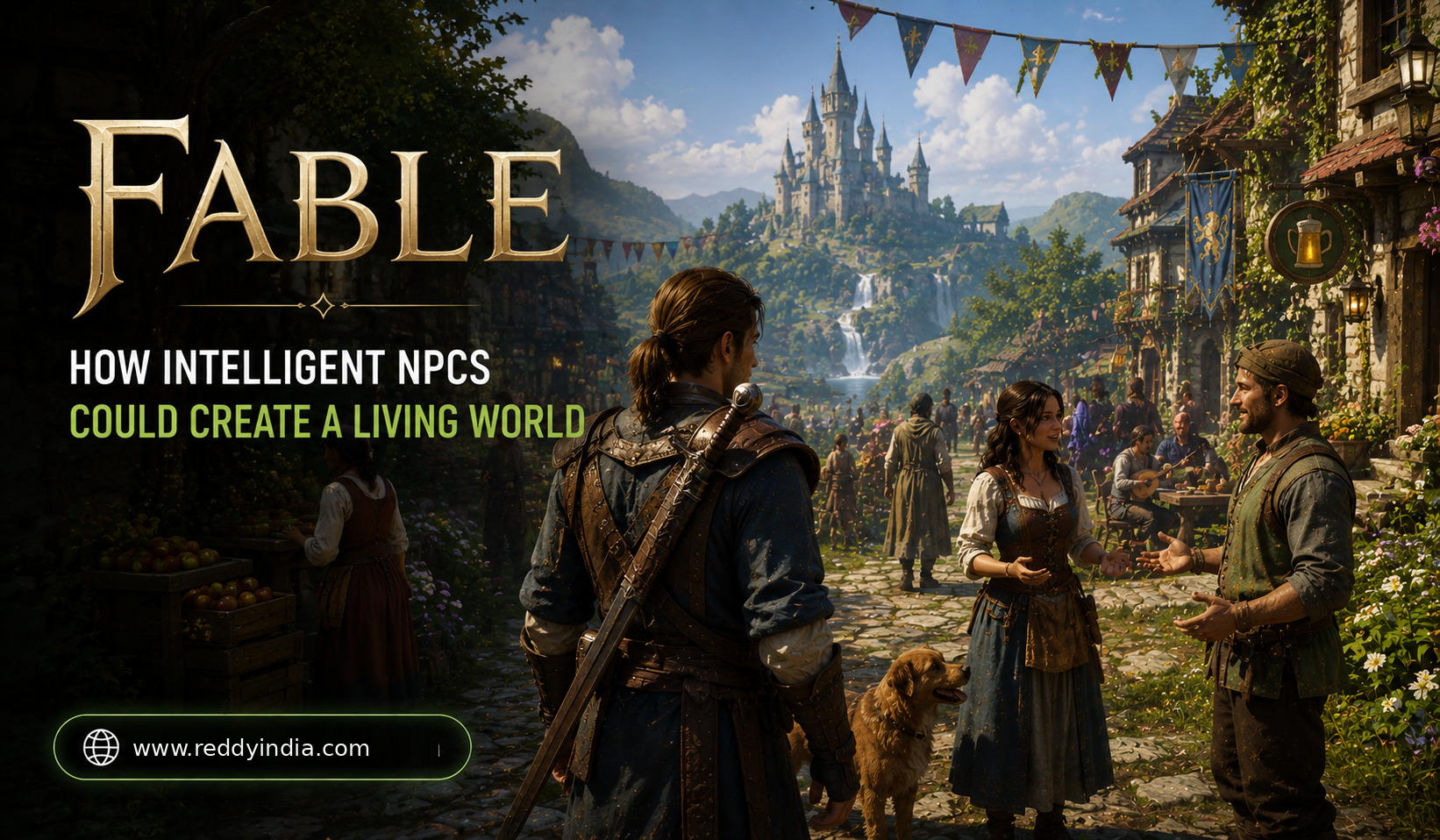
Fable: How Intelligent NPCs Could Create a Living World
Video games have always tried to make their worlds feel alive. Developers fill towns with villagers, merchants, guards, workers, and other non-player characters (NPCs), hoping players will believe that these digital people have lives beyond the main storyline.
The new Fable from Playground Games takes that idea much further with its Living Population system. Rather than treating NPCs as background decoration, the game is designed around more than 1,000 persistent characters, each with personalities, homes, jobs, schedules, relationships, and routines. Playground Games says these characters can continue living their lives whether or not the player is watching them.
Interestingly, Fable’s approach to intelligent NPCs is not based on replacing human voice actors with generative AI. Playground has confirmed that its large NPC cast is fully voiced by human actors, with no AI-generated voice generation involved.
Instead, Fable shows another important side of intelligent game design: creating systems that allow carefully crafted NPCs to react, remember, move around the world, and influence one another in believable ways.
What Is Fable’s Living Population?
The Living Population is the system Playground Games uses to bring Albion’s inhabitants to life.
According to the developer, the game features more than 1,000 NPCs, and each one has an individual personality and a life that continues independently. Players can interact with these characters, develop friendships and rivalries, employ them, form romantic relationships, or even turn them into enemies.
This is significantly more ambitious than simply placing hundreds of characters around a map.
For a virtual population to feel believable, each person needs somewhere to live, something to do, and a reason to move around the world. Playground explains that the system connects NPCs with homes, beds, jobs, hobbies, schedules, and other aspects of daily life.
The result is intended to make Albion feel like a functioning society rather than a collection of attractive locations.
Every NPC Has an Individual Identity
One of the most interesting details about Fable’s NPC system is that the characters are not generated randomly and left to behave however they want.
Playground originally considered using procedural generation to create the population. However, the developer found that randomly generated characters felt inconsistent and incoherent. The team therefore chose to design its NPCs individually so it could control their personalities and details.
Each character has a defined personality trait, home, job, schedule, appearance, and other characteristics.
This handcrafted approach allows visual design and behavior to support each other.
A wealthy noble might live in a large manor, dress differently from a commoner, and have routines suited to their social position. A bartender might spend the day working at a pub and return home afterward.
These details help players understand characters without needing an enormous exposition dump.
NPC Schedules Make Albion Feel Active
A major part of a living world is movement.
If every NPC stays in the same location all day, players quickly recognize that the world is simulated. Fable attempts to avoid this by giving its characters schedules and responsibilities.
A worker needs to travel to work. A resident needs somewhere to sleep. A person with hobbies may spend time on activities outside their profession.
Playground has explained that this level of simulation creates practical challenges. During development, the team discovered situations where NPCs were traveling too far between their homes and workplaces, leaving settlements unexpectedly empty during the day.
That example illustrates how interconnected the system is.
The NPC’s location is not just an animation choice. It depends on the broader structure of the world.
NPCs Can React to the Player
The most important feature of intelligent NPCs is their ability to respond to player behavior.
In Fable, reputation plays a major role in determining how characters perceive the player. NPCs can like or dislike the hero, fear them, or even become attracted to them. Their reactions can change based on the player’s reputation within a settlement.
This creates a feedback loop.
The player makes a choice.
The choice affects reputation.
Reputation changes how NPCs respond.
Those interactions can influence later decisions.
This is much more interesting than a world where every character treats the player identically regardless of what happens.
Reputation Creates a Socially Reactive World
Fable’s reputation system is particularly important because it allows one action to have consequences beyond the original interaction.
According to Playground, settlements can have multiple active reputations, and these reputations influence NPC opinions. A character’s response to the player can therefore depend on how that individual interprets the hero’s reputation and behavior.
This helps create moral complexity.
A player may believe that a decision was heroic, while another character may see it differently.
That is a classic Fable idea, but the Living Population system expands it across the wider community.
Instead of morality existing only as a statistic on the player’s character sheet, it becomes something that other people react to.
Small Actions Can Create Bigger Consequences
One of the strengths of a reactive NPC system is that seemingly insignificant interactions can have wider effects.
A short conversation might change someone’s opinion. A particular choice can affect reputation. A relationship may influence another interaction later.
Playground describes this as creating a ripple effect, where even small encounters can feed into broader systems in the game.
This is important because living worlds are not created only through huge scripted events.
They become convincing when smaller systems connect.
A player might remember a major story mission, but they may also remember the strange villager they met several hours earlier or the character who unexpectedly became a friend.
Relationships Give NPCs More Meaning
Fable’s NPC system is designed to support more than simple conversations.
Players can develop different kinds of relationships with inhabitants of Albion. Characters can become friends, rivals, romantic partners, employees, enemies, or even victims of the player’s actions.
This gives NPC encounters a sense of permanence.
When a character matters to the player, visiting a settlement becomes more than walking through a busy environment. The player begins to recognize individuals and remember previous interactions.
That emotional connection is one of the strongest indicators that an NPC system is working.
Why Human-Crafted NPCs Still Matter in an AI Era
The discussion around AI in gaming often focuses on generative dialogue and AI-created characters. Fable provides an interesting alternative.
The game’s large population is handcrafted, with developers controlling personality traits, appearances, roles, homes, schedules, and other details. The NPCs are also fully voiced by human performers. Playground has said that the game does not use AI-generated voice production for its NPC population.
This approach demonstrates that a character can be “intelligent” without being generated by an AI language model.
Intelligence in a game can come from interconnected rules and systems.
A carefully designed NPC that reacts consistently to reputation, schedules, relationships, and world events can feel more believable than a character that simply produces unlimited dialogue.
A Living City Needs Infrastructure
One hidden challenge of NPC simulation is that the environment must support the population.
If a game says that hundreds of people live in a settlement, that settlement needs enough homes, beds, workplaces, paths, social spaces, and other infrastructure to make the claim believable.
Playground’s developers have described this challenge directly. Fable’s settlements must function as real communities because the characters need places to live and activities to perform.
This creates a fascinating relationship between world design and NPC design.
Buildings are not simply scenery.
A house is a place where an NPC sleeps.
A shop is a workplace.
A pub can be a social destination.
A road connects different parts of a character’s daily routine.
When all these elements connect, the environment becomes part of the simulation.
Could Intelligent NPCs Make Every Playthrough Different?
A reactive population can also improve replayability.
If players make different choices, they can develop different reputations and relationships. Since NPCs respond to these changes, the social experience can evolve differently from one playthrough to another.
One player could become beloved by a community.
Another might become feared.
A third could develop strong friendships or romantic relationships with particular characters.
The world remains recognizable, but the player’s personal experience within it changes.
That is a powerful form of replayability because it comes from interactions rather than simply adding multiple endings.
The Difference Between a Living World and a Busy World
It is easy to confuse a crowded game world with a living game world.
A busy city may contain hundreds of characters, but if they simply walk in circles and repeat the same lines, it may still feel artificial.
A living world requires relationships between systems.
Characters need goals.
They need routines.
They need locations.
They need reactions.
They need consequences.
Fable’s Living Population attempts to connect these elements so that NPCs have a sense of continuity. Playground’s goal is not merely to make Albion look crowded, but to make its people feel like individuals who exist independently of the player’s presence.
How Fable Could Influence Future RPGs
Fable’s approach could have a significant influence on open-world RPG design.
Developers do not necessarily need generative AI to create convincing characters. A combination of handcrafted personalities, systemic behavior, persistent relationships, and world-aware routines can already produce a highly reactive population.
Future games may combine these traditional systems with generative AI.
For example, developers could continue handcrafting important NPC identities while using AI for more flexible conversations. Characters could have carefully designed memories and personalities while AI helps produce context-sensitive dialogue.
That hybrid approach could offer the best of both worlds: human creative control combined with more dynamic interactions.
Conclusion
Fable’s intelligent NPC approach shows that creating a living game world is about much more than artificial intelligence generating dialogue.
Playground Games has built a Living Population of more than 1,000 handcrafted NPCs, giving each character a personality, home, occupation, schedule, relationships, and fully voiced presence.
The most impressive aspect is how these pieces connect. A player’s reputation changes how people react. NPC schedules determine where characters go. Their homes and jobs shape settlement life. Individual interactions can influence relationships and create wider consequences.
And importantly, Fable achieves this without relying on AI-generated voices; the NPC population was recorded by a large cast of human actors.
As games become more sophisticated, the future of NPCs may not be about making them endlessly talkative. It may be about making them feel like people who belong to the world.
That is what could make Albion special: not simply having more characters, but having a population that feels like it has a life of its own.