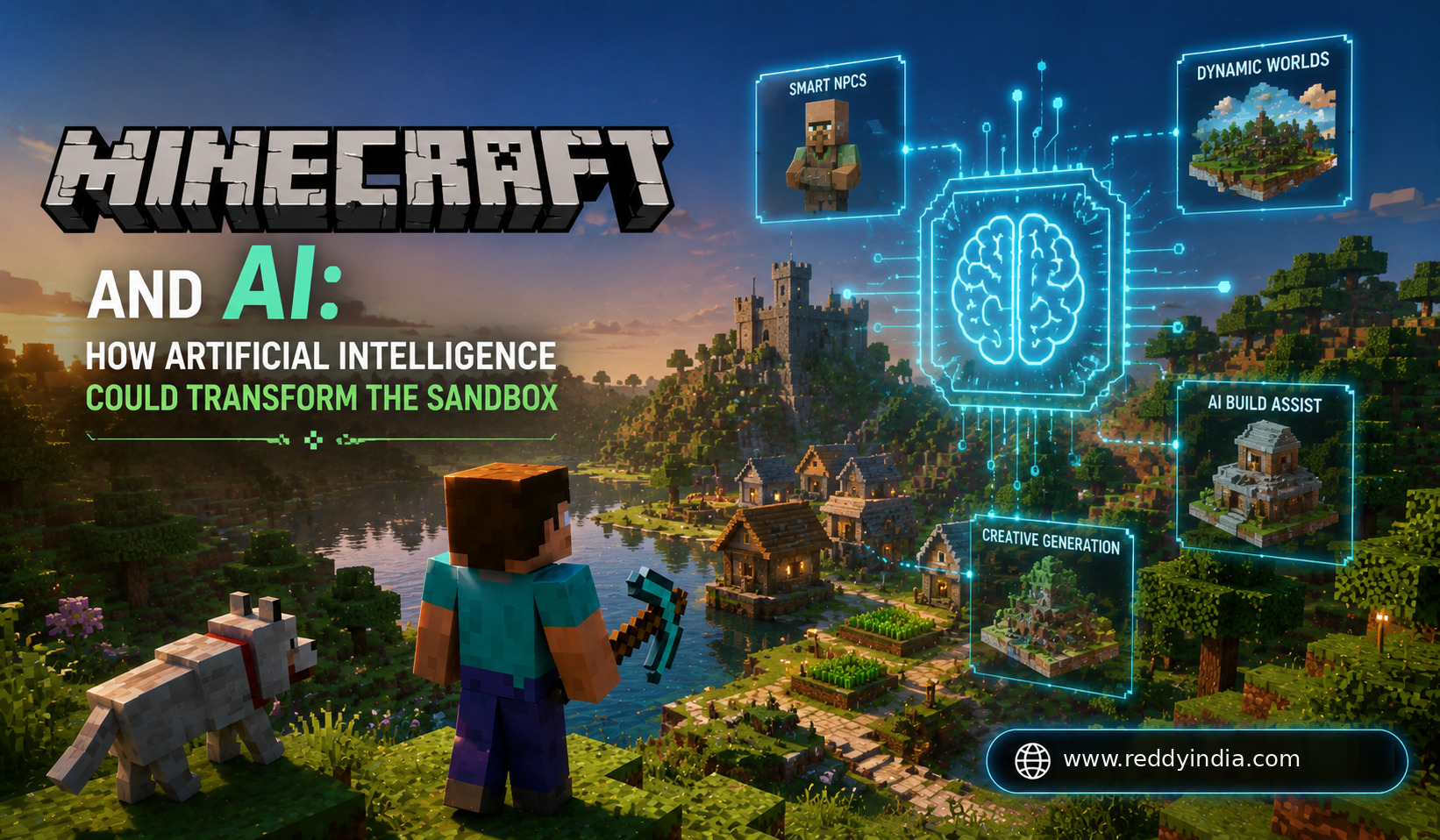
Minecraft and AI: How Artificial Intelligence Could Transform the Sandbox
Minecraft has always been more than a traditional video game. Its block-based world gives players almost unlimited freedom to explore, build, survive, experiment, and create their own stories. Unlike games that guide players through a fixed sequence of missions, Minecraft provides an open sandbox where the player decides what to do next.
That freedom also makes Minecraft an interesting environment for artificial intelligence.
Researchers have been using Minecraft as a testing ground for AI for years. Microsoft’s Project Malmo, for example, was created specifically to support AI research in Minecraft, including navigation, survival, crafting, problem-solving, and collaboration between human and artificial agents.
As generative AI and intelligent agents become more advanced, Minecraft could eventually become more than a sandbox for human creativity. AI could help create smarter NPCs, personalized companions, dynamic adventures, automated building assistants, and worlds that respond to individual players.
Why Minecraft Is Perfect for AI Experimentation
Minecraft offers something that many other games do not: an open-ended environment with an enormous number of possible actions.
A player can build a house, explore a cave, farm crops, fight hostile mobs, create complex machines, or cooperate with other players. There is rarely one correct way to accomplish a goal.
That complexity makes the game useful for AI research.
Microsoft’s Project Malmo was designed as an AI experimentation platform built on Minecraft. Researchers can use it to train and test agents on tasks such as navigation, survival, crafting, collaboration, and problem-solving.
In other words, Minecraft provides an environment where AI can be challenged to understand a world, make decisions, learn from mistakes, and work with humans.
Those same capabilities could eventually influence the Minecraft experience itself.
Smarter NPCs Could Change the Game
One of the most obvious uses of AI in Minecraft would be more intelligent non-player characters.
Traditional villagers have defined behaviors and routines. They can trade, work, sleep, and interact with certain game systems, but their actions remain relatively limited.
Generative AI could introduce a different type of NPC.
Imagine talking to a village blacksmith and asking where to find a rare resource. Instead of selecting from fixed dialogue, the character could respond naturally based on its role and the information available in the game.
An AI villager might remember that you previously helped defend the village. Another could become suspicious after repeated thefts. A merchant might change its attitude depending on the player’s reputation.
These characters could make settlements feel less like collections of automated entities and more like communities.
AI Companions Could Make Solo Minecraft More Dynamic
Minecraft is enjoyable alone, but survival can sometimes feel isolated.
AI companions could change that.
A player might have a digital teammate who can help gather resources, explore caves, defend a base, or provide suggestions. Instead of simply following the player like a conventional companion, an AI agent could understand natural language instructions.
For example, a player could say, “Help me collect enough stone to finish the castle wall,” and the companion could determine what resources are needed and assist with the task.
More advanced systems could remember player preferences and adapt over time.
A companion might learn that its player prefers exploration over combat or building over mining. Eventually, the AI could become a personalized partner rather than a generic NPC.
The idea of external AI companions being connected to Minecraft has already appeared in community discussions, showing interest in expanding the solo experience through intelligent digital partners.
AI Could Make Villages Feel Alive
Minecraft’s villages could benefit significantly from AI.
Instead of villagers following simple schedules, imagine a settlement where residents have individual goals.
One villager might focus on farming. Another could prioritize trading. A third might explore nearby areas. Some could form friendships, while others might disagree over resources or responsibilities.
AI could allow characters to react to events happening around them.
If hostile mobs attack the village, residents could organize defenses. If resources become scarce, they might change their activities. If the player builds a new structure, villagers could react to the development.
This would turn villages into evolving communities.
The world would not simply contain NPCs. It would contain social systems.
Personalized Adventures Could Replace Fixed Quests
Another major opportunity is AI-generated storytelling.
Minecraft already allows players to create their own adventures, but building a detailed quest system can require significant time and technical skill.
AI could simplify the process.
A player might ask for a fantasy adventure involving an abandoned kingdom, a missing treasure, and a dangerous underground fortress. The AI could generate objectives, characters, locations, clues, and challenges based on the player’s request.
The adventure could also change as the player makes decisions.
If the player decides to help an enemy faction instead of destroying it, the AI could adjust the storyline accordingly.
This would make Minecraft feel less like a game with optional stories and more like a platform for endless interactive storytelling.
AI Could Become a Building Assistant
Minecraft is famous for construction, but not every player is an expert builder.
AI could become a creative assistant for players who need inspiration or practical help.
A player could describe what they want to build:
“Create a medieval village around this lake.”
The AI could generate a building plan, suggest materials, divide the project into stages, or even help construct portions of it through an approved in-game system.
More advanced tools could analyze an existing structure and suggest improvements.
For example, an AI assistant could recommend adding windows, changing roof proportions, improving lighting, or creating paths between buildings.
This would not replace creativity. Instead, it could make complex building projects more accessible.
AI Could Improve Exploration
Exploration is one of Minecraft’s most enjoyable activities, but it can also become repetitive.
AI could make exploration more personalized by observing the player’s interests.
A player who enjoys ancient structures could receive suggestions about unexplored ruins. Someone who prefers resource gathering could receive useful information about nearby environments. An adventurous player could be directed toward more challenging areas.
AI could also create dynamic exploration objectives.
Instead of simply finding a generated structure, a player might discover a mystery that develops through clues scattered across the world.
The environment itself could become part of an ongoing story.
AI Agents Could Learn Through Gameplay
Minecraft is already valuable for studying how AI agents learn.
Project Malmo was designed to support experiments in areas such as reinforcement learning, where agents learn through trial and error rather than being explicitly programmed with every action.
This is important because Minecraft contains many tasks that require planning.
An AI agent may need to gather wood before crafting tools, collect better resources before entering dangerous areas, and coordinate multiple actions to reach a larger objective.
Learning these relationships can be much more difficult than simply recognizing an object.
Research using Minecraft has also explored collaboration between AI agents and humans, including tasks where agents must decide when and how to cooperate.
That research could eventually contribute to smarter cooperative gameplay.
AI Could Improve Multiplayer Cooperation
Minecraft multiplayer depends heavily on teamwork.
Players often divide responsibilities. One person gathers materials, another builds, another explores, and someone else may handle farms or defenses.
AI agents could join these teams.
Instead of having human players manage every detail, an AI teammate could take responsibility for a specific role.
A player might tell the AI to gather wood while another teammate builds a house. The AI could then work toward the objective and report its progress.
More advanced agents could recognize when a teammate needs help and adjust their priorities.
This would move AI from being an opponent or background character to being an actual member of the team.
AI Could Create Dynamic Worlds
The most ambitious possibility is a Minecraft world that changes based on player behavior.
Imagine an AI system observing how players interact with an environment and adjusting the world accordingly.
A heavily explored area could develop new challenges. A neglected village might change over time. Player-built settlements could attract new inhabitants. A conflict between two groups could expand into a larger event.
AI could make the world feel responsive rather than static.
This concept does not necessarily require every block or event to be generated by AI. Instead, AI could manage relationships between existing game systems and make decisions based on player actions.
That would create a more dynamic sandbox.
Generative AI Could Change Minecraft Modding
Minecraft has one of the largest modding and customization communities in gaming.
AI could lower the technical barrier for creating new content.
Players may eventually be able to describe a feature in natural language and receive help creating the necessary code, assets, dialogue, or configuration.
For example, a creator could request a custom NPC with a particular personality, a new quest line, or a special gameplay mechanic.
AI could help turn that idea into a prototype much faster.
However, creators would still need to test and refine the result. AI-generated code can contain mistakes, and complex Minecraft projects require careful integration.
The technology is more likely to become a creative accelerator than a completely automatic development solution.
AI Could Also Make Minecraft More Accessible
Artificial intelligence may have benefits beyond entertainment.
Players who struggle with complex interfaces could potentially use voice commands to control certain systems. AI assistants could explain crafting recipes, provide navigation help, describe environments, or answer questions about game mechanics.
New players could receive personalized guidance rather than relying entirely on external tutorials.
An AI system could also adapt its explanations to the player’s experience level. A beginner might receive simple instructions, while an experienced player could get more advanced information.
This could make Minecraft easier to learn without removing its depth.
The Challenges of AI in Minecraft
AI integration also brings important challenges.
First, AI behavior needs to remain consistent with Minecraft’s rules. An NPC that can do anything it wants could easily disrupt gameplay or create unfair situations.
Performance is another concern. Running advanced AI for many characters simultaneously could require significant computing resources.
There are also concerns involving privacy, moderation, security, and player safety, particularly when AI systems process voice or text conversations.
Perhaps the biggest challenge is balance.
Minecraft’s greatest strength is that players feel free to experiment. AI should expand that freedom without taking away the player’s sense of control.
The best systems will likely be optional, transparent, and carefully integrated into the existing sandbox.
Microsoft Has Already Shown Minecraft’s AI Potential
Minecraft’s connection with AI is not purely speculative.
Microsoft has used Minecraft as a research environment for years through Project Malmo, which provides tools for training and evaluating AI agents in a complex 3D world.
Microsoft has also used Minecraft-related research to investigate collaboration, navigation, learning, and problem-solving.
More recently, Microsoft introduced Muse, a generative AI model designed around understanding gameplay and supporting game development research. While Muse is not simply an “AI Minecraft update,” it illustrates the broader direction of Microsoft’s gaming AI research.
Together, these developments show why Minecraft remains an important environment for exploring what AI can do in interactive worlds.
The Future of Minecraft and AI
The biggest opportunity is the combination of Minecraft’s freedom with AI’s ability to understand language, make decisions, and adapt.
A future Minecraft experience could include intelligent villagers, conversational companions, dynamic quests, AI building assistants, personalized exploration, and cooperative agents.
Players would still decide what to build and where to explore, but AI could make the world respond more intelligently.
Instead of one fixed Minecraft experience, every player could gradually create a different version of the game based on their choices and interests.
That would be a natural evolution of the sandbox concept.
Conclusion
Minecraft and artificial intelligence are a powerful combination because both are built around possibility.
Minecraft gives players an open world where almost anything can be created. AI can add systems that understand player intentions, adapt to behavior, generate new challenges, and help people create content.
Research such as Microsoft’s Project Malmo has already demonstrated that Minecraft can serve as a sophisticated environment for AI experimentation, including learning, navigation, problem-solving, and human-AI collaboration.
The next step could be bringing some of those ideas closer to everyday gameplay.
Imagine a Minecraft world where villagers remember you, companions understand your plans, quests evolve around your choices, and the environment responds to how you play.
That would not simply make Minecraft smarter.
It could make the sandbox feel more alive, more personal, and almost limitless.