RimWorld: How AI Storytellers Create Unique Gameplay
Many strategy and simulation games challenge players with resources, enemies, construction, and survival. RimWorld takes this formula in a different direction by using an AI-driven storytelling system to shape the events of each playthrough.
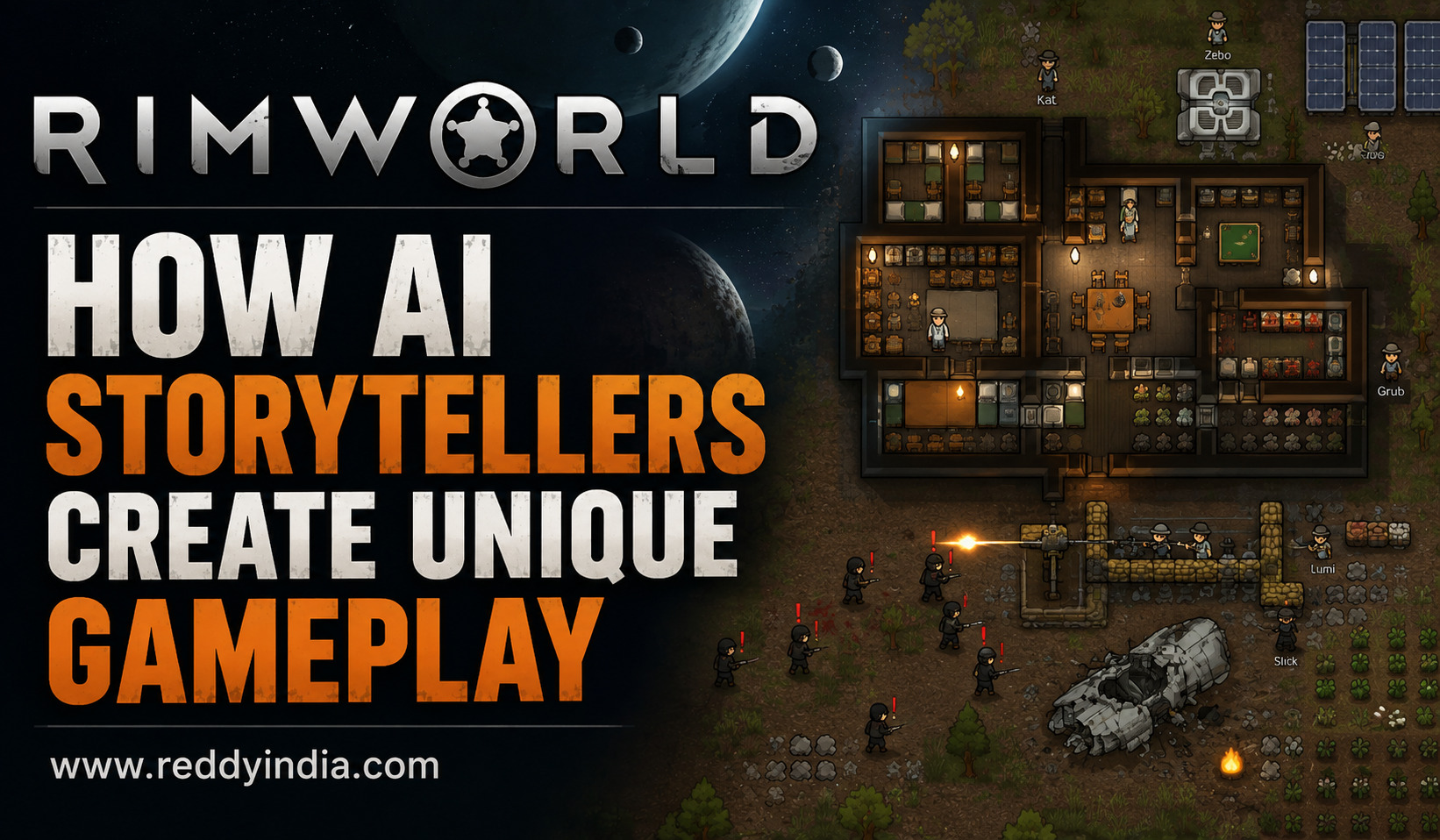
Developed by Ludeon Studios, RimWorld places players on a distant planet where a small group of survivors must establish a colony and survive against difficult conditions. Colonists have individual personalities, skills, relationships, needs, and emotional states, while the world constantly introduces new challenges.
At the center of this experience is the game’s unique AI storyteller system. Rather than simply following a fixed sequence of events, the storyteller observes the player’s situation and generates incidents designed to keep the colony interesting, challenging, and unpredictable.
This system is one of the main reasons no two RimWorld stories feel exactly the same.
What Is an AI Storyteller in RimWorld?
An AI storyteller in RimWorld is essentially a system responsible for deciding when different events should occur during a colony’s development.
Instead of presenting a traditional scripted campaign, the game continuously monitors the state of the colony.
It can consider factors such as population, wealth, previous events, colony progress, and difficulty settings before introducing new situations.
These situations can include raids, illnesses, animal attacks, resource shortages, visitors, environmental problems, disasters, and many other incidents.
The goal is not necessarily to make the player lose.
The storyteller’s broader purpose is to create interesting situations that produce stories.
Turning Gameplay Into a Story
RimWorld does not need a traditional narrator to tell players what their colony’s story is.
The story emerges from events.
A colonist may become sick shortly before an enemy raid. Another character might survive the attack but suffer a serious injury. A rescue mission could then create a new relationship between characters.
These events can connect together naturally.
The player might later remember that particular sequence as one of the defining moments of the colony.
This is different from a scripted story because the exact combination of events depends on the simulation.
The AI storyteller provides situations, but the player and the colony determine how those situations develop.
Different AI Storytellers Create Different Experiences
RimWorld offers multiple storyteller personalities, each designed to influence the pace and style of gameplay.
Some storytellers focus more heavily on unpredictable events.
Others provide a steadier progression.
There are also options that can create harsher survival conditions.
This gives players control over the type of story they want.
Someone looking for a dramatic and unpredictable experience can choose a storyteller that produces frequent changes.
Another player may prefer a slower colony-building experience with more time between major crises.
The important idea is that the storytelling system can adapt the rhythm of gameplay rather than forcing every player through the same sequence.
Cassandra Classic and Structured Drama
One of RimWorld’s most recognizable storytellers is Cassandra Classic.
Her approach is designed to create a rising sense of challenge.
As the colony develops, the game can introduce increasingly serious threats and complications.
This creates a dramatic structure that resembles a traditional story.
There are quieter periods where players can build and prepare, followed by events that increase tension.
However, the exact events are still generated dynamically.
A raid, illness, disaster, or social conflict can become the major turning point of a particular colony.
Randy Random and Unpredictability
Randy Random takes a very different approach.
As the name suggests, his storytelling style emphasizes unpredictability.
Unexpected events can happen at surprising times.
A colony might experience a peaceful period followed by several incidents in rapid succession.
Alternatively, a major threat might arrive when the player is completely unprepared.
This style can produce some of RimWorld’s funniest and most dramatic moments.
The unpredictability also creates stories that players could not easily plan.
Phoebe Chillax and a Slower Pace
For players who prefer a more relaxed experience, Phoebe Chillax is designed around a slower rhythm.
Events can still occur, but the pacing gives players more time to develop their colony.
This demonstrates an important advantage of the AI storyteller system.
The same basic simulation can support very different experiences depending on how events are scheduled.
Players are not required to accept one universal storytelling pace.
The Storyteller Responds to the Colony
One of the most interesting aspects of RimWorld’s AI storytelling is that events do not exist independently of the colony.
The game’s systems can consider the current state of the settlement when determining what happens next.
A small colony may experience different challenges from a wealthy, heavily defended settlement.
A growing population creates different needs.
Increasing wealth can attract greater threats.
This creates a relationship between player success and future challenges.
The better the colony becomes, the more significant the potential consequences can become.
Wealth and Difficulty
Wealth plays an important role in RimWorld’s storytelling system.
As a colony accumulates valuable buildings, weapons, resources, and equipment, its overall wealth increases.
Greater wealth can influence the difficulty and scale of future events.
This creates an interesting balance.
Building a powerful colony provides advantages, but it can also make the colony a more attractive target for larger threats.
Players therefore have to consider whether rapid expansion is worth the additional risks.
The game turns success into a potential source of future difficulty.
Colonists Make Events Personal
The AI storyteller creates events, but colonists give those events emotional meaning.
Each colonist can have different skills, traits, relationships, and personal goals.
A raid is not simply a battle when the colony’s best doctor is injured.
A food shortage becomes more serious when several colonists have difficult dietary requirements.
A character’s death can affect friends and family members.
Because colonists are individuals, the same event can have very different consequences depending on who is involved.
This is what turns a mechanical incident into a memorable story.
Social Relationships Create Unexpected Drama
RimWorld’s social systems work alongside the AI storyteller to create additional unpredictability.
Colonists can become friends, rivals, lovers, spouses, or enemies.
These relationships can change over time.
A conflict between two characters can influence the mood of the colony.
A romantic relationship can create new family connections.
A death can trigger emotional consequences among surviving colonists.
These social systems mean that not every important story comes from an external threat.
Sometimes the biggest drama comes from inside the colony.
Mental States and Emotional Consequences
Mental health and mood systems also play a major role in the game’s storytelling.
Colonists have needs and emotional states that can change based on their environment and experiences.
Poor living conditions, hunger, injuries, deaths, social conflicts, and other problems can affect their mood.
If stress becomes too severe, a colonist may experience a mental break.
These events can create unexpected situations.
A character might suddenly refuse to work, damage property, start a fight, or behave unpredictably.
The storyteller may create the initial conditions, but the colony’s systems determine how the consequences unfold.
Survival Problems Become Narrative Events
RimWorld can transform ordinary survival challenges into major story moments.
A shortage of food might force players to search for new resources.
A disease outbreak could require difficult medical decisions.
A winter storm might make travel dangerous.
A damaged power system could threaten food storage.
Each problem requires the player to respond.
The solution then becomes part of the colony’s history.
This is one of the game’s greatest strengths: ordinary management decisions can become memorable narrative moments.
AI Storytelling Is Different From Generative AI
It is important to distinguish RimWorld’s AI storyteller from modern generative AI.
The storyteller is not a chatbot writing unlimited dialogue or creating completely new characters through a language model.
Instead, it is a game system designed to select and schedule events within the rules of the simulation.
Its intelligence comes from managing timing, difficulty, pacing, and context.
This approach demonstrates that AI-inspired game design does not always require advanced generative models.
Carefully designed systems can create surprisingly complex stories using predefined building blocks.
Why Every RimWorld Colony Feels Different
The combination of AI storytelling and simulation creates enormous variation.
Different starting locations produce different environmental conditions.
Different colonists create different social dynamics.
Different resources influence development.
Different storyteller settings change the pacing.
Player decisions determine how the colony responds.
All of these factors interact.
As a result, two players can start with similar conditions and end up with completely different stories.
One colony might become a successful trading settlement.
Another could transform into a heavily defended military base.
A third might collapse after a series of disasters.
The game does not need to tell players which story to experience.
It creates the conditions for them to discover one.
The Future of AI Storytelling in Games
RimWorld offers an interesting example of where interactive storytelling can go.
Future games could potentially combine systems like RimWorld’s storyteller with more advanced AI technology.
Characters might remember more experiences, conversations could become more dynamic, and events could adapt even more closely to player behavior.
However, the fundamental idea would remain similar: instead of writing every possible story in advance, developers create systems that generate situations capable of producing stories.
This could make games increasingly personal.
Final Thoughts
RimWorld demonstrates how AI-driven storytelling can transform a survival simulation into a constantly evolving narrative experience.
Its AI storytellers manage the timing and intensity of events, while colonists, relationships, resources, environments, and player decisions determine what those events ultimately mean.
The result is a game where failure can become memorable, unexpected disasters can become stories, and even ordinary moments can develop into important parts of a colony’s history.
RimWorld’s greatest innovation is not simply that it creates random events. It creates contextual situations that interact with a living simulation.
That distinction is important.
Random events can be entertaining, but events become truly memorable when they affect characters the player has invested in.
By combining AI storytelling with complex simulation systems, RimWorld shows how games can move beyond fixed narratives and create stories that belong uniquely to each player.