Call of Duty: How the Franchise Has Evolved Over the Years
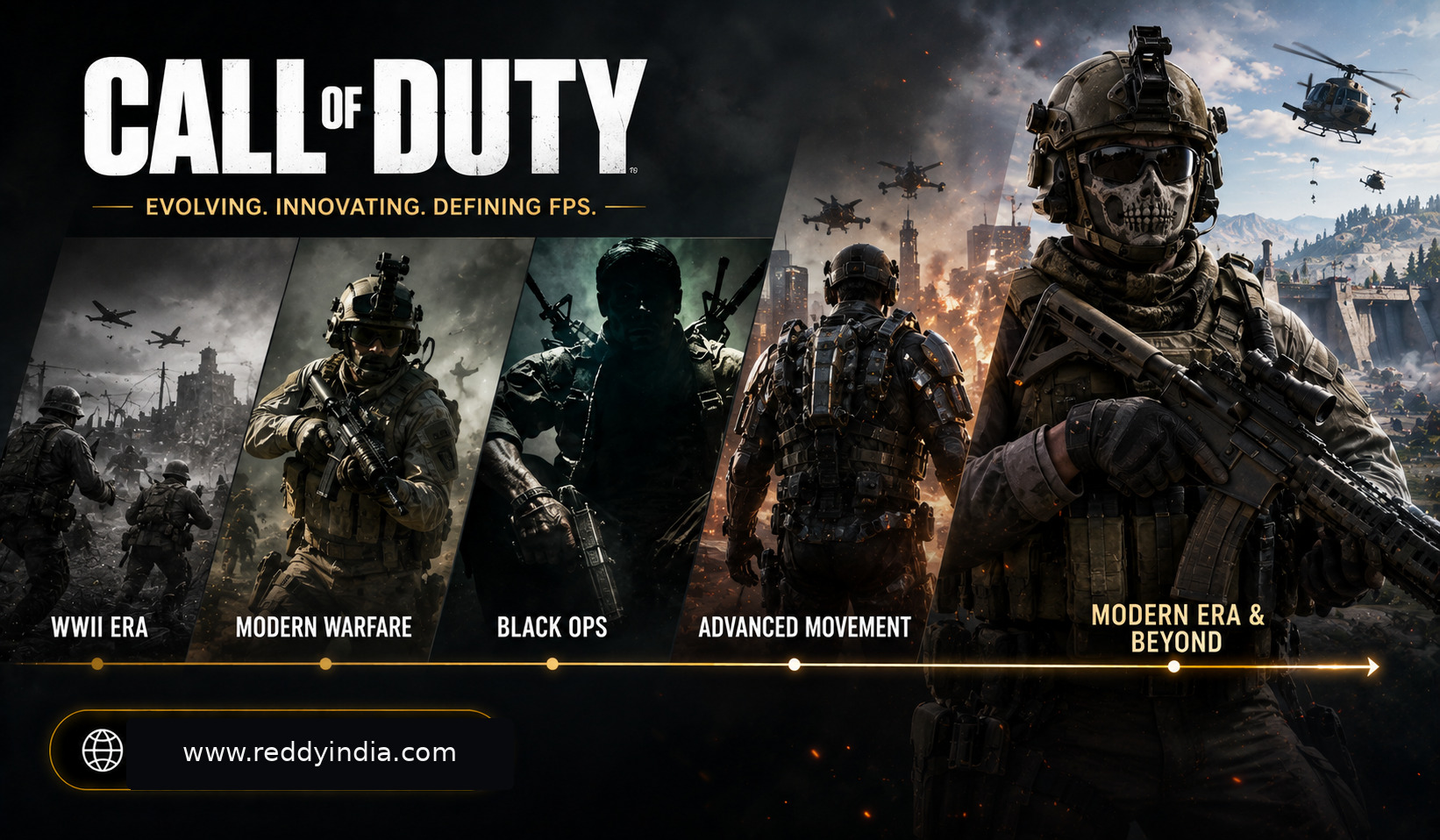
Few video game franchises have changed as much while remaining instantly recognizable as Call of Duty. What began as a World War II-focused first-person shooter has developed into a massive gaming ecosystem featuring historical campaigns, modern military stories, futuristic combat, zombies, free-to-play battle royale, competitive multiplayer, mobile gaming, and increasingly connected progression systems.
The series has been around for more than two decades, yet it continues to adapt to changing player expectations. In 2026, the franchise includes Black Ops 7, Warzone, Call of Duty: Mobile, and the upcoming Modern Warfare 4, showing just how far the series has expanded beyond its original formula. The official Call of Duty site currently lists the Modern Warfare 4 open beta running from August 21 through August 25, 2026.
But how did Call of Duty evolve from a traditional World War II shooter into one of gaming’s biggest entertainment franchises?
The World War II Beginning
The original Call of Duty launched in 2003 and focused on World War II.
At the time, the first-person shooter genre already had major military titles, but Call of Duty distinguished itself with cinematic campaigns, squad-based action, intense set pieces, and a strong emphasis on creating the feeling of being part of a larger military operation.
Instead of making the player feel like an unstoppable lone hero, early Call of Duty games often placed them alongside AI-controlled soldiers in large battles.
This helped establish one of the series’ defining characteristics: combining traditional shooting mechanics with cinematic storytelling.
The early games also established the franchise’s interest in different historical perspectives and large-scale military conflicts.
Modern Warfare Changed Everything
A major turning point arrived with Call of Duty 4: Modern Warfare in 2007.
Instead of returning to World War II, Infinity Ward moved the series into a contemporary setting. The game introduced modern weapons, military technology, international conflicts, and a story involving characters such as Captain Price and Soap MacTavish.
The change was enormously successful.
Modern Warfare demonstrated that Call of Duty could tell a contemporary military story while preserving the fast-paced gameplay people expected from the franchise.
It also helped popularize a more cinematic style of campaign design, with memorable missions built around dramatic events and constantly changing environments.
Multiplayer Became a Core Attraction
While Call of Duty’s campaigns attracted attention, multiplayer became one of the franchise’s most important features.
The series developed a highly refined multiplayer formula built around short matches, fast gunfights, customizable loadouts, progression systems, killstreak rewards, and unlockable equipment.
Players could develop their own preferred playstyle.
Some focused on aggressive close-range combat, while others preferred assault rifles, sniper rifles, or tactical support.
The progression loop also encouraged players to keep returning.
Play matches, earn experience, unlock equipment, improve your loadout, and become more competitive.
That structure became one of the foundations of modern Call of Duty.
Black Ops Expanded the Formula
Treyarch’s Black Ops series introduced another major direction.
The first Black Ops game combined Cold War history with psychological storytelling, espionage, conspiracies, and experimental technology. Its narrative was considerably different from the straightforward military structure of earlier games.
The franchise also developed one of Call of Duty’s most popular side modes: Zombies.
Zombies transformed what had originally been an additional mode into a major part of the overall Call of Duty identity.
Over the years, Zombies evolved through new maps, storylines, characters, weapons, upgrades, and gameplay systems.
The continued popularity of Zombies demonstrated that players wanted Call of Duty experiences beyond traditional military multiplayer.
The Franchise Experimented With Futuristic Combat
Call of Duty did not stay in the present forever.
Games such as Advanced Warfare, Black Ops III, and Infinite Warfare moved toward futuristic settings featuring advanced technology, enhanced movement, drones, exoskeletons, and science-fiction-inspired weapons.
These games introduced mechanics that changed how players moved around maps.
Instead of being restricted largely to running and jumping, players could use abilities such as boosts, wall-running, or advanced mobility systems.
Not every experiment received the same response from fans, but they showed that the franchise was willing to take risks with its core gameplay.
Movement Became a Major Design Tool
The futuristic period had a long-term impact on Call of Duty’s gameplay.
Even after the series returned to more traditional military settings, movement remained an important part of multiplayer design.
Modern Call of Duty titles increasingly focused on faster movement, sliding, tactical positioning, and advanced mobility.
The introduction of Omnimovement in Black Ops 6 expanded this concept further, allowing players to move and dive in multiple directions while maintaining combat control.
The system continues in Black Ops 7, where Omnimovement is combined with additional multiplayer customization and combat systems.
This demonstrates how mechanics introduced through experimentation can eventually become part of the franchise’s broader gameplay identity.
Warzone Changed Call of Duty’s Scale
One of the biggest changes in recent Call of Duty history was the introduction of Call of Duty: Warzone.
Instead of traditional multiplayer maps and short rounds, Warzone placed the Call of Duty formula inside a large-scale battle royale environment.
Players could explore huge maps, collect equipment, complete contracts, fight opposing squads, and attempt to survive until the end.
Warzone helped Call of Duty compete directly in the rapidly growing battle royale market.
It also changed the way players interacted with the franchise because Warzone became a major free-to-play component connected to the broader Call of Duty ecosystem.
Free-to-Play Changed the Business Model
Traditional Call of Duty releases generally required players to purchase a new game.
Warzone introduced another model.
A free-to-play experience could attract players who might not buy the annual premium release.
That created a much larger potential audience and allowed Call of Duty to develop a more continuous service-based structure.
Battle passes, cosmetic items, seasonal content, events, and live updates became increasingly important parts of the ecosystem.
The franchise therefore evolved from a sequence of separate annual games into something closer to a connected platform.
Progression Became More Connected
Modern Call of Duty games increasingly connect progression across different modes.
Black Ops 7 is an example of this evolution. Its official site states that players can earn level XP across Multiplayer, Co-op Campaign, Zombies, Dead Ops Arcade 4, and Warzone, while global progression also connects parts of the overall experience.
Even the campaign is becoming more integrated with progression.
Black Ops 7 introduces global progression to its campaign, allowing players to level weapons and contribute to progression while playing story content.
This is a major departure from older Call of Duty games, where campaign and multiplayer often felt like relatively separate experiences.
Campaigns Have Become More Flexible
Call of Duty campaigns have also evolved.
Early campaigns were mostly linear cinematic experiences. Later games experimented with branching decisions, multiple outcomes, open-ended missions, character progression, and cooperative gameplay.
Black Ops 7 takes this evolution further with a co-op campaign that can be played solo or with a squad. Its campaign moves between locations including Japan and the Mediterranean while also introducing a replayable Endgame experience.
This reflects changing player expectations.
Modern audiences increasingly want campaigns that offer replayability rather than experiences that can be completed once and then forgotten.
Zombies Became More Than a Side Mode
Zombies has evolved alongside the main series.
What started as a relatively straightforward wave-survival mode gradually became a narrative-driven experience with quests, character progression, special weapons, upgrades, and multiple gameplay formats.
Black Ops 7 continues this trend with Standard, Directed, Survival, and Cursed Zombies modes, alongside story-driven quests and additional features.
This variety shows how Call of Duty now supports multiple gameplay identities under one franchise.
Players can choose competitive multiplayer, story campaigns, cooperative Zombies, or battle royale depending on what they want.
Customization Has Become Much Deeper
Another major evolution is customization.
Older Call of Duty games had simpler loadout systems. Modern titles offer extensive options for weapons, attachments, operators, cosmetics, camos, perks, field upgrades, scorestreaks, and other equipment.
Black Ops 7, for example, introduces the Overclock system, which gives players additional customization options for Lethals, Tacticals, Field Upgrades, and Scorestreaks.
This level of customization allows players to create highly specific combat styles.
Instead of choosing only a weapon, players can build a complete gameplay identity around how they want to approach a match.
Technology Has Become Part of the Experience
The visual and technical side of Call of Duty has advanced dramatically.
Modern games offer larger environments, more detailed character models, improved animation, better lighting, more sophisticated audio, and faster performance.
Black Ops 7’s PC version, for example, offers extensive graphics, audio, interface, and control customization, along with support for modern display technologies and advanced upscaling features.
This reflects a broader change in the franchise.
Call of Duty is no longer designed around a single hardware generation or simple visual target. It increasingly takes advantage of current platforms and advanced rendering technologies.
Call of Duty Became a Broader Entertainment Brand
The franchise’s evolution is not limited to gameplay.
Call of Duty has expanded into esports, streaming culture, mobile gaming, merchandise, collaborations, seasonal events, and an increasingly broad digital ecosystem.
Call of Duty: Mobile brought the franchise’s familiar gameplay style to smartphones, making the brand accessible to another enormous audience.
Meanwhile, esports helped turn multiplayer into a spectator experience, with professional players competing at the highest level.
This broader ecosystem has helped Call of Duty remain relevant beyond traditional console releases.
The Annual Release Model Has Changed
For years, Call of Duty was strongly associated with annual releases.
A new major title arrived roughly every year, often alternating between different development studios and sub-series.
While that model remains important, the franchise’s live-service components have changed the relationship between players and new releases.
Warzone, seasonal updates, battle passes, and ongoing content mean players can remain engaged with Call of Duty even between major launches.
The result is a more continuous cycle.
Instead of simply buying a new game once a year, players can remain involved throughout the year while moving between different parts of the franchise.
The Latest Generation Shows How Far the Series Has Come
Today’s Call of Duty is very different from the game released in 2003.
Black Ops 7 currently combines a solo-or-co-op campaign, traditional multiplayer, Zombies, shared progression, advanced movement, extensive customization, and Warzone integration.
At the same time, the franchise is already moving forward with the Modern Warfare 4 beta in August 2026.
This constant transition is one of the defining characteristics of Call of Duty.
The franchise rarely stays in one place for long.
Why Call of Duty Has Survived So Long
The biggest reason for Call of Duty’s longevity is its ability to preserve a recognizable core while changing the surrounding experience.
The fundamental appeal remains easy to understand:
Fast combat.
Powerful weapons.
Competitive multiplayer.
Cinematic action.
But around that foundation, the franchise can introduce new settings, movement mechanics, story structures, multiplayer systems, cooperative modes, battle royale experiences, and progression models.
That balance between familiarity and experimentation has allowed Call of Duty to evolve without completely losing its identity.
Conclusion
Call of Duty’s evolution is a story of constant experimentation.
It began as a World War II shooter and became a modern military franchise through Modern Warfare. Black Ops introduced psychological storytelling and helped turn Zombies into a major mode. Later entries experimented with futuristic movement and technology, while Warzone expanded the series into battle royale and free-to-play gaming.
Today, Call of Duty is a connected ecosystem rather than simply an annual first-person shooter. Black Ops 7 combines co-op campaign gameplay, multiplayer, Zombies, global progression, and Warzone, while the franchise continues expanding with Modern Warfare 4.
What makes the series remarkable is that its evolution has never depended on abandoning its core identity.
Instead, Call of Duty keeps asking a simple question: how can fast-paced military action become something new?
For more than two decades, that question has produced historical battles, modern warfare, futuristic combat, zombies, battle royale, mobile gaming, esports, and live-service experiences.
And as the franchise continues to develop, its greatest strength may remain the same one that made it successful in the first place: the ability to reinvent the way players experience the familiar excitement of Call of Duty.