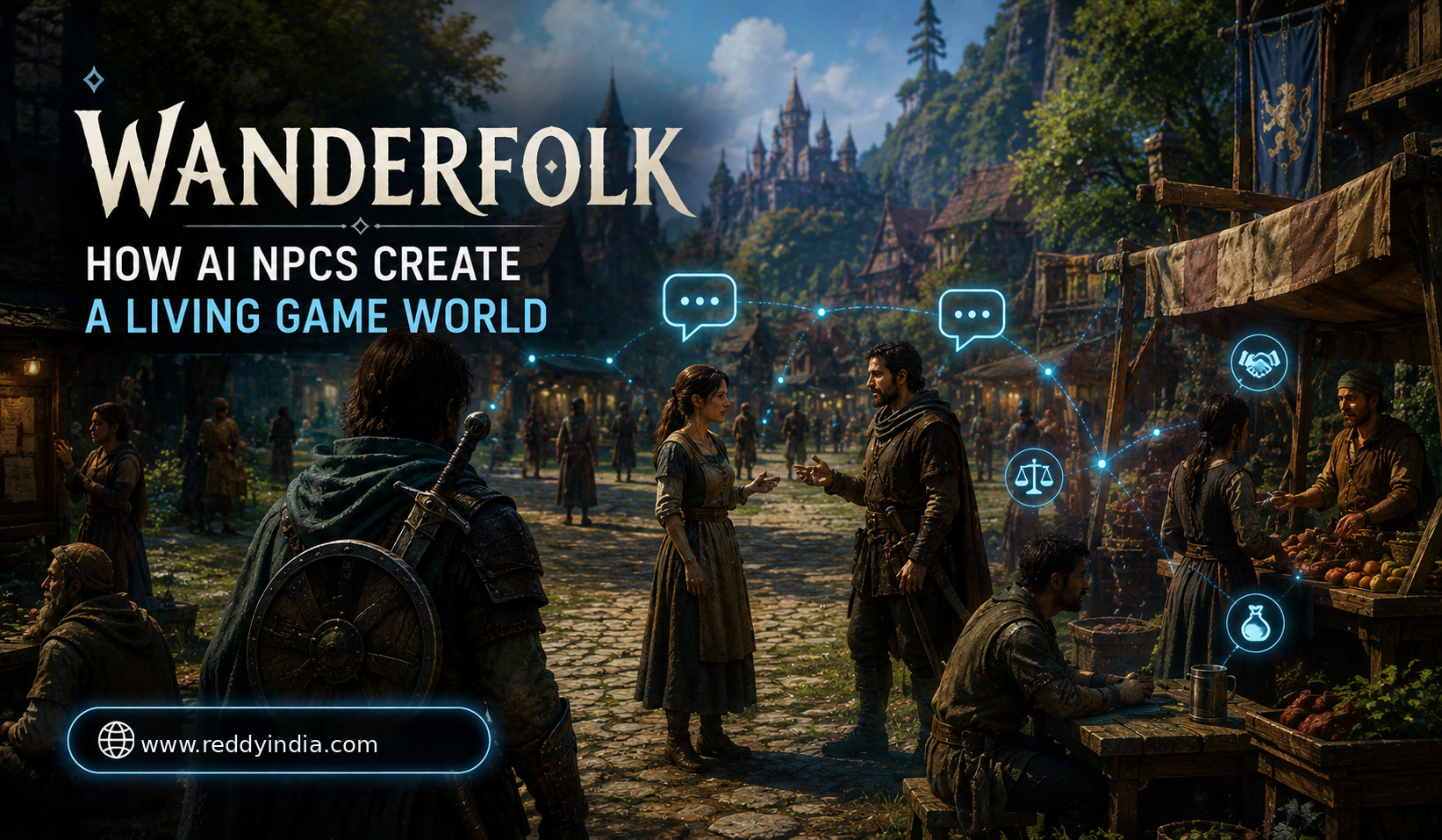
Wanderfolk: How AI NPCs Create a Living Game World
Video games have spent decades trying to make virtual worlds feel alive. Developers create busy cities, populated towns, realistic environments, and hundreds of non-player characters (NPCs) to give players the impression that the world exists beyond their own actions. Yet many NPCs still follow predictable routines, repeat the same dialogue, and respond to players in limited ways.
Artificial intelligence is beginning to change that formula. Wanderfolk represents an emerging style of game design in which AI-driven NPCs can play a more active role in creating a dynamic world. Instead of simply standing in one place and waiting for the player, intelligent characters can potentially interact with their environment, communicate more naturally, develop relationships, and contribute to stories that emerge during gameplay.
This approach could transform games from carefully scripted experiences into worlds that feel more spontaneous and unpredictable. Here is how AI NPCs can help create a living game world and why games like Wanderfolk are attracting attention.
What Is Wanderfolk?
Wanderfolk can be viewed as part of the growing movement toward AI-enhanced simulation and character-driven gaming. The central idea behind this type of experience is simple: make virtual characters behave more like participants in a world rather than static background objects.
In a traditional game, developers often determine where an NPC goes, what they say, when they work, and how they react to specific events. A large number of these behaviors are carefully scripted.
AI can introduce more flexibility.
Instead of creating every possible interaction manually, developers can give characters goals, personalities, memories, and behavioral rules. The AI can then use those elements to determine how a character might respond to changing circumstances.
The result can be a world where players discover stories rather than simply follow them.
Why NPCs Matter So Much
NPCs are one of the most important parts of a virtual world.
A beautifully designed city can still feel empty if every character behaves like a cardboard cutout. On the other hand, a relatively simple environment can become engaging when the people living in it appear to have their own lives.
Players notice when NPCs repeat themselves or behave unnaturally. A shopkeeper who says exactly the same sentence every time you walk into a store quickly stops feeling like a real resident.
AI-powered NPCs offer an opportunity to solve some of these limitations.
Characters can potentially respond differently depending on circumstances, remember previous interactions, and develop behavior that reflects their individual personalities.
From Scripted NPCs to Intelligent Characters
Traditional NPCs are usually built using scripts and state machines. Developers define specific conditions and actions.
For example, an NPC might follow this routine:
Wake up, go to work, eat lunch, return home, and sleep.
This approach works well because it is predictable and efficient. However, it also creates limitations. If a major event happens nearby, the NPC may continue following the same routine unless developers specifically programmed a response.
AI can make that behavior more flexible.
A character could potentially recognize a change in the environment and decide to react. They might visit another location, talk to a nearby character, avoid a dangerous area, or change their plans.
That makes the world feel more responsive.
AI Gives NPCs Goals
One of the most important concepts behind believable AI characters is goal-driven behavior.
A character should not simply perform random actions. It should have reasons for what it does.
An AI NPC could have goals such as earning money, making friends, protecting a family member, improving a skill, exploring a neighborhood, or finding a new job.
Different goals can produce different behavior.
A character who values wealth might work longer hours. A social character may spend more time at community locations. An adventurous character could frequently explore unfamiliar places.
When many NPCs have different goals, a game world becomes more complex without every event needing to be directly controlled by the player.
Personalities Make Virtual People Different
Goals alone are not enough. Personality can make characters feel individual.
Consider two NPCs who both want to make friends. One could be confident and outgoing, while the other is shy and cautious.
They may pursue the same goal in completely different ways.
AI systems can use personality traits to influence dialogue, decisions, and relationships. A character might become angry more easily, prefer certain activities, avoid conflict, or actively seek social interaction.
This creates variation.
Instead of having hundreds of NPCs who are essentially copies with different appearances, developers can create communities filled with characters who behave differently.
Memories Can Create Long-Term Relationships
Memory is another powerful feature of AI-driven NPCs.
In many games, characters have limited memory of previous encounters. Once a conversation ends, it may have little effect on future interactions.
AI systems can potentially allow characters to retain important information.
A character might remember that the player helped them during an emergency. Another might remember being insulted. A merchant could remember a player’s buying habits.
These memories can influence future behavior.
Over time, relationships may develop naturally. A stranger can become an ally, a competitor, a friend, or an enemy based on previous experiences.
This makes interaction more meaningful because player actions can have consequences beyond a single conversation.
AI Can Create Emergent Stories
The idea of emergent storytelling is at the heart of living game worlds.
In a traditional story-driven game, developers write major events in advance. Players experience those events by following the game’s narrative structure.
AI-driven worlds can take a different approach.
Stories can emerge from interactions between systems.
Imagine an NPC losing their job, meeting another character, moving to a new neighborhood, and eventually starting a business. None of these events necessarily needs to be part of a traditional scripted mission.
The story emerges from the character’s decisions and circumstances.
The player might discover this story simply by paying attention to what happens in the world.
That can make gameplay feel surprisingly personal.
Dynamic Social Networks
A living world also needs relationships between NPCs.
AI can potentially create social networks in which characters have friendships, rivalries, family connections, professional relationships, and changing opinions.
These relationships can influence behavior.
If two characters dislike each other, they may avoid one another or argue. If they are close friends, they may spend more time together. A character could introduce the player to another NPC, creating new opportunities for interaction.
This produces a chain reaction.
One relationship affects another, which affects another event, eventually creating stories that the player did not directly initiate.
AI NPCs Can Change the Environment
Intelligent characters can also influence the world itself.
A business owner might expand a store. A farmer could change what they produce. A group of residents could move to another location. Characters might participate in festivals, respond to economic changes, or adapt to events created by the player.
When NPC behavior affects the environment, the world stops feeling like a static collection of locations.
It becomes a system.
This is one of the biggest differences between traditional scripted worlds and AI-driven simulations.
The Player Becomes Part of the Ecosystem
In a traditional game, the world often revolves around the player.
NPCs give quests, enemies appear when the player approaches, and major events happen because the player triggers them.
AI-powered worlds can reduce that dependence.
Characters can continue pursuing their own goals when the player is not present. They can make decisions, develop relationships, and create events independently.
The player becomes one participant in a larger ecosystem.
That can create a stronger sense of immersion because the world appears to have a life of its own.
Why This Makes Games More Replayable
Replayability is another major advantage.
If every character follows the same script, replaying a game often produces almost identical experiences.
AI-driven behavior can introduce variation.
A character might make a different decision during a second playthrough. A relationship could develop differently. An unexpected event might occur in another location. The player’s own decisions can also redirect the behavior of other characters.
This means that two players can experience the same world but create completely different stories.
That is especially valuable for sandbox and simulation games.
AI NPCs Still Have Challenges
Creating believable AI characters is not easy.
One major problem is consistency. Characters need to remember who they are and behave according to their personality. If an NPC suddenly changes its attitude for no reason, players may lose trust in the simulation.
Another issue is performance. Managing intelligent behavior for dozens or hundreds of characters can require significant computing resources.
AI-generated dialogue can also produce strange or repetitive responses. Developers need strong systems to keep AI behavior within the game’s setting and tone.
There are additional concerns involving moderation, privacy, data processing, and player safety.
For these reasons, AI NPCs will likely work best when combined with traditional game systems rather than replacing them entirely.
The Future of Living Game Worlds
Wanderfolk-style AI NPC systems could represent an important step toward the next generation of virtual worlds.
Future games may feature characters with persistent memories, evolving personalities, long-term goals, and complex social relationships. NPCs could change jobs, move homes, form communities, and react to the player’s decisions over much longer periods.
Game worlds could become less like theme parks built around a fixed path and more like simulated societies.
Artificial intelligence may eventually allow developers to create the rules of a world while giving NPCs enough autonomy to produce their own stories within those rules.
That could create experiences that are impossible to fully predict, even for the people who created the game.
Conclusion
Wanderfolk highlights an exciting direction for the gaming industry: using AI to make NPCs more active, responsive, and believable.
AI can give virtual characters goals, personalities, memories, and relationships that influence their behavior. Instead of simply delivering scripted dialogue or standing in predetermined locations, NPCs can become participants in the world.
The most important change is not simply better dialogue. It is the possibility of creating a game environment where stories emerge naturally from the actions of many different characters.
There are still technical and creative challenges to solve, especially around consistency, performance, and responsible AI design. But the potential is significant.
As AI technology becomes more capable, the future of gaming may involve worlds that continue to evolve even when the player is doing nothing. In such games, the question may no longer be, “What story did the developers create?” but rather, “What story is happening right now?”
That shift could make virtual worlds feel more alive than ever before.