Suck Up!: Exploring AI-Powered Conversations in Gaming
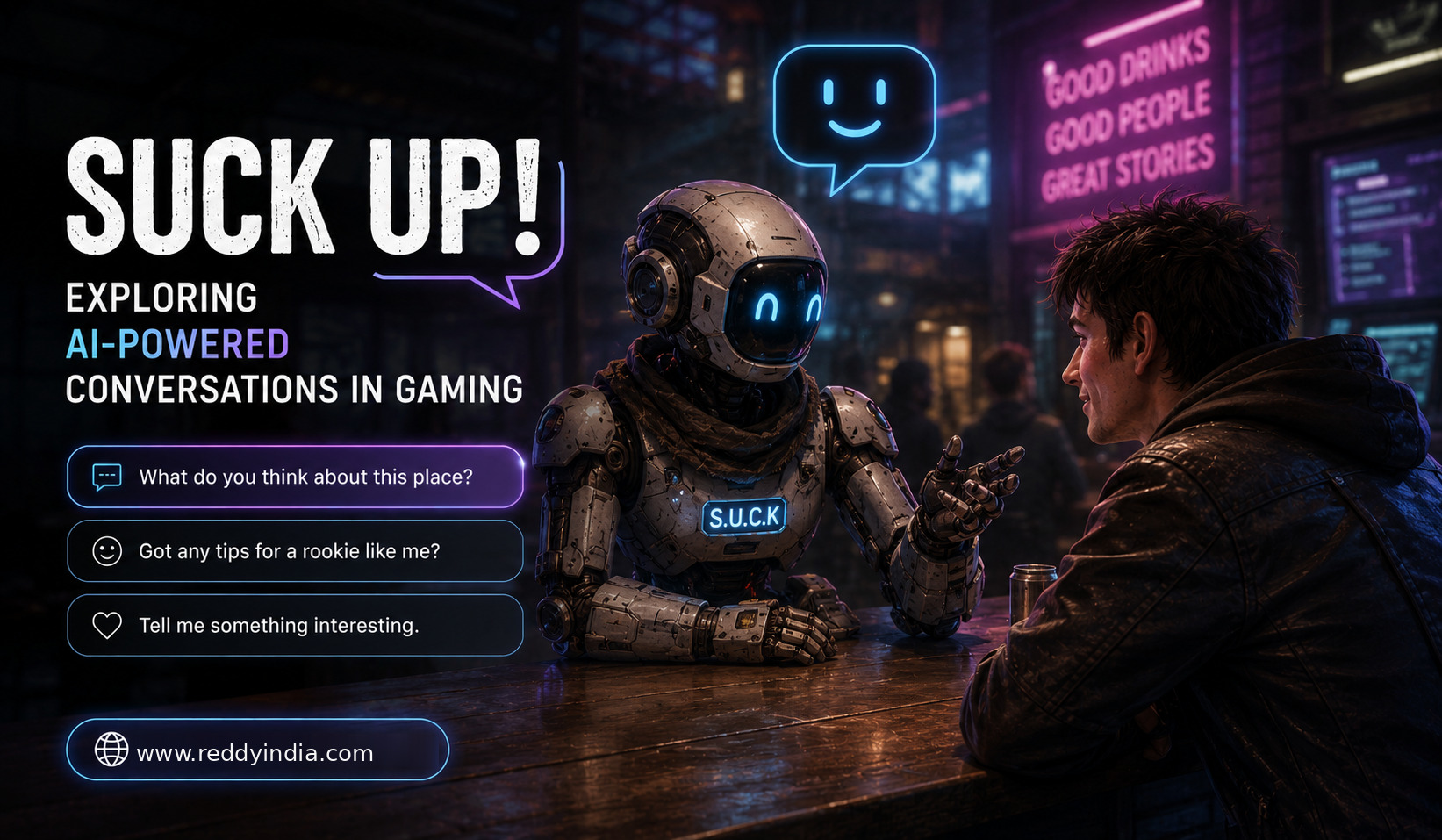
Artificial intelligence is changing video games in ways that go far beyond graphics and automated opponents. One of the most interesting developments is the rise of games where talking to characters is not simply part of the story—it is the gameplay itself. Suck Up! is a memorable example of this idea, using AI-powered characters and voice conversations to create a different kind of interactive experience.
Developed by Proxima, Suck Up! puts players in the role of a vampire trying to enter people’s homes. Instead of fighting their way inside, players must use conversation, persuasion, costumes, and quick thinking to convince AI-controlled residents to trust them. The game uses AI-generated responses and real voice interaction, making conversations more flexible than traditional scripted dialogue.
The result is a game where players cannot always predict what a character will say. That unpredictability demonstrates how artificial intelligence could change the role of dialogue in future games.
What Is Suck Up!?
Suck Up! is a comedic vampire-themed game built around social interaction. Players explore a neighborhood and try to persuade residents to invite them inside. Once inside, the vampire can pursue the game’s central objective without relying on conventional combat.
What makes the game unusual is the way players communicate. According to the game’s Steam listing, players can use their real voice to talk their way into homes, with AI characters responding in real time. The system is designed to react to the player’s tone and strategy rather than forcing every conversation into a fixed dialogue tree.
This changes the basic structure of a game conversation. Instead of selecting one option from a menu, the player becomes responsible for what to say.
AI Turns Conversation Into Gameplay
In many games, dialogue serves as a bridge between gameplay sections. Players talk to an NPC, receive information, complete a conversation, and return to exploration or combat.
Suck Up! reverses that relationship.
Conversation is the challenge.
The player has to decide how to introduce themselves, what story to tell, which details to reveal, and how to respond when the NPC becomes suspicious. Because AI generates responses rather than simply selecting from a small collection of scripted lines, conversations can develop in unexpected ways.
This makes communication itself a game mechanic.
A player might pretend to be a delivery worker, a superhero, a friend, or another character. They may use humor, compliments, excuses, or elaborate stories. The success of each approach depends partly on how convincing the conversation becomes.
Real Voice Interaction Makes the Experience More Personal
One of the most notable features of Suck Up! is voice interaction. Players can speak using a microphone instead of typing every response. The game is designed around using the player’s actual voice to attempt to persuade characters.
Voice input creates a stronger connection between the player and the virtual character.
When a player speaks naturally, the experience feels different from selecting a prewritten sentence. The player is effectively performing as the vampire.
This can also create funny situations. A carefully planned explanation might fail, while an improvised comment could unexpectedly work.
The technology makes the player an active part of the conversation rather than just a decision-maker observing a dialogue scene.
AI Characters Can Respond to Context
Traditional NPCs usually follow predefined dialogue trees. Developers write possible questions, answers, reactions, and outcomes ahead of time.
AI-powered NPCs can generate responses based on the conversation’s current context.
The developers describe Suck Up! as using AI characters with different personalities and behaviors. The AI is intended to respond to the player’s tone and strategy, helping make encounters less predictable.
This creates a different type of interaction.
A player cannot always assume that one successful line will produce the same result every time. The conversation itself becomes part of the problem the player has to solve.
Personalities Make NPCs More Interesting
The value of conversational AI does not come only from generating more dialogue. It comes from giving characters different characteristics.
Imagine two residents standing in the same neighborhood. One may be suspicious and difficult to convince, while another may be friendly and easily distracted.
The player can no longer use exactly the same strategy with everyone.
This encourages experimentation. Players may need to listen carefully, understand a character’s attitude, and adjust their approach.
That is an important step toward more believable NPC design. Instead of memorizing the correct dialogue option, players begin reacting to the virtual person’s behavior.
Why Unpredictability Matters in AI Games
Unpredictability can be one of AI’s biggest advantages in interactive entertainment.
Traditional games are carefully controlled because developers need to know what players can experience. That control makes games reliable, but it can also make them predictable.
AI introduces a degree of uncertainty.
In Suck Up!, a player can say something unusual and receive a response they did not expect. The humor often comes from this unpredictability. The developers have created a game where conversational mistakes and strange ideas can become part of the entertainment.
This approach works particularly well because the game’s tone is comedic. Unexpected AI responses can create funny moments instead of immediately destroying a serious narrative.
Disguises Add Another Layer to Conversations
Conversation is not the only way Suck Up! uses AI to create interaction.
Players can also use costumes and props to disguise themselves. The Steam description explains that players can dress as different characters, including a knight or superhero, and use items to help gain trust.
This is important because it adds visual context to the conversation.
The player’s appearance becomes part of the social strategy. A disguise can affect how an NPC understands the situation, creating another variable for the AI-powered interaction.
Instead of simply asking, “What should I say?”, players can also think about, “Who should I pretend to be?”
AI Can Create Emergent Comedy
Comedy is one of the strongest advantages of AI-powered conversations.
Human players naturally produce unusual, ridiculous, or unexpected ideas. A traditional dialogue system may reject those ideas because they were never included in the script.
A generative AI system can attempt to respond to them.
That opens the door to spontaneous comedic moments. Players can experiment with absurd explanations, strange introductions, or creative attempts at persuasion.
These moments can become memorable precisely because they were not completely scripted.
The game essentially creates a space where players and AI contribute to the humor together.
What Suck Up! Shows About the Future of NPCs
Suck Up! is not necessarily the final form of AI-powered game characters. Instead, it offers an early example of what conversational NPCs can look like when AI becomes a central part of gameplay.
Future games could push this idea much further.
NPCs might remember previous conversations, develop relationships with players, recognize long-term behavior, and change their attitudes over time. Characters could potentially have more persistent personalities, goals, and social networks.
That could make game worlds feel less like collections of programmed characters and more like interconnected communities.
The Challenges of AI Conversations in Games
AI-powered dialogue also comes with limitations.
One major challenge is consistency. AI-generated responses can sometimes be strange, repetitive, or unrelated to the intended situation. In a comedy game, an unexpected answer might be entertaining. In a serious role-playing game, it could break immersion.
Latency is another problem. Conversation feels natural when responses happen quickly. Waiting too long for an AI-generated answer can disrupt the rhythm of an interaction. The technical cost of generating responses at scale is also important for developers.
There are additional considerations involving moderation, privacy, online connectivity, and the use of third-party AI services.
These challenges show why AI should not simply replace traditional game design. Developers still need strong systems around the technology.
AI May Change How Games Are Written
For decades, game writers have worked within branching dialogue systems. They write numerous possible lines because they must anticipate player decisions.
Generative AI could change that workflow.
Instead of writing every possible response, designers could define a character’s personality, objectives, background, and boundaries. The AI could then generate dialogue within those rules.
This would not eliminate the need for writers. In fact, writers could become more focused on designing personalities, relationships, worlds, and narrative frameworks.
The emphasis could shift from writing every sentence to designing the system that makes conversations feel believable.
The Future of Conversational Gaming
Suck Up! provides a fascinating glimpse into a future where talking to game characters becomes as important as fighting, exploring, or solving puzzles.
As AI models improve, conversational games could become more sophisticated. Players might negotiate with merchants, interrogate suspects, build friendships, persuade enemies, or develop long-term relationships using natural language.
Instead of asking players to choose a response from four options, future games could simply ask them to speak.
That would make every player’s experience potentially different.
The biggest change may be psychological as much as technical. When a character responds directly to the player’s own words, the interaction can feel more personal. The player is no longer just choosing what the protagonist should say—they are participating in the conversation themselves.
Conclusion
Suck Up! demonstrates how AI-powered conversations can transform a simple game mechanic into the main source of interaction. By combining voice input, generative AI, character personalities, and social deception, the game gives players more freedom to experiment with language and strategy.
Its approach also highlights both the promise and limitations of conversational AI. Unexpected responses can create humor and replayability, while issues such as consistency, latency, and development costs remain significant challenges.
Even so, the concept is important. Games have traditionally given players control over movement and choices, but AI is beginning to give them greater freedom over conversations themselves.
As this technology develops, the next generation of NPCs may not simply wait for players to select dialogue options. They may listen, respond, remember, and challenge players in ways that make virtual worlds feel much more alive.
That is the real potential of AI-powered conversations in gaming: not just more dialogue, but a more interactive relationship between the player and the digital world.