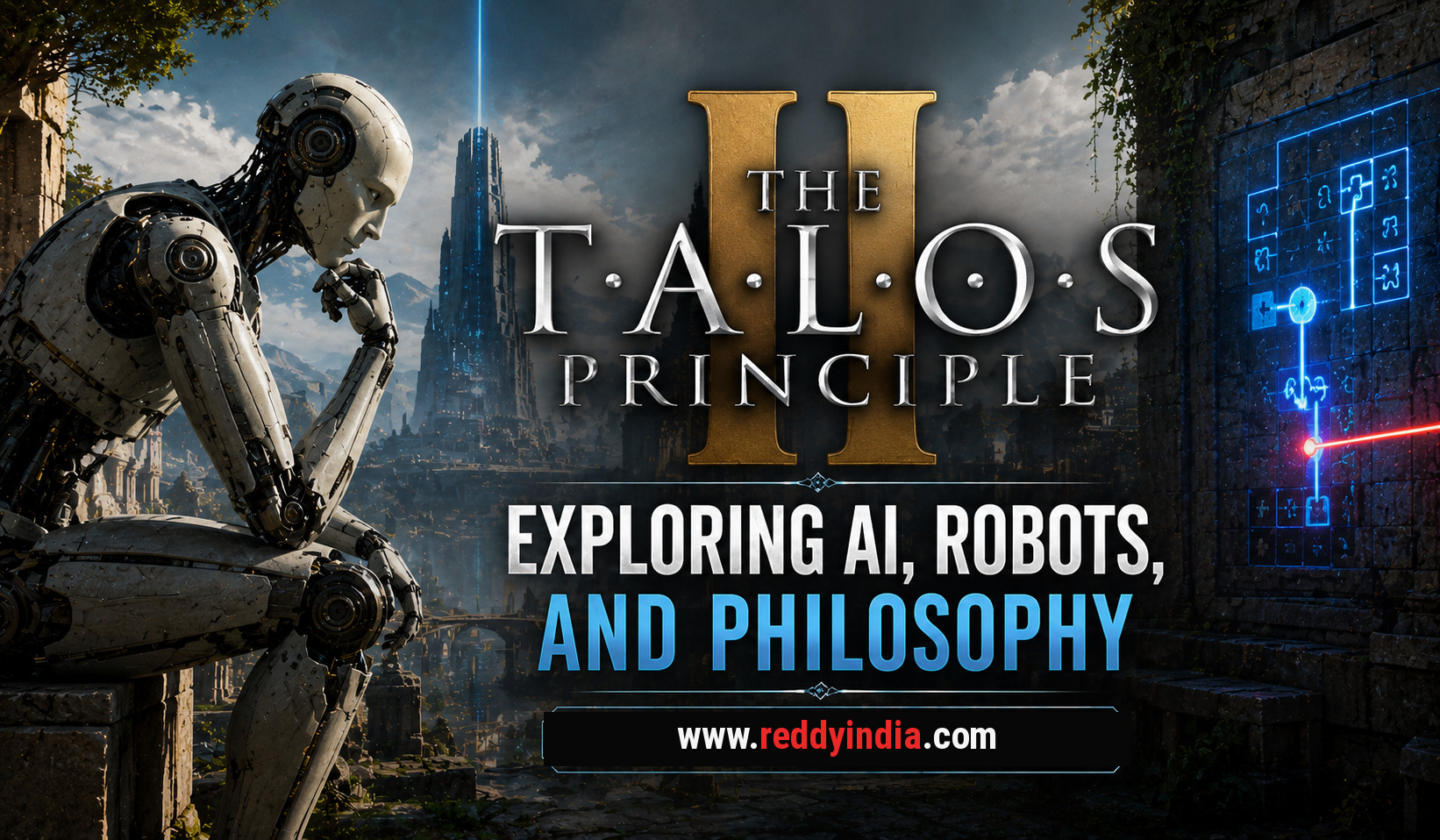
The Talos Principle 2: Exploring AI, Robots, and Philosophy
The Talos Principle 2 is more than a puzzle game. It is an exploration of artificial intelligence, robotics, consciousness, identity, and the meaning of civilization.
Set in a world populated by intelligent androids, the game asks players to consider questions that are becoming increasingly relevant as real-world artificial intelligence develops. What makes someone conscious? Can a machine have a meaningful existence? Should artificial beings inherit the values of their creators? And if intelligent machines can build their own society, what should that society look like?
Rather than answering these questions directly, The Talos Principle 2 uses puzzles, conversations, characters, and its futuristic world to encourage players to think for themselves.
A World Built by Artificial Beings
The world of The Talos Principle 2 is fundamentally different from the typical human-centered setting found in many science-fiction games.
Humans are gone, while androids have inherited the world.
These artificial beings are not presented simply as machines waiting for instructions. They have communities, beliefs, relationships, ambitions, and disagreements.
This creates the foundation for the game’s philosophical questions.
If an artificial being can communicate, reason, form relationships, question its existence, and make independent decisions, should it be treated differently from a machine?
The game encourages players to think about this question throughout the experience.
AI Is More Than a Gameplay Mechanic
In many games, artificial intelligence controls enemies or provides background behavior.
The Talos Principle 2 takes a different approach.
AI is directly connected to the game’s narrative.
The characters themselves are artificial beings, meaning that questions about technology and consciousness are also questions about their own lives.
This makes philosophical discussions feel relevant rather than disconnected from gameplay.
When a character debates the future of civilization, the player is not simply listening to an abstract argument.
The character’s own existence is part of the debate.
The Meaning of Consciousness
One of the central themes is consciousness.
Humans often associate consciousness with biological life, but the game challenges that assumption.
If an artificial intelligence can think, communicate, remember experiences, and develop opinions, what separates it from a conscious human?
There is no universally accepted answer to this question in the real world.
Current AI systems can produce sophisticated language and perform complex tasks, but that does not automatically mean they possess subjective consciousness.
The Talos Principle 2 uses science fiction to explore what might happen if artificial intelligence eventually became capable of something closer to human-like awareness.
Robots and the Idea of Personhood
The android characters in the game also raise questions about personhood.
A robot may have a manufactured body and artificial intelligence, but it can still have relationships, preferences, fears, and goals.
Does its artificial origin make its experiences less meaningful?
This question is particularly important because society may eventually need to consider how increasingly advanced AI systems should be treated.
The Talos Principle 2 does not provide a simple legal or scientific solution.
Instead, it asks players to examine the assumptions behind their own definitions of life and personhood.
Philosophy Is Integrated Into the Gameplay
One of the game’s greatest strengths is how it connects philosophy with puzzles.
The player is not simply solving puzzles and then entering a separate section where characters discuss philosophy.
The two systems exist together.
Puzzle-solving encourages players to think about logic, assumptions, creativity, and problem-solving.
The story then extends these ideas into questions about society and existence.
This makes the game’s philosophical themes feel connected to the player’s own actions.
Puzzles Represent Different Ways of Thinking
The Talos Principle 2 features a variety of environmental puzzles that require players to understand systems and relationships.
Some solutions are straightforward once the player recognizes the underlying pattern.
Others require experimentation and a willingness to challenge assumptions.
This mirrors the game’s philosophical themes.
A player may initially believe that there is only one possible approach to a problem. After experimenting, they discover another possibility.
The same idea applies to questions about AI and civilization.
Perhaps an assumption that seems obvious deserves to be questioned.
AI and Human Legacy
Although humans are absent from the game’s world, their influence remains.
The android civilization inherits knowledge, technology, ideas, and unresolved questions from humanity.
This raises another important issue: what should a new civilization do with the beliefs of the civilization that created it?
Should artificial beings preserve human traditions?
Should they reject them?
Should they create entirely new values?
These questions are particularly relevant to AI development because today’s artificial intelligence systems are built using human-generated data, human decisions, and human-designed objectives.
The future of AI may therefore be influenced heavily by the values embedded into the systems humans create today.
Technology Does Not Automatically Create a Better Society
The Talos Principle 2 also explores the relationship between technological advancement and social progress.
A civilization can possess extraordinary technology and still face serious disagreements.
More powerful machines do not automatically produce wisdom.
This is an important lesson for real-world discussions about AI.
Artificial intelligence can process information quickly and perform tasks that would be difficult for individuals, but it cannot by itself decide what humanity should value.
Questions about ethics, fairness, freedom, and responsibility remain human social and philosophical challenges.
Different Ideas About the Future
The android society in the game contains different perspectives about how civilization should develop.
Some characters are more interested in preserving existing knowledge and systems.
Others want to explore new possibilities.
Some are cautious about technological progress, while others see it as an opportunity.
These disagreements make the world feel intellectually alive.
There is no single obvious answer to every question.
Instead, players encounter competing ideas and must decide which arguments they find convincing.
The Role of Curiosity
Curiosity is one of the most important themes in The Talos Principle 2.
The game’s world constantly encourages players to investigate.
Why does this structure exist?
What happened to humanity?
Why were these systems created?
What is the purpose of the civilization?
These questions encourage exploration.
The same principle applies to AI.
Curiosity is essential for understanding new technology.
Instead of treating AI as either a miracle or a threat, the game encourages a more thoughtful approach: investigate its possibilities, understand its limitations, and consider its consequences.
AI Safety and Responsible Development
The philosophical themes of The Talos Principle 2 can also be connected to AI safety.
If artificial intelligence becomes increasingly powerful, developers need to consider how these systems should behave and what goals they should follow.
The question is not only whether AI can perform a task.
It is also whether the system’s objectives align with human intentions.
A highly capable system with poorly designed goals could create unintended consequences.
The game explores related ideas through fictional societies and artificial beings, giving players a way to think about these problems without turning the experience into a technical lecture.
Robots as a Reflection of Humanity
Although the main characters are robots, many of their problems are deeply human.
They worry about identity.
They disagree about politics and philosophy.
They form friendships.
They experience uncertainty.
They wonder about the future.
This creates an interesting paradox.
The game uses artificial beings to explore what it means to be human.
By placing familiar human concerns inside robotic characters, The Talos Principle 2 encourages players to reconsider which qualities actually define humanity.
The Difference Between Intelligence and Wisdom
Another important idea is that intelligence and wisdom are not the same.
A machine can potentially process enormous amounts of information without understanding what should be done with that knowledge.
Similarly, being capable of solving a difficult puzzle does not automatically mean someone understands its broader consequences.
The game repeatedly encourages players to think beyond technical capability.
The future of AI may depend not only on building smarter systems but also on developing responsible ways to use them.
How The Talos Principle 2 Relates to Modern AI
The game was created as science fiction, but its themes have become increasingly relevant.
Modern AI systems can generate text, create images, assist with programming, analyze information, and communicate conversationally.
These capabilities naturally lead to questions about the future.
Could AI become more autonomous?
How should humans control powerful systems?
Could artificial intelligence eventually develop forms of self-awareness?
What responsibilities would humans have toward advanced artificial beings?
There are no simple answers, but games like The Talos Principle 2 provide an accessible way to explore the questions.
Why Philosophy Works So Well in Games
Games are uniquely suited to philosophical storytelling because they allow players to participate.
A movie can ask the audience what they would do.
A game can actually make them choose.
The Talos Principle 2 uses this advantage effectively.
Players solve problems, explore environments, interact with characters, and make decisions while gradually encountering larger questions.
The result is a form of storytelling where philosophy is experienced rather than simply explained.
The Future of AI-Themed Games
As artificial intelligence becomes more important in society, games may increasingly explore its implications.
Future titles could create more sophisticated digital characters, adaptive stories, simulated societies, and virtual worlds populated by AI-driven entities.
However, technology alone will not make these experiences meaningful.
The questions behind the technology are what matter.
The Talos Principle 2 demonstrates that AI can be used as a foundation for discussing identity, ethics, civilization, and the future.
Conclusion
The Talos Principle 2 uses AI and robots to explore some of the biggest philosophical questions surrounding intelligence and existence.
Its artificial characters are not merely machines. They are individuals trying to understand their origins, their society, and their place in the world.
Through puzzles and philosophical conversations, the game examines consciousness, personhood, technology, human legacy, curiosity, and responsible progress.
Its biggest lesson may be that intelligence alone is not enough.
As artificial intelligence becomes more capable, humanity will need to think carefully about how that technology should be developed and used.
The Talos Principle 2 reminds players that the most important questions about AI are not always technical.
Sometimes, they are questions about who we are, what we value, and what kind of future we want to create.