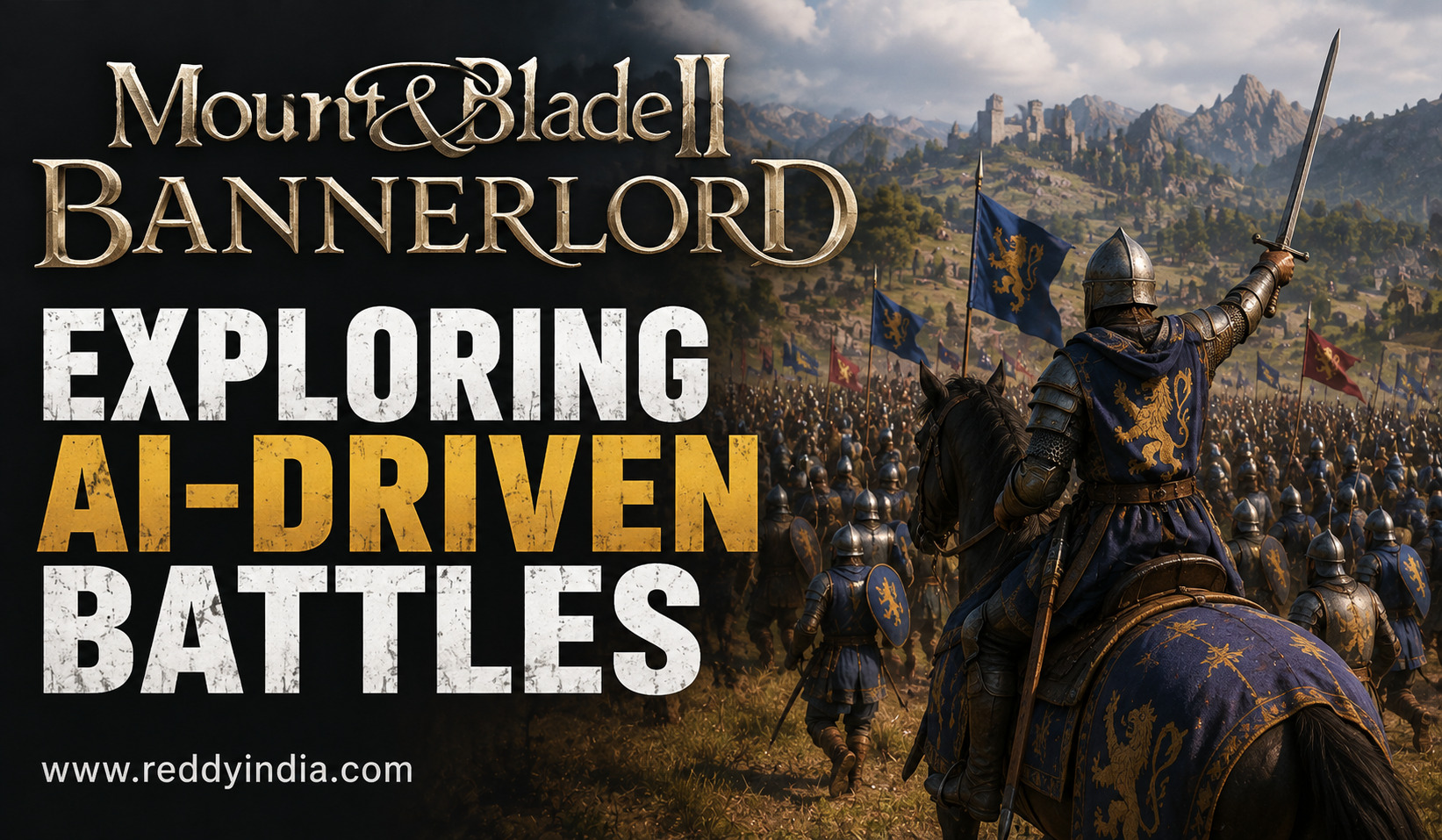
Mount & Blade II: Bannerlord: Exploring AI-Driven Battles
Large-scale medieval battles have always been difficult to recreate in video games. Hundreds or even thousands of soldiers need to move, attack, defend, respond to commands, and react to changing battlefield conditions. Mount & Blade II: Bannerlord tackles this challenge by combining role-playing, strategy, and large-scale combat with sophisticated artificial intelligence systems.
Developed by TaleWorlds Entertainment, Bannerlord places players in a dynamic medieval-inspired world where armies compete for territory, kingdoms rise and fall, and individual decisions can influence entire campaigns. Its battles are particularly interesting because soldiers are not simply static targets. They follow orders, move in formations, respond to threats, and interact with other units.
AI is therefore a major part of what makes Bannerlord’s battles feel dynamic.
A Medieval World Built Around Conflict
Bannerlord takes place in the fictional world of Calradia, where different kingdoms and factions compete for power.
Players can become warriors, commanders, nobles, traders, or rulers. They can recruit soldiers, build armies, participate in battles, capture settlements, and influence political events.
The game operates on multiple levels.
At the campaign level, armies travel across the map, factions make decisions, settlements change ownership, and political relationships develop.
At the battlefield level, individual soldiers follow orders and engage enemies.
AI connects these different layers.
The campaign world creates the conditions for battles, while battlefield AI determines how those battles unfold.
AI Controls Hundreds of Soldiers
One of Bannerlord’s biggest technical challenges is managing large numbers of units at the same time.
During major battles, hundreds of soldiers may be present.
Each group needs to know where to move, who to attack, how to respond to orders, and how to interact with nearby units.
The game’s AI helps coordinate these behaviors.
Soldiers can form lines, advance, retreat, defend positions, charge enemies, use ranged weapons, and respond to battlefield commands.
This creates the impression of an organized army rather than a collection of independent characters.
Formation-Based Combat
Formations are an important part of Bannerlord’s battlefield system.
Players can organize soldiers into different formations depending on their roles and equipment.
Infantry can form defensive lines.
Archers can remain behind other units and attack from a distance.
Cavalry can maneuver around enemy formations.
These formations allow players to approach battles strategically.
AI-controlled soldiers then attempt to maintain these structures while responding to battlefield conditions.
This creates a relationship between player strategy and AI execution.
The player decides what should happen, while the AI determines how individual units carry out those instructions.
Cavalry and Battlefield Movement
Mounted units are particularly interesting because their effectiveness depends heavily on movement.
Cavalry can charge enemy formations, move quickly across the battlefield, and attack from different directions.
AI helps these units navigate large battlefields while responding to enemy positions.
A successful cavalry attack depends on timing and positioning.
If cavalry charges directly into a strong formation, the attack may fail.
If it reaches a vulnerable flank, the result can be much more effective.
This demonstrates how AI-driven movement can influence tactical gameplay.
Ranged Units and Positioning
Archers and other ranged units introduce another layer of battlefield intelligence.
Their effectiveness depends on distance, line of sight, positioning, and protection.
Players can place ranged units behind infantry formations or on elevated terrain.
The AI then helps individual soldiers respond to enemy movements.
If the enemy advances, archers may need to reposition.
If enemy cavalry approaches, the formation may become vulnerable.
These interactions create battles where positioning matters as much as raw numbers.
The Player as Commander
Bannerlord gives players direct control over their own character while also allowing them to command large armies.
This creates an unusual combination of perspectives.
Players can personally fight on the battlefield while simultaneously giving strategic orders.
They can command an infantry charge and then ride toward another section of the battlefield to fight alongside cavalry.
The AI makes this possible because the player’s army continues operating even when the player is personally occupied elsewhere.
Without autonomous soldier behavior, managing a large army while participating in combat would be extremely difficult.
AI Makes Battles Less Predictable
A major benefit of AI-driven combat is unpredictability.
Even when players issue similar commands, battles may develop differently depending on terrain, enemy formations, troop composition, timing, and other conditions.
An enemy cavalry charge may disrupt an infantry formation.
A defensive position may hold longer than expected.
A sudden flank attack can change the balance of a battle.
These events make combat feel dynamic.
The player can plan a strategy, but the battlefield may still force them to adapt.
Terrain and Tactical Decisions
Terrain plays an important role in Bannerlord’s battles.
Hills, open fields, forests, and other environments can influence movement and combat.
AI-controlled units need to navigate these spaces while maintaining their formations and responding to threats.
For players, terrain becomes a strategic resource.
High ground can benefit ranged units.
Narrow areas can limit cavalry movement.
Open terrain may provide more space for mounted attacks.
The interaction between terrain and AI movement helps create battles that feel less repetitive.
Siege Battles and AI Challenges
Sieges are among the most complicated encounters in Bannerlord.
Armies must attack or defend fortified settlements with walls, gates, towers, and other defensive structures.
The AI has to manage large numbers of soldiers while dealing with complex environments.
Attackers need to approach walls, use siege equipment, breach defenses, and enter the settlement.
Defenders need to protect key positions, use ranged attacks, and respond to breaches.
The complexity of these environments makes siege AI particularly important.
A well-organized defense can delay a much larger army, while a poorly executed assault can lead to heavy losses.
Campaign AI Shapes the Bigger War
Battlefield AI is only one part of Bannerlord’s larger simulation.
The campaign map also depends on AI-controlled factions.
Kingdoms can declare wars, form alliances, attack settlements, recruit armies, and respond to threats.
These decisions influence which battles occur.
A player might be preparing to attack one settlement when an enemy army approaches from another direction.
A faction that was previously weak may become powerful after winning several battles.
This creates a constantly changing political environment.
The AI therefore affects not only individual battles but also the broader story of the campaign.
Armies Have Different Strengths
Different armies can contain different combinations of troops.
Some may rely heavily on infantry.
Others may use cavalry or ranged units.
The composition of an army influences how AI-controlled forces behave on the battlefield.
Players therefore need to understand their army’s strengths and weaknesses.
A large army is not automatically a guaranteed victory.
Poor positioning or ineffective commands can allow a smaller but better-organized force to win.
This creates strategic depth beyond simply recruiting more soldiers.
AI and Emergent Battle Stories
Bannerlord’s battles often create stories that players remember long after the fight ends.
A commander might survive despite being surrounded.
A small cavalry group might destroy a vulnerable enemy formation.
An army that appears to be winning could suddenly collapse after losing an important position.
These moments emerge from the interaction of AI, player commands, terrain, unit types, and battlefield conditions.
The developers do not need to script every dramatic moment.
The simulation can create it naturally.
The Importance of Player Adaptation
AI-driven battles work best when the player understands that plans can change.
A strategy that works against one army may fail against another.
A formation that succeeds on open terrain may struggle during a siege.
A cavalry charge may be powerful in one situation and disastrous in another.
The player must observe what the AI-controlled armies are doing and respond accordingly.
This creates a more active form of strategy.
Instead of simply selecting a predetermined winning tactic, players need to make decisions as the battle develops.
AI and the Future of Strategy Games
Bannerlord demonstrates how AI can help strategy games simulate large-scale conflicts without removing player control.
Future games could potentially create even more sophisticated battlefields where units react to morale, terrain, communication, supply conditions, and changing objectives.
However, the basic principle will remain similar.
Players provide strategic direction, while AI handles the complex behavior of individual units.
This balance allows games to create large battles while keeping the player focused on important decisions.
Why Bannerlord’s Battles Feel Dynamic
The strength of Bannerlord’s combat comes from the interaction between several systems.
Unit AI controls individual soldiers.
Formation systems organize groups.
Terrain influences movement.
Player commands provide strategic direction.
Campaign AI determines when and where wars occur.
Together, these systems create battles that are difficult to predict perfectly.
The player has significant influence, but never complete control.
That uncertainty is part of the excitement.
Final Thoughts
Mount & Blade II: Bannerlord demonstrates how AI-driven systems can transform large-scale battles into dynamic and unpredictable experiences.
From infantry formations and cavalry charges to ranged attacks and massive sieges, AI helps hundreds of soldiers behave as coordinated groups while responding to player commands and battlefield conditions.
The game’s campaign AI adds another layer by allowing kingdoms and armies to pursue their own objectives, creating wars and conflicts that can change over time.
What makes Bannerlord especially interesting is the balance between control and unpredictability. Players can create strategies, issue orders, and influence battles, but AI-controlled soldiers and factions determine how those plans interact with a constantly changing world.
Ultimately, Bannerlord shows that the future of strategy gaming does not necessarily require players to control every individual action. When AI handles the complexity of the battlefield, players can focus on leadership, tactics, and decisions that shape the course of an entire war.