PUBG: How AI Teammates Could Change Battle Royale Gaming
Battle royale games are built around uncertainty. Players drop into a large map, collect weapons and resources, make tactical decisions, and try to survive longer than everyone else. But one element has remained relatively traditional: the teammates assisting players in matches.
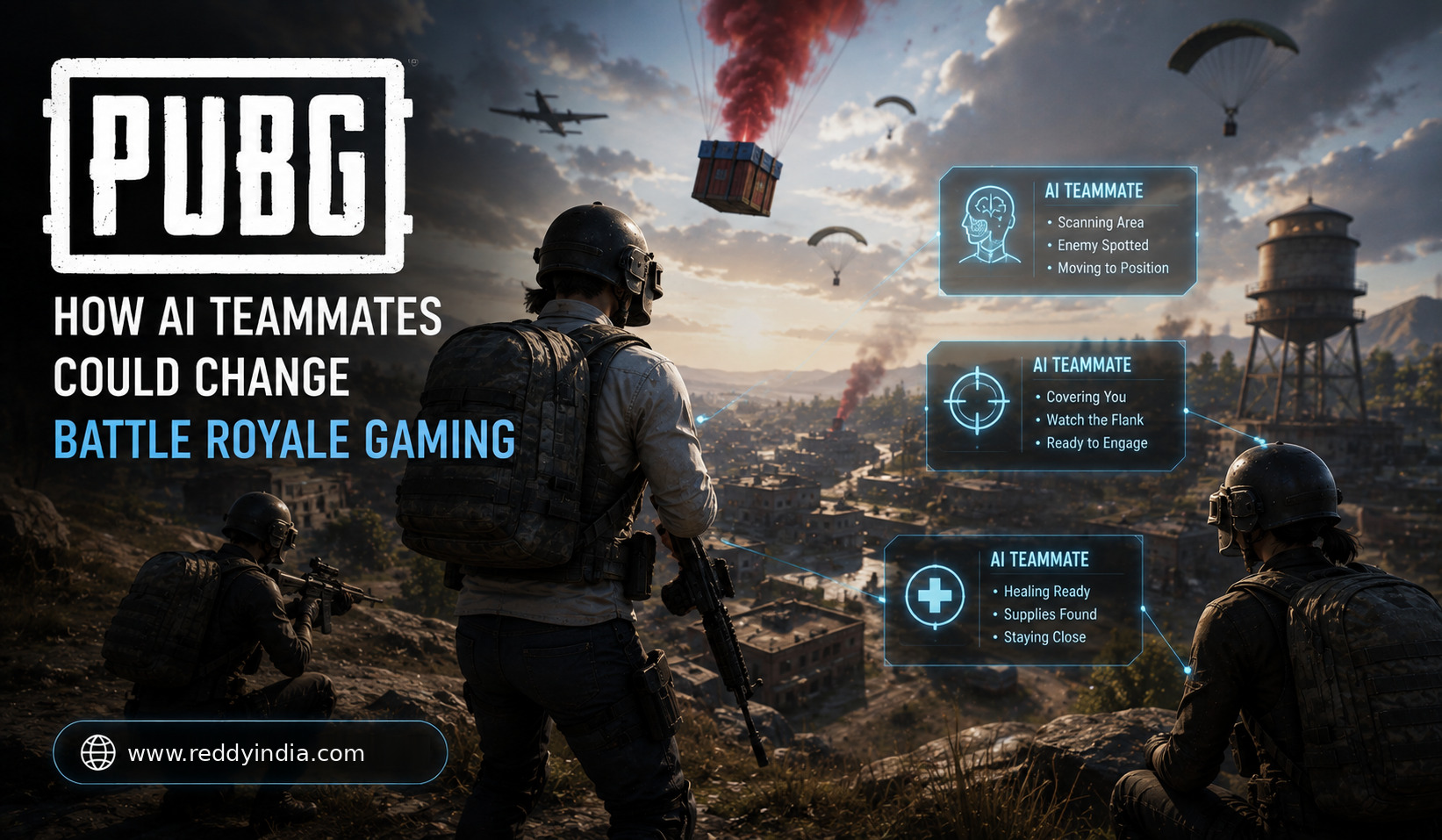
That is beginning to change with PUBG Ally, an AI-powered teammate developed by KRAFTON for PUBG: BATTLEGROUNDS. Powered by NVIDIA ACE technologies, PUBG Ally is designed to communicate naturally with players, understand the current game situation, make decisions, loot items, fight enemies, and support players during a match. KRAFTON introduced it as a Co-Playable Character (CPC) rather than a conventional NPC.
The development of AI teammates could have a major impact on battle royale gaming. Instead of simply filling an empty squad position with a predictable bot, AI companions could behave more like active teammates that understand commands, react to changing situations, and remember previous interactions.
What Is PUBG Ally?
PUBG Ally is an AI-powered companion designed to play alongside human players in PUBG: BATTLEGROUNDS. KRAFTON has built the system using NVIDIA ACE, which combines speech recognition, a small language model, text-to-speech, and game-specific tools to let the companion communicate and act during matches.
Players can communicate with the AI using natural voice commands. Instead of selecting a menu option such as “follow” or “loot,” players can speak more naturally and ask the teammate to perform tasks or coordinate a strategy.
The AI can also act without being constantly told what to do. It can loot equipment, respond to combat situations, move through the environment, and support the player based on what is happening around it.
This represents a significant change from the traditional battle royale bot.
Why AI Teammates Are Different From Traditional Bots
Traditional game bots generally work through predefined rules.
A bot may follow a player, pick up certain items, attack nearby opponents, or revive teammates when specific conditions are met. These behaviors can be useful, but they often feel predictable.
AI companions are designed to interpret context.
Instead of only responding to fixed triggers, PUBG Ally can combine the player’s instructions with information about the current game state. NVIDIA says the system can understand player intent, interpret live gameplay situations, and respond dynamically during a match.
This means an AI teammate has the potential to understand more complicated instructions.
A player might say that they need ammunition, want to move toward a particular area, or plan to attack another squad. Rather than simply following a single command, the AI can use the available game information to participate in the strategy.
Natural Voice Could Change Squad Communication
Communication is one of the most important parts of battle royale gaming.
Human teammates constantly exchange information about enemies, weapons, locations, rotations, and tactical plans. Voice chat makes this possible, but playing with strangers can sometimes be difficult. Teammates may not communicate, may speak different languages, or may simply have different skill levels.
An AI teammate could provide a more consistent communication partner.
PUBG Ally uses automatic speech recognition to understand player voice input, while a small language model processes the request and game context. A text-to-speech system then generates the AI’s spoken response.
This creates a conversational loop that feels more like speaking to a squadmate than operating a traditional game bot.
AI Teammates Can React to the Battlefield
Battle royale matches change constantly.
One moment, a player may be collecting equipment. The next, another squad could attack from a nearby building. The safe zone may shift, resources may become scarce, or a teammate may be knocked down.
An effective AI teammate needs to react to these changes quickly.
KRAFTON designed PUBG Ally with two different systems for this purpose. A behavior tree handles rapid actions such as movement, aiming, and immediate combat responses, while the AI language system handles more deliberate tasks such as interpreting player commands and coordinating decisions.
This division is important because a battle royale cannot afford to wait several seconds for an AI model to make a basic combat decision.
The result is intended to combine fast game reactions with more flexible reasoning.
AI Could Make Solo Players More Competitive
One of the biggest potential benefits of AI teammates is accessibility.
Not every player has a regular squad available. Some people prefer playing alone, while others may struggle to find teammates at the right skill level or schedule.
An AI companion can provide support without requiring another person to be online.
This could make team-based battle royale experiences more accessible to solo players. Instead of entering a squad match with unreliable teammates or playing a different game mode, players could potentially have an AI companion that understands their instructions and participates in the match.
NVIDIA specifically describes AI companions as a way to give players a collaborative experience when they do not have another person available to play with.
AI Could Help New Players Learn PUBG
AI teammates could also become useful training partners.
New players often struggle because battle royale games require knowledge of weapons, maps, positioning, movement, rotations, and team coordination. Learning these skills while playing against experienced players can be intimidating.
An AI teammate could provide a lower-pressure environment.
Instead of simply following a fixed tutorial, players could practice real match situations with a companion that communicates with them. They could learn how to rotate, loot, defend an area, respond to enemy attacks, and coordinate pushes.
This could turn AI companions into interactive training tools rather than simple replacements for human teammates.
Long-Term Memory Could Make AI Teammates Feel Personal
One of the most interesting developments in PUBG Ally is its memory capability.
At CES 2026, KRAFTON demonstrated long-term memory for the AI companion. NVIDIA reported that Ally can remember player preferences, including names, preferred weapons, favorite drop locations, and notable moments from previous matches.
KRAFTON later explained that the memory system works on two timescales: short-term memory for the current match and long-term memory that can carry information between sessions.
This could make a huge difference to player attachment.
An AI that remembers that you prefer a particular rifle or landing location feels more like a continuing teammate than a disposable bot that resets after every match.
Every Player Could Have a Different AI Experience
Personalization is another major advantage.
If AI teammates remember individual players, different users could develop different relationships with their companions.
One player might prefer aggressive strategies, while another likes slow, defensive rotations. An AI teammate that learns from previous interactions could potentially adapt to those preferences.
That means the AI experience may become increasingly personalized over time.
NVIDIA says PUBG Ally’s combination of memory and adaptive interaction is intended to create an experience that can be unique to individual players.
This could eventually become a major part of multiplayer gaming.
AI Teammates Could Change Game Design
AI companions may also affect how developers design battle royale maps and game modes.
Currently, many game systems are optimized around human players communicating with other humans. Designers could eventually build mechanics specifically for AI-human cooperation.
For example, a map could include objectives that require different forms of coordination. AI companions might gather resources while players focus on combat, scout locations, provide cover, or help plan rotations.
This would make AI a genuine gameplay system rather than a substitute for a missing player.
The wider NVIDIA ACE platform already categorizes AI game characters as autonomous teammates capable of communicating in natural language and acting within game environments.
AI Could Make Battle Royale Matches Less Predictable
Traditional bots can sometimes make matches feel repetitive because their behavior is relatively easy to anticipate.
More advanced AI companions could introduce greater variety.
An AI teammate could respond to different situations based on the player’s commands, the current state of the match, and its available objectives. It may choose different actions depending on whether the team is looting, defending, rotating, or fighting.
That does not mean the AI will always make the perfect choice.
In fact, some mistakes could make the experience feel more authentic. Human teammates also make bad calls, misunderstand instructions, and sometimes take unnecessary risks.
The challenge for developers is making the AI capable without making it unrealistically perfect.
The Challenges of AI Teammates
Building a convincing AI teammate is technically difficult.
Battle royale games require quick reactions, precise movement, reliable decision-making, and awareness of a constantly changing environment. An AI that understands language but reacts too slowly would not be useful during intense combat.
KRAFTON says latency was one of the biggest challenges in developing PUBG Ally. Running the AI locally helped remove network delays, while separating fast behavior-tree actions from slower language-based reasoning helped maintain responsiveness.
There are also questions around fairness.
If AI teammates become significantly better than average human teammates, competitive modes could be affected. Developers will need clear rules about where and how AI companions can be used.
Privacy and player data also matter, particularly when systems store memories across matches.
What the Future Could Look Like
PUBG Ally could be an early step toward a broader transformation in multiplayer gaming.
Future AI teammates may remember thousands of player interactions, understand more complex strategies, recognize individual play styles, and develop more natural personalities.
A player might eventually have an AI squadmate that knows their preferred landing locations, understands how aggressively they like to play, recognizes when they are under pressure, and suggests tactics based on previous matches.
Beyond PUBG, similar systems could appear in tactical shooters, survival games, MMORPGs, sports games, and cooperative adventures.
The central idea is simple: instead of playing with a bot, players could play with an intelligent digital teammate.
Conclusion
PUBG’s AI teammate experiment shows how artificial intelligence could change battle royale gaming. PUBG Ally is designed to understand natural voice commands, interpret the live game environment, make tactical decisions, perform actions autonomously, and remember player information across matches.
The technology could benefit solo players, help beginners learn the game, and make squad-based experiences more accessible. More importantly, it could introduce a new type of game character that behaves less like a programmed bot and more like a cooperative teammate.
There are still major challenges involving latency, fairness, memory, consistency, and responsible use of AI. But the direction is promising.
For years, battle royale games have asked players to survive against unpredictable opponents. The next evolution may also give players something new on their side: an AI teammate that can listen, learn, adapt, and fight alongside them.
That could change not only how PUBG is played, but how multiplayer games define the meaning of a teammate.