Tacoma: How Technology Drives Its Interactive Story
Some games are designed around action, while others are built around exploration, atmosphere, and discovery. Tacoma belongs strongly to the second category. Developed by Fullbright, the creators of Gone Home, Tacoma is a narrative-focused science-fiction game that uses technology as one of its most important storytelling tools.
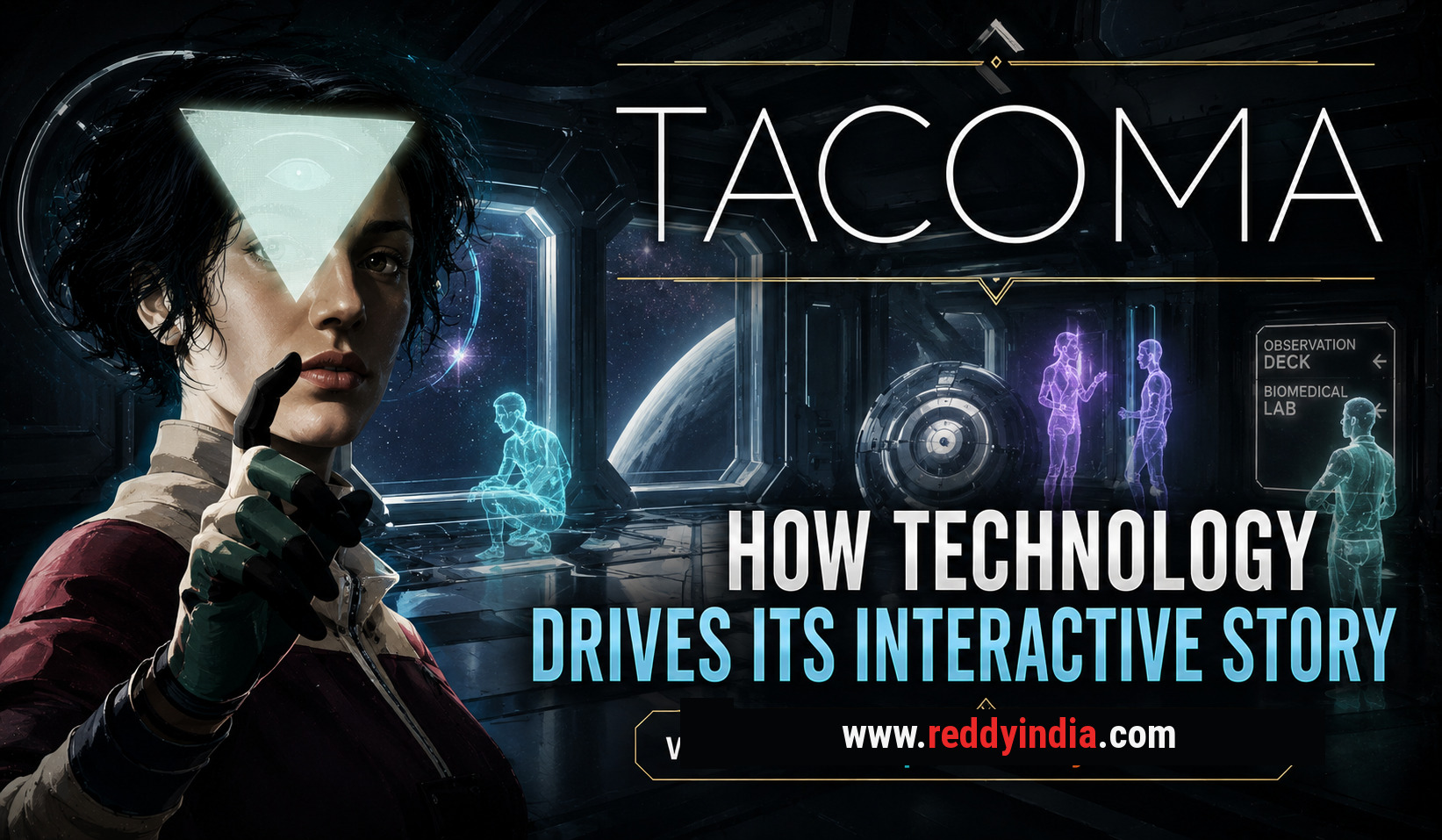
Set aboard a seemingly abandoned space station in the year 2088, Tacoma places players in the role of Amy Ferrier, an investigator sent to discover what happened to the station’s six-person crew. Instead of relying on traditional cutscenes and long conversations, the game allows players to reconstruct events through advanced digital recordings, augmented reality systems, computer interfaces, and interactive environments.
What makes Tacoma particularly interesting is that technology is not simply part of its futuristic setting. It is the mechanism through which the entire story is experienced.
A Science-Fiction Story Built Around Technology
Tacoma takes place aboard Tacoma Station, a large commercial facility orbiting Earth. When Amy arrives, she finds the station empty. The crew is gone, but their digital traces remain.
This setup immediately creates a mystery. Rather than finding characters waiting to explain what happened, players must investigate their surroundings and piece together the story themselves.
The station is filled with futuristic technology that feels believable because it serves practical purposes. Computer terminals, communication systems, artificial intelligence, augmented reality displays, security equipment, and digital identification systems are integrated naturally into everyday life aboard the station.
The result is a science-fiction world that feels less like a fantasy and more like a possible extension of technologies that already exist today.
Augmented Reality Becomes the Main Storytelling Tool
One of Tacoma’s most memorable technological features is its augmented reality system. Throughout the station, players can discover AR recordings that preserve moments from the crew’s lives.
These recordings allow players to observe conversations and events that happened before Amy arrived. Instead of watching a conventional flashback, players can move around a three-dimensional representation of the recorded scene.
This approach makes storytelling interactive.
Characters may move between rooms, talk to one another, pick up objects, use computers, or perform ordinary tasks. Players can follow them, pause the recording, move around the environment, or explore different parts of the scene.
The technology therefore changes the player’s role. You are not simply watching a story unfold. You are investigating digital evidence.
AI Plays a Central Role
Artificial intelligence is another important part of Tacoma’s world. The station’s systems depend heavily on automated technology, including an AI named ODIN.
ODIN is responsible for many operational aspects of Tacoma Station. Its presence raises questions about how much control people should give to intelligent systems, especially when those systems are responsible for safety, communication, and critical infrastructure.
However, Tacoma does not treat AI as a simple villain or magical supercomputer. Instead, it presents artificial intelligence as a normal part of the future environment.
That makes the technology more interesting.
The game asks players to think about relationships between humans and intelligent machines without turning the entire experience into a conventional battle between humanity and AI.
Technology Makes the Crew Feel Present
Although Tacoma begins with an empty station, technology makes the missing crew feel surprisingly alive.
Their recorded movements reveal personalities, relationships, disagreements, responsibilities, and fears. Digital objects and computer systems provide additional information about their lives.
Players can discover emails, documents, personal belongings, voice communications, and other digital evidence while exploring the station.
This creates an unusual storytelling effect. The characters are physically absent, but their technological footprints remain everywhere.
In the modern world, people already leave behind enormous amounts of digital information. Messages, photographs, social media posts, emails, recordings, and cloud files can preserve pieces of someone’s life long after they have disappeared.
Tacoma expands this idea into a science-fiction setting.
Interactive Environments Encourage Exploration
Technology also influences how players interact with Tacoma’s environment.
The station is divided into different areas, each designed around a particular function. Players can inspect computers, open drawers, read documents, interact with objects, and search for information.
These interactions are generally simple, but they serve an important purpose. They encourage players to slow down and pay attention.
Instead of constantly directing the player toward the next objective, Tacoma gives them room to explore.
This design makes the environment feel like part of the narrative. A computer screen can reveal information about the station. A personal object can provide insight into a crew member. A digital recording can explain an event that initially seems mysterious.
Technology turns ordinary objects into pieces of the larger story.
A Futuristic World That Feels Surprisingly Practical
One of Tacoma’s strengths is its approach to futuristic technology.
Many science-fiction games focus on spectacular inventions that have little connection to everyday life. Tacoma takes a different approach. Its technology is often practical, commercial, and workplace-oriented.
The station contains systems that exist because people need to live and work there.
This makes the setting more convincing.
The futuristic elements are not included only to impress the player. They are connected to communication, transportation, entertainment, security, work, and survival.
That attention to practical technology helps Tacoma create a believable vision of the future.
Technology and Human Relationships
Despite its technological setting, Tacoma is ultimately a story about people.
The game’s technology provides access to the crew’s experiences, but it is their human relationships that give those experiences meaning.
Players learn about friendships, romantic connections, workplace tensions, personal ambitions, and moments of vulnerability.
This balance is important. If Tacoma focused only on futuristic gadgets, the experience could feel cold and mechanical. Instead, technology becomes a bridge between the player and the human stories taking place inside the station.
The more players explore the digital traces left behind by the crew, the more they understand that technology is deeply connected to their everyday lives.
The Influence of Technology on Game Design
Tacoma also demonstrates how technology can influence video game storytelling itself.
Traditional games often deliver narratives through dialogue scenes, scripted sequences, or collectible documents. Tacoma combines several of these ideas with interactive digital recordings.
The player controls the pace of discovery.
You can focus on one character, follow another, revisit a recorded event, or explore the surrounding environment. This creates a sense of agency that conventional storytelling sometimes lacks.
The technology within the game world and the technology-inspired design of the game work together.
That connection is one of Tacoma’s most interesting qualities.
Why Tacoma Still Stands Out
Tacoma may not offer the large-scale combat, open-world exploration, or cinematic spectacle associated with many science-fiction games. Its appeal comes from something more subtle.
The game demonstrates how technology can become a storytelling language.
Augmented reality allows players to reconstruct the past. Artificial intelligence creates questions about automation and responsibility. Digital records preserve human experiences. Interactive environments encourage investigation.
Together, these elements create a story that could not be presented in quite the same way without its technological foundation.
Final Thoughts
Tacoma shows how technology can drive an interactive story rather than simply decorate its world. From augmented reality recordings and artificial intelligence to computer systems and digital evidence, nearly every major technological feature contributes to the player’s understanding of the mystery.
The game’s greatest achievement is the way it connects futuristic technology with human emotion. The machines may be advanced, but the questions remain familiar: Who can we trust? How much control should technology have? What happens when people depend on automated systems? And how much of a person’s life can technology preserve?
By combining these questions with an interactive investigation, Tacoma creates a distinctive science-fiction experience.
For players interested in AI, futuristic technology, interactive storytelling, and narrative-driven games, Tacoma offers an excellent example of how technology can become more than a visual feature. It can become the foundation of the story itself.