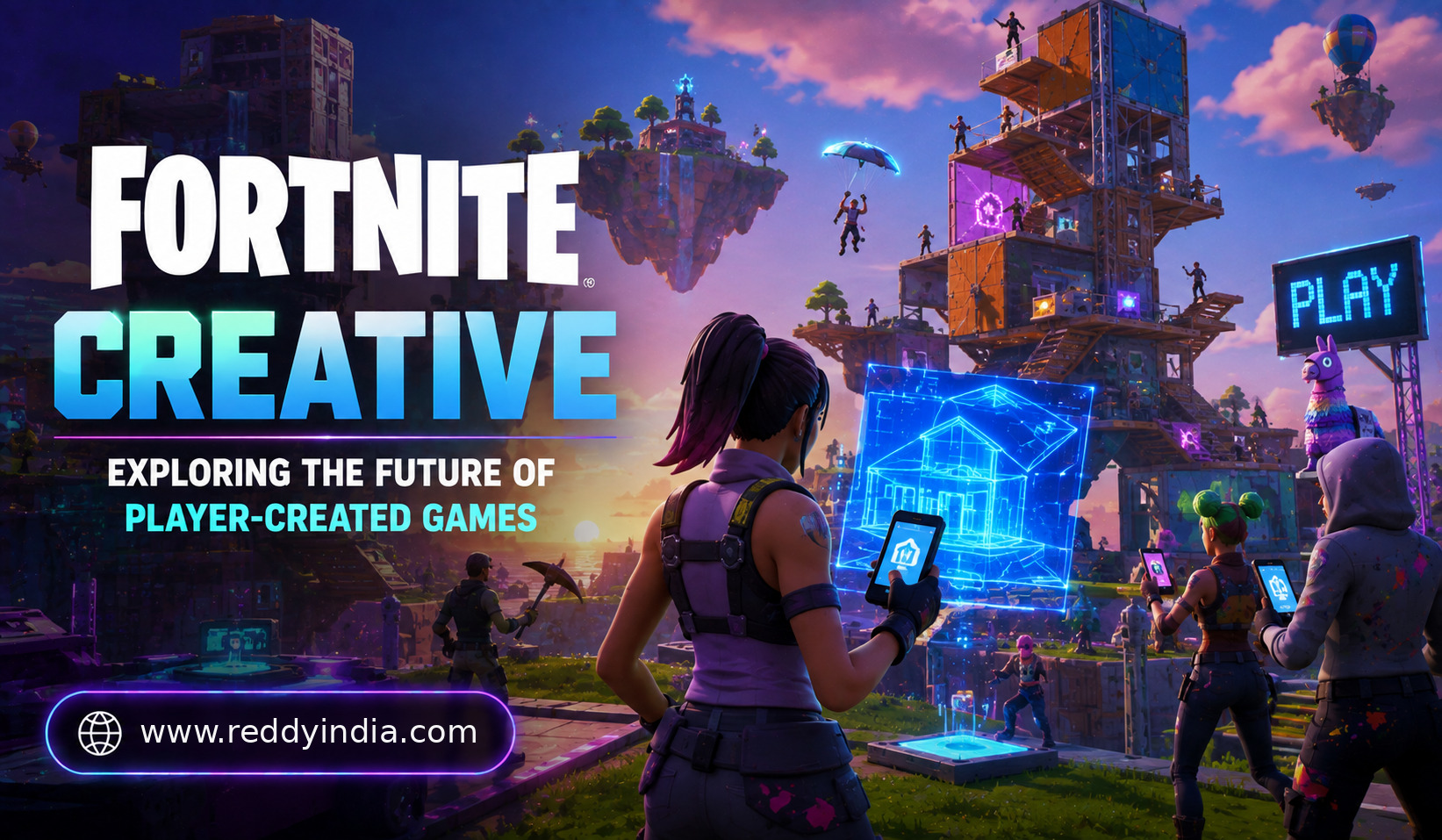
Fortnite Creative: Exploring the Future of Player-Created Games
Fortnite has changed from a single battle royale title into a massive platform for playing, creating, and sharing interactive experiences. One of the biggest reasons for that transformation is Fortnite Creative and Unreal Editor for Fortnite (UEFN), tools that allow players and developers to build their own games inside the Fortnite ecosystem.
What began as a relatively simple creative mode has evolved into a much more powerful development environment. Creators can now build racing games, role-playing adventures, horror experiences, social spaces, combat arenas, survival games, and experimental projects that look increasingly different from traditional Fortnite gameplay.
That evolution raises an important question: what could the future of player-created games look like?
With more powerful development tools, Verse scripting, advanced environments, custom gameplay systems, and growing AI capabilities, Fortnite Creative could become one of the most important platforms for user-generated gaming.
From Creative Mode to a Game-Development Platform
Fortnite Creative originally gave players a relatively accessible way to build their own islands using Fortnite assets and devices.
Over time, Epic Games expanded those capabilities.
UEFN brought many professional game-development tools into the Fortnite ecosystem, allowing creators to work with advanced environments, scripting, animation, cinematics, and other systems.
This distinction is important.
Fortnite Creative is designed to make creation accessible within the game, while UEFN gives more advanced creators a development environment that provides considerably more control.
Together, they have helped transform Fortnite from a game into a platform.
Creators Can Build Completely Different Experiences
The most exciting feature of Fortnite Creative is that creators are not limited to copying the standard Battle Royale formula.
A creator can build a horror game where players escape a monster.
Another can create a racing experience.
Someone else can develop a role-playing world with shops, quests, characters, and social systems.
There can also be puzzle games, platformers, survival experiences, competitive arenas, and experimental projects.
Epic’s ongoing ecosystem updates continue adding new devices, templates, assets, and gameplay systems designed to expand what creators can build. For example, the v32.00 update introduced the Skilled Interaction and Conversation devices, specifically aimed at narrative and role-playing experiences.
This variety is what gives the platform long-term potential.
UEFN Brings More Professional Tools
UEFN has increasingly blurred the line between a traditional game engine and a user-generated content platform.
Creators can use advanced world-building tools, Unreal Engine workflows, Verse programming, custom assets, animations, and gameplay systems.
Epic’s release history shows how frequently these tools are expanding. The UEFN ecosystem received multiple major updates throughout 2026, including releases in June, July, and August.
The result is a platform where small teams can attempt projects that would previously have required specialized development environments.
That could make Fortnite increasingly attractive to aspiring game developers.
Verse Gives Creators More Control
One of the biggest developments is Verse, Epic’s programming language for creating gameplay logic in Fortnite.
Visual devices make it possible for beginners to build basic systems without traditional programming. Verse allows more experienced creators to create complex interactions and custom mechanics.
This combination is important because it supports different levels of expertise.
A beginner can start by connecting devices.
An intermediate creator can combine those devices into larger systems.
An experienced developer can use Verse to build more sophisticated gameplay.
That creates a gradual path from experimentation to serious game development.
AI Could Change How Fortnite Games Are Created
Artificial intelligence may become one of the biggest influences on the future of Fortnite Creative.
The August 20, 2026 UEFN update introduced Unreal MCP, an integration that allows agentic coding tools such as Claude Code, Codex, and Cursor to connect directly to UEFN. Epic says the integration is intended to reduce technical friction and help creators build and iterate faster.
This could significantly change the development process.
Instead of writing every piece of code manually, a creator could describe a mechanic and use an AI-assisted development workflow to help generate or modify the implementation.
For example, a creator might want to build a checkpoint system, inventory mechanic, or enemy behavior. AI could help produce an initial implementation, which the creator could then test and refine.
Human creativity would remain important, but the technical barrier could become smaller.
AI NPCs Could Make Player-Created Worlds Feel Alive
AI can also change what players experience inside Creative islands.
Epic has been developing LLM-powered conversations that let creators build characters with customized personas and more flexible interactions.
This could allow a player-created role-playing game to feature NPCs that respond to natural language instead of relying entirely on traditional dialogue trees.
Imagine entering a fantasy village created by a Fortnite developer.
A blacksmith might explain its history.
A guard could question the player.
A merchant could answer unusual questions.
A quest character could react differently depending on how the player approaches the conversation.
These systems can make user-created worlds feel considerably more immersive.
Epic’s 41.20 update also introduced consistent voices and personas for 36 Fortnite characters in LLM conversations, showing that conversational AI is becoming an increasingly integrated part of the ecosystem.
More Dynamic Storytelling
AI-powered characters could also change how creators design stories.
Traditional game quests require developers to write many possible dialogue branches in advance.
AI can potentially handle a wider range of player questions while remaining within a character’s defined personality and role.
That means a creator could design a mystery game where players interrogate suspects in their own words rather than selecting one of three scripted questions.
The AI could respond to the player’s approach while structured game logic determines what information can actually be revealed.
This could make player-created story games much more flexible.
Procedural Systems Can Expand World Design
AI is not the only technology changing Fortnite creation.
Procedural systems can help creators generate environments, buildings, layouts, and other content.
Epic has already published examples and templates focused on procedural building systems inside UEFN. Its ecosystem updates have also included realistic environments, customizable characters, and other tools intended to help creators produce more sophisticated islands.
Procedural techniques are especially useful for large worlds.
Instead of manually constructing every building or landscape element, creators can establish rules that generate variations automatically.
Combining those systems with AI could eventually lead to worlds that are both procedurally generated and responsive to player behavior.
Player-Created Games Could Become More Like Full Games
As tools improve, the distinction between “Fortnite island” and “independent game” may become increasingly difficult to define.
A creator could build:
A complete campaign.
A multiplayer progression system.
Custom economies.
Complex NPC interactions.
Cinematic storytelling.
Unique movement mechanics.
Persistent player progression.
At that point, the experience may feel less like a modified Fortnite map and more like a standalone game built within the Fortnite ecosystem.
This could become one of UEFN’s most important developments.
Better Templates Can Help New Creators
Not everyone wants to begin with a blank project.
Templates can provide a starting structure that creators can customize.
Epic has expanded templates for different types of experiences, including a village template for cozy social worlds and examples focused on racing and other genres.
This can reduce the intimidation factor for beginners.
A new developer can take an existing concept, understand how its systems work, modify it, and gradually learn more advanced techniques.
That approach could bring more people into game development.
More Powerful Tools Mean More Creative Freedom
One of the most important consequences of better creation technology is not necessarily higher graphical quality.
It is creative freedom.
When tools become easier to use, creators can spend more time thinking about ideas rather than struggling with technical limitations.
A designer might have an unusual concept for a multiplayer game that would have been too difficult to implement several years ago.
With UEFN, Verse, templates, AI-assisted workflows, and ready-made assets, that same concept may become achievable with a much smaller team.
This could lead to more experimentation across the platform.
The Creator Economy Encourages Innovation
Fortnite’s creator ecosystem is also connected to monetization.
Creators have opportunities to build audiences around their islands and participate in Fortnite’s creator economy.
This gives developers a financial reason to continue improving their experiences.
A successful island can attract returning players, which can encourage creators to release updates, fix problems, expand content, and experiment with new ideas.
The result is a development cycle that can look surprisingly similar to traditional game development.
The difference is that the creator may be an individual or a small independent team rather than a large studio.
Discovery Will Become Increasingly Important
More games also create a new challenge: discovery.
As the number of player-created experiences grows, it becomes harder for players to find the best ones.
A creator can build an excellent game and still struggle to attract an audience if players never encounter it.
That means discovery tools, recommendations, thumbnails, descriptions, ratings, community engagement, and social sharing will remain important parts of the ecosystem.
The future of Fortnite Creative will therefore depend not only on better creation tools but also on helping players find experiences they will actually enjoy.
The Biggest Challenge: Quality
AI and faster development tools can make creating a game easier, but they do not automatically make the result good.
A creator can generate a large environment quickly, but players still need a reason to explore it.
An AI-powered NPC can talk endlessly, but the conversation still needs to be interesting.
A sophisticated gameplay system can exist without being fun.
That is why human game design remains essential.
The best player-created games will likely use AI and advanced tools as creative assistants rather than relying on them to make every decision.
Safety and Moderation Will Matter
A larger creator ecosystem also creates greater moderation challenges.
When millions of people can create content, platforms need systems to identify inappropriate material, protect users, and enforce content standards.
This becomes particularly important with AI-generated dialogue and content because responses can be dynamic rather than completely scripted.
Epic has continued developing rules and technical systems for creator-made content, while features involving AI conversations include additional safety and content considerations.
As player-created worlds become more sophisticated, moderation will need to become equally sophisticated.
The Future Could Be AI-Assisted Game Development
The combination of UEFN and agentic coding tools is particularly interesting because it points toward a broader change in how games may be made.
In the past, building a game often required separate programmers, artists, designers, technical artists, writers, and level designers.
In the future, a smaller team could potentially use AI-assisted workflows to handle more of those tasks.
That does not mean AI replaces developers.
Instead, one person may be able to accomplish what previously required a much larger team.
This could result in more experimental games being created and released.
Fortnite Could Become a Gateway Into Game Development
One of the most promising aspects of Fortnite Creative is its ability to introduce game development to people who might never have considered becoming developers.
A player can begin by modifying an existing island.
Then they might learn devices.
Next they can explore Verse.
Eventually, they may start creating original projects.
That progression can turn gaming into a pathway toward programming, 3D design, level design, storytelling, animation, and other creative skills.
The platform therefore has educational potential as well as entertainment value.
What the Future of Player-Created Games Could Look Like
The next generation of Fortnite Creative experiences could combine several technologies at once.
Imagine a player-created RPG with:
A procedurally generated world.
AI-powered NPC conversations.
Persistent character relationships.
Custom combat systems.
Dynamic quests.
AI-assisted development.
Advanced cinematics.
Such an experience would be difficult to classify as simply a “Creative map.”
It would be a complete interactive world.
And the most interesting part is that it could be created by a very small team.
Conclusion
Fortnite Creative has evolved from a simple building tool into a serious platform for player-created games.
UEFN has given creators increasingly powerful development capabilities, while Verse provides deeper control over gameplay systems. Epic’s continued updates are expanding the ecosystem with new templates, devices, animation tools, interactive systems, and advanced development workflows.
The introduction of agentic coding support through Unreal MCP could be particularly important because it may reduce the technical barriers facing creators. At the same time, AI-powered conversations and increasingly sophisticated NPC systems can make the experiences players build more interactive and responsive.
The future of Fortnite Creative is therefore not simply about bigger maps or prettier graphics.
It is about giving more people the ability to build complete interactive worlds.
As AI, procedural generation, scripting, and professional development tools become more accessible, the line between player and developer may continue to disappear.
The next major game-changing Fortnite experience may not come from a traditional studio.
It could come from a player who started with an idea, opened UEFN, and decided to build it.