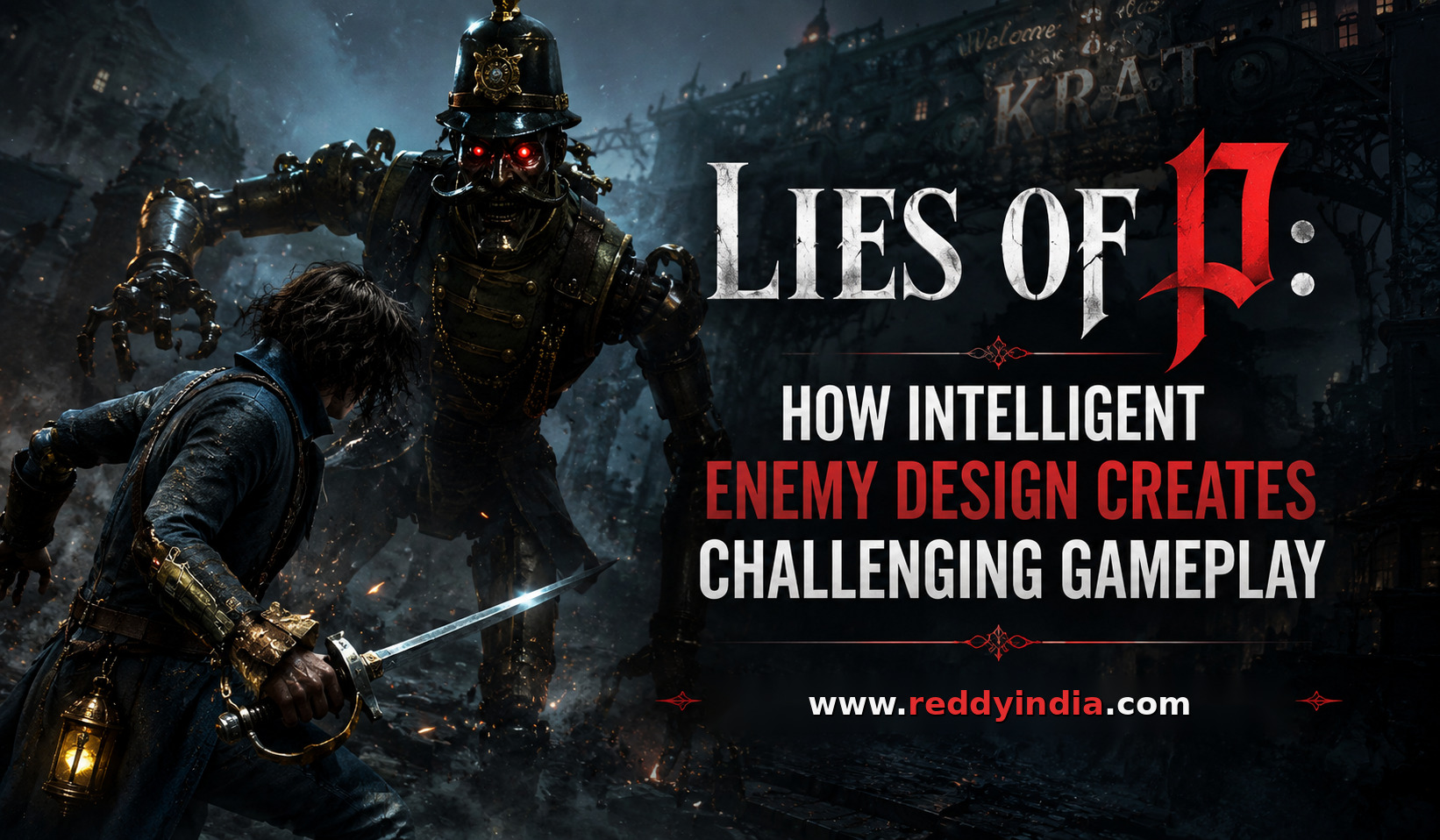
Lies of P: How Intelligent Enemy Design Creates Challenging Gameplay
Lies of P is one of the standout action RPGs of the modern Soulslike genre. Inspired by the classic story of Pinocchio, the game places players in the dark and dangerous city of Krat, where hostile machines, powerful bosses, and mysterious characters create a challenging adventure.
One of the reasons Lies of P feels difficult is not simply because enemies have high health or deal massive damage. Its challenge comes from carefully designed enemy behavior, attack patterns, positioning, timing, and encounters that force players to learn and adapt.
This type of intelligent enemy design plays an important role in making challenging games enjoyable. Enemies need to create pressure without feeling completely unfair. They should encourage players to observe patterns, understand weaknesses, improve their timing, and make better decisions.
Lies of P demonstrates how thoughtful enemy design can turn combat into a learning experience rather than simply a test of reflexes.
Why Enemy Design Matters in Lies of P
In an action RPG, enemies are more than obstacles between the player and the next area. They are part of the game’s core learning system.
Every enemy encounter teaches players something.
A basic opponent might introduce an attack pattern. A larger enemy may teach players about spacing. A fast enemy can punish slow reactions, while an enemy with delayed attacks may force players to stop relying on instinctive dodging.
Lies of P constantly asks players to observe before attacking.
This makes combat feel deliberate. Players cannot always rely on repeatedly pressing attack buttons. Understanding what an enemy is about to do can be just as important as knowing which weapon to use.
Enemies Have Recognizable Patterns
One of the most important elements of enemy design is predictability.
That might sound strange in a difficult game, but players need to recognize patterns if they are expected to improve.
Lies of P gives many enemies attacks that can be learned through observation.
After fighting the same opponent several times, players can begin to recognize when an attack is coming, how far it reaches, and how long the recovery animation lasts.
This creates a satisfying learning cycle.
At first, an enemy may seem overwhelming. After several attempts, its behavior becomes familiar. Eventually, the player knows when to block, dodge, reposition, or counterattack.
The difficulty remains, but it becomes understandable.
Delayed Attacks Test Player Timing
One of the techniques used in Lies of P is delayed attack timing.
Some attacks do not happen immediately after the enemy begins its animation. This can cause players to dodge too early.
The result is a valuable lesson: animation recognition is not always enough. Players must also understand timing.
Delayed attacks are effective because they challenge automatic reactions.
A player who always dodges as soon as an enemy raises its weapon may repeatedly get hit. With practice, the player learns to wait slightly longer.
This makes combat more about controlled reactions than simple button pressing.
Perfect Guard Creates a Risk-and-Reward System
The Perfect Guard system is one of the defining elements of Lies of P’s combat.
Players can attempt to block an incoming attack at exactly the right moment. A successful Perfect Guard can provide significant combat advantages, while a poorly timed defense can leave the player vulnerable.
This system changes how enemies are designed.
Enemy attacks become opportunities as well as threats.
Instead of simply avoiding damage, players can learn enemy attack sequences and attempt to respond with precise defensive timing.
This gives experienced players a way to turn enemy aggression into an advantage.
Enemy Attacks Encourage Different Strategies
Good enemy design should prevent players from relying on one strategy for the entire game.
Lies of P achieves this by presenting opponents with different attack speeds, ranges, movements, and defensive characteristics.
A slow enemy might give players enough time to react but punish them heavily if they make a mistake.
A faster opponent could force players to stay alert and manage distance.
Some enemies can pressure the player from unusual angles, while others may require careful positioning before an attack can be safely attempted.
This variety keeps combat from becoming repetitive.
Enemy Placement Is Part of the Challenge
Enemy design is not only about individual opponents.
Where enemies are placed can completely change an encounter.
A single enemy in an open area may be manageable. The same enemy positioned near environmental hazards or alongside another opponent can create a much more dangerous situation.
Lies of P frequently uses level design and enemy placement together.
Players may enter a new area without immediately knowing what threats are nearby. Exploring carefully can therefore become an important part of survival.
This creates tension even before combat begins.
Bosses Take Enemy Design Further
Boss battles are where Lies of P’s enemy design philosophy becomes especially visible.
Bosses are built around distinctive attack patterns, phases, timing windows, and weaknesses.
Players cannot usually defeat a major boss simply by repeating the same attack.
Instead, they need to learn the boss.
A first attempt may be spent discovering attack ranges and movement patterns. Later attempts become opportunities to refine timing and identify openings.
This creates a sense of progression even when the player’s character is not becoming dramatically stronger.
The player becomes stronger through knowledge.
Boss Phases Prevent Repetition
Many challenging boss encounters become more complex as the fight continues.
A boss may introduce new attacks, change its movement, become more aggressive, or alter the rhythm of combat.
This prevents players from treating the entire battle as one repeated pattern.
The second phase effectively asks the player to learn again.
However, because players have already understood the basic mechanics during the first phase, they have the foundation necessary to adapt.
This is a good example of how difficulty can increase without becoming completely random.
Animation Helps Players Read Enemy Behavior
Animations are extremely important in a combat-focused game.
Players need visual information to determine what an enemy is about to do.
Weapon movement, body positioning, sound effects, and attack animations can all provide clues.
If these signals are consistent, players can gradually learn to recognize them.
This is essential for challenging gameplay because difficulty becomes frustrating when attacks feel impossible to anticipate.
Lies of P generally gives players enough visual information to understand attacks after sufficient practice.
Enemy Design Rewards Patience
One of the biggest lessons Lies of P teaches is patience.
New players may be tempted to attack whenever an enemy appears vulnerable. However, aggressive attacks can often leave the player exposed to a counterattack.
The safest approach is frequently to observe first.
Wait for the enemy to attack.
Understand its sequence.
Look for the recovery window.
Then respond.
This rhythm creates a combat style where successful players are rewarded for reading situations rather than simply attacking faster.
Different Weapons Change Enemy Encounters
Weapon variety also affects enemy design.
Different weapons have different ranges, speeds, animations, and damage characteristics.
An enemy that is difficult to fight with a slow weapon might be easier to manage with a faster one.
This adds another strategic layer.
Players are not only learning enemies. They are also learning how their chosen equipment interacts with those enemies.
This encourages experimentation and makes combat more flexible.
Difficulty Feels Better When Players Can Improve
The most effective challenging games create a clear connection between failure and improvement.
Lies of P follows this philosophy.
When players die, they can often identify what went wrong.
Maybe they attacked too aggressively.
Maybe they dodged too early.
Maybe they failed to recognize an attack.
Maybe they used the wrong positioning.
This is important because players can take that knowledge into the next attempt.
The game becomes a cycle of experimentation, failure, learning, and success.
Intelligent Enemy Design Is Not the Same as Advanced AI
It is important to distinguish between enemy design and artificial intelligence.
An enemy does not necessarily need machine learning to feel intelligent.
Developers can create convincing behavior using carefully designed animations, attack patterns, state systems, movement rules, and scripted reactions.
Lies of P demonstrates that smart design can sometimes be more important than extremely complicated AI.
The enemy feels intelligent because its behavior creates meaningful decisions for the player.
How Lies of P Balances Challenge and Fairness
Difficulty alone does not make combat satisfying.
If enemies were completely unpredictable, extremely fast, or capable of unavoidable attacks, the game would feel unfair rather than challenging.
The best encounters give players tools to respond.
Players can learn patterns, block attacks, dodge, use Perfect Guard mechanics, change equipment, manage resources, and improve their timing.
That balance is what makes difficult encounters rewarding.
The player may lose repeatedly, but each attempt provides information that can eventually lead to success.
What Other Games Can Learn From Lies of P
Lies of P offers several useful lessons for action game design.
First, enemies should communicate their intentions clearly enough for players to learn them.
Second, different opponents should encourage different responses.
Third, difficulty should come from meaningful decisions rather than artificial advantages.
Finally, players should have opportunities to improve through observation and practice.
These principles can be applied to many genres beyond Soulslike games.
The Future of Enemy Design
Future games may combine traditional enemy design with more advanced AI systems.
Enemies could potentially adapt their strategies to player behavior, remember repeated tactics, or change their approach based on previous encounters.
However, developers would need to be careful.
If enemies learn too quickly or become unpredictable, players could lose the sense that combat is understandable.
The best future systems may combine adaptive AI with carefully designed boundaries.
This could allow enemies to respond dynamically while still giving players enough information to learn and improve.
Conclusion
Lies of P shows how intelligent enemy design can create challenging gameplay without relying entirely on extreme difficulty.
Its enemies use recognizable patterns, varied attacks, deliberate timing, positioning, and strong visual cues to encourage players to observe and adapt.
Boss battles take these ideas even further by combining multiple phases, changing attack patterns, and demanding precise reactions.
The result is a combat system where failure can become part of the learning process.
As game technology develops, artificial intelligence may eventually make enemies more adaptive. But Lies of P demonstrates an important principle: an enemy does not need to be powered by the most advanced AI to feel intelligent.
Sometimes, the smartest enemy design is simply the kind that teaches players how to become better at the game.