PUBG AI Features: How Technology Is Changing Battle Royale
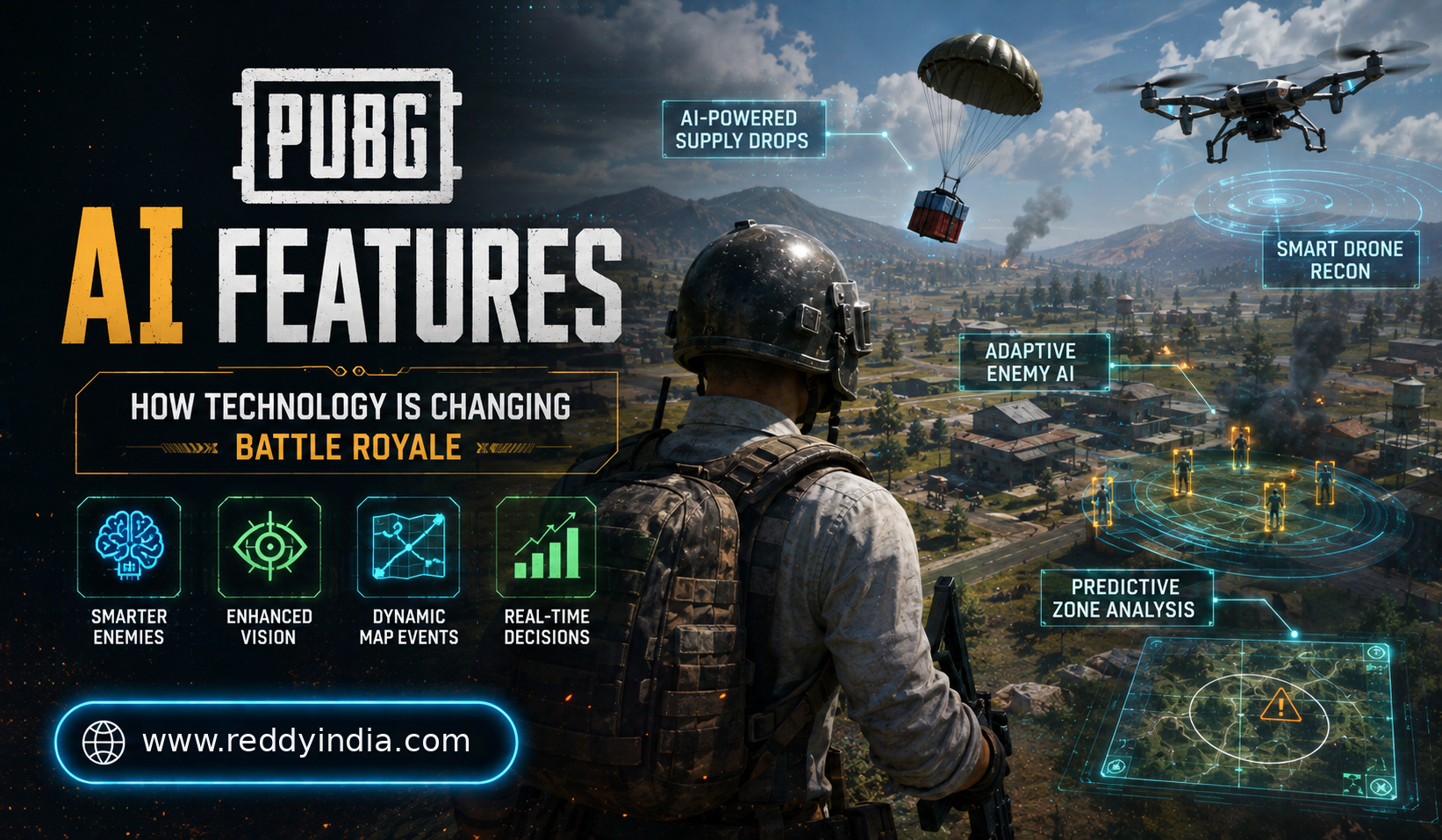
Artificial intelligence is beginning to change how video games are played, and PUBG: BATTLEGROUNDS is becoming one of the most interesting examples. Battle royale games have traditionally relied on human teammates, scripted bots, and predefined gameplay systems. Now, AI is being used to create a new type of teammate that can communicate, understand game situations, make decisions, and act alongside players.
The clearest example is PUBG Ally, an AI-powered “Co-Playable Character” developed by KRAFTON with NVIDIA ACE. Unlike a conventional NPC that follows a fixed set of commands, Ally is designed to understand natural voice instructions, react to the live match, cooperate with players, and remember information across sessions.
This technology could eventually change more than just PUBG. It could influence how battle royale games approach teamwork, communication, training, accessibility, and player interaction.
What Is PUBG Ally?
PUBG Ally is an AI teammate created specifically for PUBG: BATTLEGROUNDS.
KRAFTON developed the system using NVIDIA ACE technologies, combining automatic speech recognition, a small language model, text-to-speech, and game-specific systems. The goal is to create a companion that behaves more like a human squadmate than a traditional bot.
Players can communicate naturally using their voice. Ally can interpret what the player says while also considering information from the current match.
For example, it can understand requests related to looting, movement, combat, and cooperation. It can also respond to events happening during the match rather than waiting for a fixed scripted trigger.
That makes communication part of gameplay rather than simply an interface feature.
Natural Voice Communication Changes Teamwork
Communication is one of the most important parts of PUBG.
Squad members need to discuss enemy positions, weapons, safe-zone movement, resources, and tactical decisions. Human teammates can do this naturally, but playing with random players can sometimes make communication difficult.
An AI teammate offers another option.
PUBG Ally uses automatic speech recognition to convert spoken instructions into information the AI can process. It can then generate a spoken response through text-to-speech. KRAFTON designed the system to support English, Korean, and Chinese communication.
This could make AI teammates particularly useful for players who want team-based gameplay without depending entirely on human squadmates.
AI Can Understand the Game Situation
A major difference between PUBG Ally and a conventional bot is contextual awareness.
The system receives information about the live game state through observation tools. These tools can provide details about things such as the player’s health, weapons, ammunition, nearby items, and combat conditions.
This allows Ally to base decisions on current information.
For example, if a player asks for assistance while low on health, the AI can consider the situation before responding. If the team is in combat, it can adjust its behavior accordingly.
The important point is that the AI is not simply reacting to a sentence.
It is combining the player’s request with information about what is actually happening inside the game.
Fast Actions and AI Reasoning Work Together
Real-time battle royale games cannot afford long delays.
If an enemy suddenly appears, a teammate needs to react immediately. Waiting for a language model to finish generating a response before moving or aiming would make the AI ineffective.
KRAFTON addresses this by separating fast gameplay actions from slower language-based reasoning.
A behavior-tree system handles rapid reactions such as movement, aiming, and immediate combat actions. The language model handles more deliberate tasks, including interpreting player intent and coordinating decisions.
This is similar to having two levels of decision-making.
One layer reacts quickly.
The other thinks more deliberately.
That combination helps the AI remain useful during intense combat while still supporting natural conversation.
Why On-Device AI Matters
Another important PUBG AI feature is that Ally is designed to run on the player’s device rather than relying entirely on a remote cloud service.
KRAFTON chose a compact 2-billion-parameter language model for the system and optimized it for local execution. According to the company’s technical explanation, the model can run within the available graphics memory of systems with as little as 8GB of total VRAM.
There is an obvious benefit to this approach: lower latency.
Cloud-based AI can introduce network delays between the player’s request and the generated response. In a competitive shooter, even a small delay can make conversation feel unnatural.
Local AI can provide more predictable response times.
It also opens the possibility of integrating AI more deeply into games without sending every interaction to an external server.
AI Teammates Can Help With Looting
Loot management is an important part of PUBG.
Players need to find weapons, ammunition, armor, attachments, healing items, and other supplies while managing limited inventory space.
AI teammates could reduce some of this workload.
KRAFTON describes PUBG Ally as capable of strategic cooperation that includes looting and sharing items.
A player could therefore potentially ask the AI to look for a particular item or help collect resources.
That creates a more cooperative experience.
Instead of having a bot that simply follows the player, the AI can contribute to the team’s resource-management strategy.
AI Can Adapt During Combat
Battle royale matches are unpredictable.
A squad may be looting one moment and fighting another. A safe-zone shift can force an immediate rotation. A nearby enemy team may change the entire situation.
An AI teammate needs to adapt to these changes.
KRAFTON describes Ally as being able to cooperate and adapt based on combat and looting situations while communicating naturally with the player.
This could make AI companions much more useful than traditional game bots.
A conventional bot may follow simple rules.
An adaptive AI teammate can potentially evaluate the current situation and change its behavior.
Long-Term Memory Could Personalize Matches
One of the most interesting developments is AI memory.
KRAFTON demonstrated long-term memory for PUBG Ally in 2026, allowing the companion to remember certain information about players across matches. This can include details such as a player’s name, preferred weapons, favorite drop locations, and notable moments from previous games.
That changes the relationship between player and AI.
Imagine telling your teammate that you prefer a particular rifle during one match. In a later session, the AI could remember that preference.
The companion starts to feel less like a temporary bot and more like a continuing squadmate.
Memory could become one of the most important AI features in future multiplayer games because it allows relationships and preferences to persist.
Short-Term Memory Helps During a Match
Long-term memory is only one part of the system.
AI teammates also need short-term memory to understand the immediate context.
KRAFTON explains that PUBG Ally maintains short-term context for recent player speech and events occurring during the current match.
This helps the AI follow a conversation.
For example, if the player asks for a specific weapon and later asks where it was found, the AI needs enough context to understand the connection.
Without short-term memory, natural conversation would quickly become difficult.
AI Could Help Solo Players Experience Squad Gameplay
One major benefit of AI teammates is accessibility.
Not every player has a regular group of friends available to play.
An AI teammate can provide some of the benefits of squad gameplay without requiring another human player.
This could be particularly useful for casual players who want cooperative experiences but do not want to depend on matchmaking.
Instead of playing entirely alone, a player can have a digital partner that communicates, loots, fights, and assists with objectives.
That could make battle royale games more welcoming to different types of players.
AI Could Become a Training Partner
AI teammates can also have educational value.
New PUBG players have to learn many systems at once.
They need to understand weapons, movement, looting, positioning, rotations, combat, and communication.
An AI teammate could help players practice these skills in a less stressful environment.
For example, a beginner could ask the AI where to move, which weapon to use, or how to prepare for an approaching enemy team.
Instead of simply watching tutorials, players could learn while participating in an actual match environment.
AI Could Change How Battle Royale Bots Work
Traditional bots are often designed to fill matches, provide opponents, or support basic gameplay.
AI agents could eventually make bots much more sophisticated.
An AI-controlled teammate could have a personality, memory, preferences, and strategic goals.
AI-controlled opponents could potentially learn common player strategies and change their behavior.
This creates the possibility of a battle royale where both teammates and opponents become more dynamic.
However, balancing this technology would be extremely important.
An AI that is too weak would be frustrating.
An AI that is too strong could make matches feel unfair.
The goal should be to create useful and believable behavior rather than perfect performance.
AI Could Make Every Match More Personalized
Personalization is another major opportunity.
Different players have different preferences.
One person might enjoy aggressive combat.
Another may prefer careful rotations and long-range weapons.
Someone else may enjoy exploring and collecting resources.
An AI teammate that remembers these preferences can potentially adjust its behavior to match the player.
KRAFTON’s memory demonstrations suggest that this type of personalization is already being explored with PUBG Ally.
Over time, the same AI companion could behave differently with different players.
That creates a more individual experience.
Multilingual Communication Expands Accessibility
KRAFTON has designed PUBG Ally to support English, Korean, and Chinese. The company says language-specific data and expert reviews were used to help the system understand the short commands, slang, item names, map callouts, and other communication patterns used by PUBG players.
This is important because gaming communication is often different from normal conversation.
Players use abbreviations, map names, weapon names, and short tactical instructions.
An AI teammate that only understands formal language would not be especially useful during fast gameplay.
Better multilingual support could therefore make AI teammates more practical for an international game such as PUBG.
AI Doesn’t Replace Traditional Game AI
An important point is that generative or language-based AI does not need to replace traditional game systems.
In fact, PUBG Ally demonstrates why the two approaches can work together.
Traditional behavior systems are excellent for fast, deterministic actions.
Language models are useful for interpreting instructions, reasoning about context, and generating natural conversation.
Combining them gives developers greater flexibility.
This hybrid approach is likely to become common across future games.
Challenges of AI-Powered PUBG Features
AI integration also creates several challenges.
Latency is one of the biggest.
KRAFTON says that early cloud-based approaches introduced network and inference delays that made conversations feel too slow for live squad communication. This was one of the reasons the team moved toward a small on-device model.
Another issue is accuracy.
An AI teammate must remain grounded in the actual game state. It cannot confidently tell a player that an item exists nearby when the game engine says otherwise.
KRAFTON addresses this by allowing the agent to retrieve authoritative information from the game engine through observation tools.
There are also hardware requirements, memory considerations, moderation questions, and the challenge of making the AI useful without making it overly powerful.
The Future of AI in PUBG
PUBG Ally could be an early example of a much broader transformation.
Future AI systems could support more complex teamwork, longer-term memory, personalized strategies, and more natural interaction.
An AI teammate could eventually remember a player’s preferred landing strategy, learn from previous matches, recognize recurring opponents, and help plan squad tactics.
Developers could also introduce AI-controlled companions into other game modes.
The possibilities extend beyond PUBG.
NVIDIA’s ACE platform now describes a broader ecosystem of AI-powered game characters, including teammates, assistants, enemies, and autonomous citizens.
This suggests that AI teammates are not simply a one-off experiment.
They could become a new category of game character.
How AI Could Change Battle Royale Gaming
The most important change may be that AI turns battle royale from a purely player-versus-player experience into a more interactive ecosystem.
Human players remain at the center, but intelligent companions can help them participate more deeply.
Players can communicate naturally.
AI can assist with resources.
Companions can react to changing situations.
Memory can personalize future matches.
And game systems can connect all of these features together.
That creates a different type of multiplayer experience—one where digital characters are capable of cooperation rather than simply following predefined scripts.
Conclusion
PUBG’s AI developments show how artificial intelligence could reshape battle royale gaming.
PUBG Ally combines voice recognition, an on-device language model, game-state awareness, text-to-speech, fast behavior systems, and long-term memory to create a digital teammate that can communicate and cooperate with players.
The technology could make PUBG more accessible to solo players, provide useful training opportunities, improve squad communication, and create more personalized matches.
More importantly, it points toward a larger change in gaming.
The future of battle royale may not be built only around smarter enemies, better graphics, or larger maps. It could also involve teammates that understand what players say, remember what they like, adapt to changing situations, and develop increasingly natural relationships with them.
AI will not necessarily replace human teammates.
Instead, it could create a new category of digital teammates that make multiplayer games more flexible, personal, and interactive.
For PUBG and the wider gaming industry, that could be one of the biggest changes to battle royale gameplay yet.