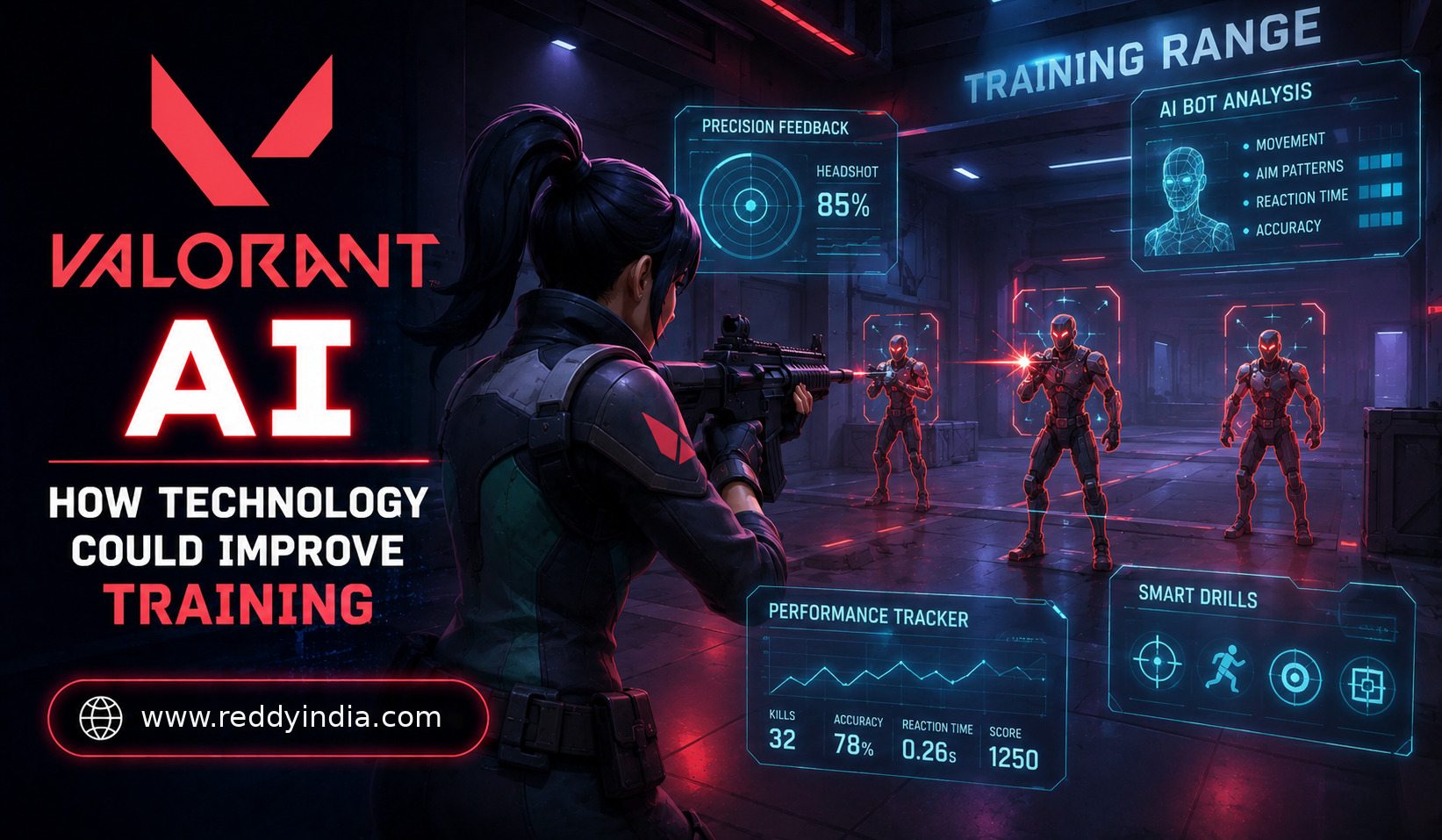
Valorant AI: How Technology Could Improve Training
Valorant has become one of the most competitive tactical shooters in the world, where success depends on much more than fast reflexes. Players need accurate aim, strong positioning, map awareness, communication, ability usage, decision-making, and the ability to adapt quickly.
Traditional practice methods can help players improve these skills, but they often require players to identify their own weaknesses. This is where Valorant AI could make a major difference. Artificial intelligence could analyze gameplay patterns, recognize mistakes, create personalized training exercises, and provide feedback based on an individual player’s performance.
Valorant already has several foundations that could support smarter training. Riot Games introduced Basic Training, a bot training match, and an updated practice experience, while the game’s Replay System now allows players to study their previous matches from different perspectives.
The next step could be combining these systems with AI to create a more personalized training environment.
What Is Valorant AI Training?
Valorant AI training refers to the use of artificial intelligence to help players practice and understand the game more effectively.
Instead of giving every player the same drills, an AI-powered system could study individual performance and determine what needs improvement. For example, one player might struggle with crosshair placement, while another may have excellent aim but frequently make poor decisions during retakes.
An AI coach could identify these differences and recommend specific exercises.
Rather than simply saying that a player needs to “improve aim,” an intelligent training system could provide a more detailed recommendation such as practicing short-range flicks, counter-strafing, head-level crosshair placement, or reaction-based scenarios.
This could make training more efficient, especially for players who have limited time.
AI Could Create Personalized Training Plans
One of the biggest advantages of AI is personalization.
Many players follow the same warm-up routine every day. While repetition has value, it may not address their most important weaknesses. AI could analyze statistics and gameplay footage before generating a training plan specifically for the player.
For example, an AI system might discover that a player:
- Loses many opening duels
- Frequently holds predictable angles
- Uses abilities too late
- Struggles during retake situations
- Has inconsistent crosshair placement
- Takes unnecessary fights after gaining an advantage
The system could then create a daily routine based on these weaknesses.
A player who struggles with aim might receive mechanical drills, while someone with strong mechanics but weak decision-making could receive more tactical scenarios.
This approach would turn training from a generic routine into a more targeted learning process.
AI-Powered Gameplay Analysis
Valorant’s Replay System gives players a much better way to review previous matches. Riot describes Replays as a tool for understanding what happened during a round or game, with features such as different player perspectives, third-person viewing, playback controls, and timeline markers for important events.
AI could make this system even more useful.
Instead of requiring players to watch an entire match manually, AI could scan a replay and identify important moments. It could highlight repeated deaths from similar positions, unnecessary peeks, poor rotations, missed utility opportunities, or situations where a player had a numerical advantage but failed to convert it.
Imagine finishing a competitive match and receiving a simple report:
“Your three most common mistakes were over-peeking after first contact, rotating too early, and using your defensive ability without information.”
That type of feedback could help players understand patterns that are difficult to notice themselves.
Smarter AI Bots Could Improve Practice
Bots are another area where AI could significantly improve Valorant training.
Basic bots can provide useful warm-up opportunities, but advanced AI opponents could behave more dynamically. Instead of repeatedly following predictable patterns, intelligent bots could change their positioning, aggression, movement, and decision-making based on the player’s actions.
For example, an AI opponent could learn that a player frequently swings wide and begin punishing that habit.
Another scenario could involve an AI teammate that behaves more realistically during site executes, retakes, rotations, and defensive setups.
This would allow solo players to practice situations that normally require a coordinated team.
Riot has already included an optional bot training match designed to help players apply the fundamentals they learn during basic training.
More sophisticated AI could take this concept much further.
AI Could Improve Aim Training
Aim remains one of the most important mechanical skills in Valorant, but improving it is not simply about shooting more targets.
AI could analyze a player’s aim patterns and determine exactly where the problem occurs. It might identify slow target acquisition, excessive mouse movement, poor tracking, inconsistent flicks, or crosshair placement problems.
The player could then receive drills designed around those weaknesses.
This idea already has a foundation in the Valorant ecosystem. Riot has worked with Aim Lab as an official training and coaching partner, with specialized exercises designed around skills such as flicking, wall peeking, holding angles, tracking, and trigger control.
AI could make these training systems even more adaptive by continuously changing difficulty according to player performance.
AI Could Teach Better Decision-Making
Mechanical skills are relatively easy to measure. Game sense is much harder.
A player can have excellent aim and still struggle to climb because of poor decisions.
AI could analyze situations involving positioning, rotations, economy, utility usage, timing, and risk management. It could compare a player’s decisions across hundreds of rounds and identify recurring habits.
For example, if a player consistently rotates too quickly whenever they hear one piece of utility, AI could identify this as a behavioral pattern.
It could then create scenarios designed to teach patience and information gathering.
Over time, this could help players understand not only what they did wrong but why the decision was ineffective.
AI Could Make Map Training More Effective
Learning maps is another major part of Valorant.
Players need to understand common angles, choke points, rotation routes, utility lineups, defensive positions, and likely enemy locations.
An AI training system could create map-specific scenarios based on the player’s preferred agents and role.
A controller player, for example, could receive exercises focused on smoke timing and site control. A sentinel could practice defensive setups and information gathering, while a duelist could receive entry-focused scenarios.
AI could also identify areas of a map where the player repeatedly dies and create drills around those locations.
This would make map knowledge more practical instead of simply memorizing layouts.
AI Coaching Could Help Players Understand Their Progress
Another potential advantage of Valorant AI is long-term progress tracking.
Instead of looking only at rank or kill-death ratios, an AI coach could monitor several areas of development over weeks or months.
A progress dashboard could track categories such as aim consistency, first-duel performance, positioning, ability efficiency, clutch decisions, and survival after gaining an advantage.
This would give players a broader picture of improvement.
For example, a player might remain at the same rank while significantly improving their mechanics and decision-making. AI could identify that progress even before it becomes obvious through rank changes.
Could AI Provide Real-Time Coaching?
Real-time AI coaching sounds exciting, but it also creates important competitive concerns.
An AI that tells a player exactly where an enemy might be, when to rotate, or where to aim during a live competitive match could provide an unfair advantage.
Riot’s developer documentation specifically distinguishes between training tools that help players learn through reflection and tools that provide immediate real-time performance advantages. Some live overlays that alter player behavior in the moment are not approved use cases.
Because of this, the most useful and fair form of Valorant AI coaching may happen before or after matches, rather than during them.
AI could teach players how to make better decisions without making those decisions for them.
The Future of Valorant AI Training
The future could combine replays, statistics, training bots, aim trainers, and AI coaching into one connected learning system.
A player might finish a match, and AI could automatically analyze the replay, identify three weaknesses, generate a 20-minute training session, and recommend a few tactical scenarios. After completing those exercises, the system could measure improvement and adjust the next session.
This would create a continuous training cycle:
Play → Analyze → Practice → Measure → Improve.
Such a system could benefit beginners who need structured guidance as well as experienced players looking for small improvements.
Conclusion
Valorant AI could change how players train by making practice more personalized, analytical, and efficient. Instead of relying entirely on generic drills or watching hours of gameplay, players could use AI to identify specific weaknesses and receive training designed around their individual performance.
Riot’s existing training features, replay technology, and partnership with Aim Lab show that technology already plays an important role in Valorant’s competitive development.
The biggest opportunity is not for AI to play the game for people. It is for AI to become a smarter learning assistant that helps players understand their mistakes, practice intelligently, and develop better habits.
If developed responsibly, AI-powered training could make improvement in Valorant less about endlessly grinding matches and more about understanding how to become a better player.