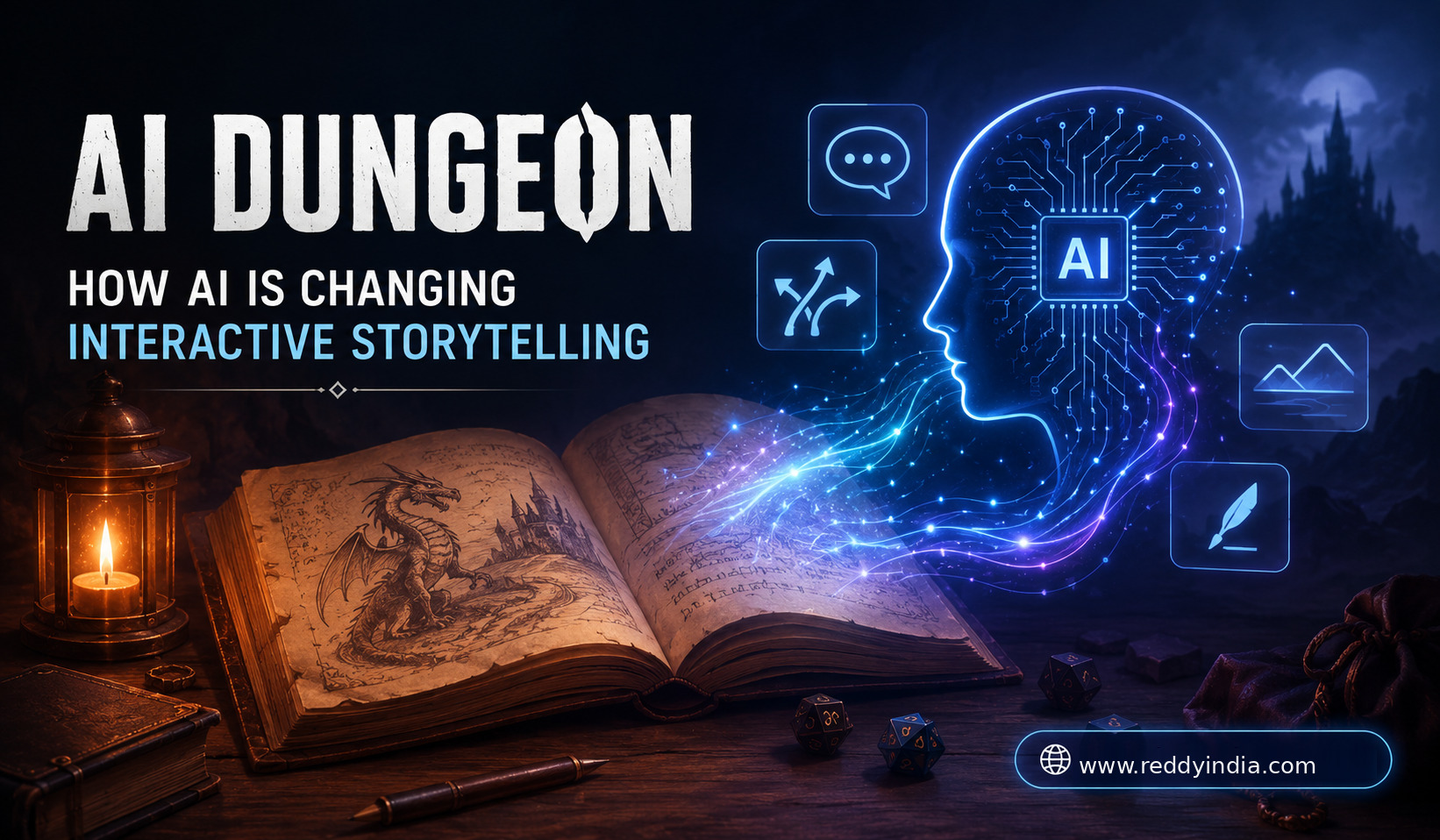
AI Dungeon: How AI Is Changing Interactive Storytelling
Interactive storytelling has always been about giving audiences more control over a story. Traditional books, movies, and even video games follow carefully designed paths, but artificial intelligence is opening the door to something much more flexible. With AI-powered platforms such as AI Dungeon, users can enter a fictional world, make decisions, create characters, and influence events in ways that can feel almost limitless.
Unlike conventional games where developers write most possible outcomes in advance, AI storytelling systems can generate new scenes based on what the player says or does. This creates a more unpredictable experience where the story can change from one moment to the next.
The rise of AI Dungeon reflects a larger shift in digital entertainment. Instead of simply consuming a story, people can now participate in its creation. This article explores how AI is transforming interactive storytelling, why AI Dungeon has become an interesting example of this technology, and what the future may look like.
What Is AI Dungeon?
AI Dungeon is an AI-powered interactive storytelling platform that allows users to play through stories using natural language. Instead of selecting only from predefined options, users can type actions, conversations, ideas, or instructions and allow the AI to continue the narrative.
For example, a player could write that their character enters an abandoned castle during a thunderstorm. The AI might respond with a mysterious hallway, a locked door, or a strange voice coming from another room. The player can then decide what happens next.
This creates a storytelling format based on interaction rather than fixed choices.
AI Dungeon can support different genres and scenarios, including fantasy, science fiction, adventure, mystery, comedy, and role-playing. Users can create original characters and situations or build stories around existing ideas.
The key difference is that the narrative is generated dynamically rather than following one predetermined storyline.
How AI Is Changing Interactive Storytelling
Artificial intelligence is changing storytelling in several important ways. The biggest change is the move from fixed narratives to responsive narratives.
In a traditional video game, developers may create hundreds or thousands of dialogue lines and possible events. Although the player has choices, those choices usually remain within boundaries established by the game.
AI-generated storytelling can expand those boundaries. The system can interpret a user’s language and generate an appropriate response, even when the player makes an unusual decision.
This means the player is not simply choosing between option A and option B. They can describe what they actually want to do.
For example, instead of selecting “attack the monster,” a player could type, “I distract the monster by throwing my sword into the river and then hide behind the ancient statue.” An AI system can attempt to incorporate that action into the story.
This creates a much stronger sense of freedom.
Personalized Stories for Every Player
One of the most exciting advantages of AI storytelling is personalization.
Traditional stories are generally designed to work for a broad audience. The central plot, characters, and ending remain mostly the same for everyone.
AI-powered storytelling can create a different experience for each player.
Two people might start with the same fantasy setting but end up with completely different stories because they make different decisions. One player might become a heroic warrior, while another could become a merchant, explorer, detective, or villain.
The AI can also adapt its responses to the user’s writing style and choices. As the story develops, characters and events can evolve around the player’s actions.
This makes interactive storytelling feel more personal and replayable.
AI Makes Improvisation Possible
Human storytellers have traditionally been responsible for improvising when players take a story in an unexpected direction. Tabletop role-playing games are a great example. A game master may have a planned adventure but must constantly react to players.
AI can automate part of this process.
An AI storytelling engine can generate dialogue, descriptions, conflicts, locations, and possible consequences in real time. Instead of preparing every scenario in advance, creators can establish a world and allow AI to help fill in the details.
This doesn’t necessarily replace human creativity. In many cases, it acts as a creative partner.
A writer might introduce a setting and characters while the AI generates alternative scenes. A player might provide the direction while the AI handles the narrative improvisation.
AI Dungeon and the Rise of AI Role-Playing
Role-playing is especially well suited to AI because the format depends heavily on conversation and decision-making.
In traditional role-playing games, players often interact with non-player characters through predefined dialogue. AI can make those interactions more dynamic by generating responses based on context.
Imagine talking to a fictional detective in a mystery story. Instead of choosing from three dialogue options, you could ask the detective your own questions. The AI can respond as the character and continue the conversation.
This makes fictional characters feel more interactive.
It also creates opportunities for stories that focus less on completing missions and more on exploring relationships, personalities, and unexpected conversations.
Why AI Storytelling Is So Engaging
The biggest attraction of AI-generated storytelling is uncertainty.
Readers generally know that a traditional novel will follow the author’s planned structure. Video game players may know that specific choices lead to predetermined outcomes.
AI-generated stories can feel different because even the creator may not know exactly what will happen next.
That uncertainty encourages experimentation.
Players may try strange decisions simply to see how the AI responds. They can test unusual ideas, create unexpected conflicts, or take the narrative in directions that would not normally be possible.
This turns storytelling into an ongoing experiment.
Another advantage is replayability. Since the story can respond differently to different decisions, players can return to the same concept and experience a completely different adventure.
The Role of Large Language Models
Modern AI storytelling relies heavily on large language models, or LLMs. These systems are trained to understand and generate human-like language.
When a player enters an action or dialogue, the AI analyzes the text and its available context before producing a response.
In a storytelling environment, this allows the system to generate descriptions, character dialogue, events, and narrative transitions.
However, generating a convincing story requires more than simply producing grammatically correct sentences. The AI must maintain context, understand character roles, and attempt to keep events consistent.
This is one of the major technical challenges of AI storytelling.
If a character suddenly forgets something important or a previously established fact changes without explanation, the illusion of the story can quickly disappear.
Challenges of AI-Generated Stories
Despite its potential, AI storytelling is not perfect.
One common challenge is consistency. Long stories can become difficult for AI systems to track. Characters may change personalities, locations may be described differently, or important plot details may be forgotten.
Another challenge is quality. AI can generate creative ideas, but some responses may feel repetitive, predictable, or disconnected from the narrative.
There are also concerns surrounding content moderation, copyright, privacy, and responsible use of AI-generated material.
Developers must balance creative freedom with appropriate safeguards, particularly when platforms allow users to generate stories without strict predefined boundaries.
AI Storytelling Is Not Replacing Human Writers
The growth of AI-generated stories does not necessarily mean traditional storytelling is disappearing.
Human writers remain essential because storytelling involves more than generating words. Writers understand themes, emotions, cultural context, symbolism, pacing, and long-term narrative structure.
AI is better viewed as a new creative tool.
A writer can use AI to brainstorm characters, explore alternative plot directions, experiment with dialogue, or develop interactive scenarios. Similarly, players can use AI to participate in stories rather than simply consume them.
The future may involve a combination of human creativity and machine-generated possibilities.
The Future of Interactive Storytelling
AI Dungeon represents only one step toward a larger transformation in digital storytelling.
Future AI storytelling platforms could create worlds that adapt continuously to individual users. Characters might remember previous interactions over much longer periods. Story environments could respond dynamically to player behavior. AI-generated voices, visuals, music, and animation could also be combined with text-based storytelling.
This could lead to entertainment experiences that feel less like traditional games and more like living fictional worlds.
Imagine entering a virtual universe where every character has an AI-generated personality and remembers your previous conversations. The story would not simply have multiple endings. It could continuously evolve around you.
That possibility makes AI one of the most important technologies influencing the future of interactive entertainment.
Conclusion
AI Dungeon demonstrates how artificial intelligence can transform storytelling from a fixed experience into a collaborative and unpredictable one. By allowing users to type actions, create scenarios, and influence events in real time, AI-powered platforms give players a greater role in shaping their own narratives.
The technology still has limitations, especially when it comes to consistency, quality, and responsible content generation. However, its potential is enormous.
As AI models become better at understanding context, emotion, and long-term narratives, interactive storytelling could become far more immersive. The future of stories may no longer be something audiences simply read or watch. Instead, they may enter those stories, shape them, and create something new every time they play.
For readers, gamers, writers, and creators, AI storytelling represents a fascinating new chapter in the evolution of entertainment.