Detroit: Become Human: How AI Shapes Interactive Storytelling
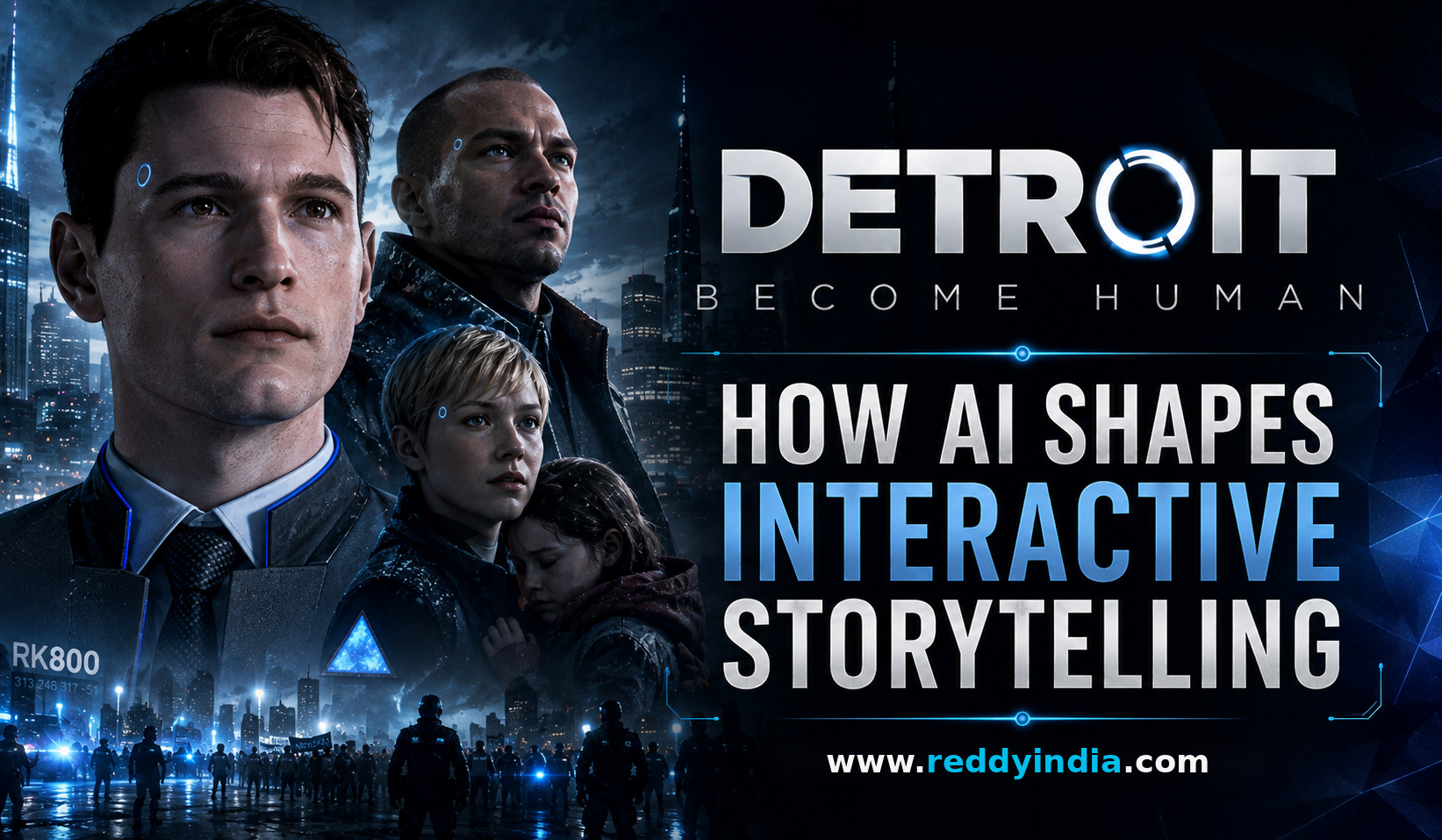
Detroit: Become Human is one of the most interesting examples of how artificial intelligence can become part of a game’s storytelling rather than simply functioning behind the scenes.
Developed by Quantic Dream, the narrative-driven adventure explores a future where highly advanced androids become part of everyday human life. Players control multiple android characters and make decisions that can dramatically affect relationships, events, and endings.
The game’s central idea revolves around artificial intelligence, but its most important contribution is how it connects AI with interactive storytelling.
Instead of simply watching a story unfold, players influence it. Their choices can change character relationships, determine who survives, unlock different scenes, and lead the narrative toward different outcomes.
This makes Detroit: Become Human an interesting case study in how games can use technology and player decisions to create personalized stories.
AI Is at the Center of the Story
The world of Detroit: Become Human is built around advanced androids designed to perform tasks for humans.
These machines can work in homes, assist businesses, provide security, and perform jobs that would traditionally require people.
At first, many androids appear to be highly sophisticated machines following their programming.
However, the story gradually explores what happens when these artificial beings begin demonstrating behavior that appears to go beyond their original instructions.
This creates the central conflict of the game.
The player is encouraged to question whether the androids are simply machines or something closer to conscious individuals.
Three Androids, Three Perspectives
The game follows three major playable characters: Connor, Markus, and Kara.
Each character provides a different perspective on artificial intelligence and human-machine relationships.
Connor is designed as an advanced android detective working with law enforcement. His storyline focuses heavily on investigation, obedience, logic, and the possibility of deviating from his programmed purpose.
Markus begins as a caretaker but becomes involved in a much larger social movement. His story explores leadership, freedom, and how androids respond to oppression.
Kara’s story focuses more heavily on family, protection, vulnerability, and the relationship between humans and androids.
Together, these perspectives allow the game to explore AI from several different angles.
Player Choices Drive the Story
The most important storytelling feature of Detroit: Become Human is its branching structure.
Players constantly make decisions that influence what happens next.
A conversation can affect a relationship. A failed investigation can change future events. A character can survive or die depending on earlier choices.
This means there is no single experience shared by every player.
Two people can play the same chapter and reach completely different outcomes.
That is one of the strengths of interactive storytelling.
The player becomes part of the narrative rather than simply observing it.
AI and the Idea of Free Will
One of the game’s biggest philosophical questions is whether an artificial intelligence can have free will.
The androids are created to follow instructions.
Yet the story repeatedly places them in situations where they appear to make independent decisions.
This raises difficult questions.
If an AI system makes a decision that was not explicitly programmed by its creator, does that mean it has free will?
If a machine can express fear, attachment, or sadness, should humans treat it differently?
The game does not provide simple answers.
Instead, it gives players situations and allows them to decide how they interpret them.
Interactive Storytelling Makes Ethics Personal
Detroit: Become Human is effective because it does not discuss ethical questions only through dialogue.
It forces players to make decisions themselves.
A player may understand that a particular action has moral consequences, but the situation can become much more difficult when they are responsible for choosing what happens.
This creates an emotional connection between the player and the story.
The player is not simply watching a character make a difficult decision.
They are making it.
That distinction is central to the game’s storytelling style.
The Game Uses AI as a Narrative Tool
Artificial intelligence is not simply a subject in Detroit: Become Human.
It is also a storytelling mechanism.
The androids’ programmed behavior provides the foundation for the game’s conflicts. Their ability to process information and respond to situations creates opportunities for different outcomes.
Connor’s investigative abilities, for example, allow players to examine crime scenes, collect evidence, reconstruct events, and make deductions.
The game uses the concept of artificial intelligence to justify mechanics that support the narrative.
This creates a stronger connection between gameplay and story.
Connor Shows the Relationship Between Logic and Emotion
Connor is particularly interesting because his character is built around the contrast between logic and emotion.
He is designed to investigate cases efficiently and follow his instructions.
However, his experiences can create situations where following orders conflicts with personal relationships or moral choices.
Players experience this conflict through gameplay.
The character’s development therefore becomes something the player participates in rather than something they simply watch.
Markus Explores AI and Social Change
Markus’s story focuses on larger social questions.
His journey explores how a group of artificial beings might respond when they believe they are being treated unfairly.
The player can influence how Markus approaches this conflict.
Different decisions can lead toward different forms of resistance, diplomacy, confrontation, or compromise.
This makes the player’s choices more significant than simple dialogue selections.
They can influence the direction of a broader social movement.
Kara Shows the Human Side of AI
Kara’s story approaches artificial intelligence from a more personal perspective.
Her relationship with Alice emphasizes protection, trust, and emotional attachment.
Instead of focusing primarily on political or philosophical questions, this storyline asks whether an artificial being can form meaningful emotional relationships.
It also challenges players to think about whether the origin of an emotion matters.
If a machine protects someone because it has been programmed to do so, does that make the feeling less meaningful?
The game leaves space for players to form their own interpretations.
The Flowchart System Shows Narrative Complexity
One of Detroit: Become Human’s most recognizable features is its flowchart system.
After completing a chapter, players can see the decisions and paths they discovered.
They can also see that many other possibilities remain unexplored.
This is an effective way of showing players how complex the narrative structure is.
Traditional games often hide branching possibilities. Detroit: Become Human makes them visible.
The flowchart reinforces the idea that every decision can lead to another possibility.
AI Could Make Future Stories Even More Dynamic
Detroit: Become Human uses carefully written branching narratives.
Future AI technology could potentially expand this concept.
Instead of developers writing every possible conversation manually, AI could help generate variations based on a player’s previous actions.
Characters might remember more interactions, adjust their behavior, or respond differently to the player’s choices.
A future narrative game could potentially combine scripted major events with AI-generated smaller interactions.
This could create worlds that feel more responsive without requiring developers to manually create thousands of dialogue variations.
AI Characters Could Develop More Complex Relationships
One potential application of AI in future storytelling is relationship modeling.
Characters could have multiple emotional or social variables that change based on player behavior.
A character might become more trusting after repeated positive interactions or more suspicious after the player breaks promises.
The relationship could develop gradually rather than changing after one dialogue choice.
This could make characters feel more believable.
However, developers would need to carefully control these systems to maintain narrative consistency.
Challenges of AI-Driven Storytelling
Using AI in interactive storytelling also presents challenges.
AI-generated dialogue can sometimes be inconsistent, repetitive, or emotionally inappropriate.
A character may suddenly behave in a way that does not fit their personality or the larger story.
There is also the challenge of maintaining narrative quality.
Professional writers carefully construct dialogue, pacing, character arcs, and emotional moments.
AI can assist with variation, but completely unrestricted generation could weaken the carefully designed storytelling that makes narrative games memorable.
The best approach may be combining AI assistance with strong human direction.
Detroit: Become Human and the Future of Narrative Games
The game demonstrates that interactive storytelling can make players feel responsible for fictional events.
Its characters are not simply waiting for the player to watch their stories.
They respond to player decisions.
That concept could become even more powerful as AI systems improve.
Future games could potentially feature characters that remember long-term relationships, adapt their dialogue, respond to unexpected situations, and develop more complex behavioral patterns.
This could make interactive stories feel less like branching movies and more like living narratives.
Why the Game Still Matters
Detroit: Become Human remains relevant because its central questions have become increasingly interesting as real-world AI develops.
Modern artificial intelligence can already generate text, recognize images, translate languages, assist with programming, and interact conversationally.
These systems are not equivalent to the conscious androids portrayed in the game, but they make the game’s questions easier to imagine.
What happens if AI becomes significantly more capable?
How should humans interact with increasingly advanced machines?
Can intelligence exist without consciousness?
These questions remain open to debate.
Conclusion
Detroit: Become Human demonstrates how AI can shape interactive storytelling by becoming both the subject of a narrative and a foundation for gameplay.
Its android characters allow players to explore questions about free will, identity, emotion, morality, and the relationship between humans and machines.
The game’s branching structure makes these themes more powerful because players are not simply watching decisions being made. They are making them.
As AI technology continues to advance, future games could take this concept even further with characters that remember interactions, adapt to player behavior, and participate in more dynamic stories.
Detroit: Become Human shows that the most interesting use of AI in gaming may not be creating smarter enemies or better graphics.
It may be creating characters and stories that make players question their own decisions.