Minecraft AI Mods: How Artificial Intelligence Can Enhance Gameplay
Minecraft has always been one of the most flexible games in the world. Players can build enormous cities, explore caves, fight monsters, automate farms, create redstone machines, and design entirely new ways to play. Mods have expanded that freedom even further by introducing new blocks, creatures, mechanics, dimensions, and gameplay systems.
Now, artificial intelligence is becoming another major area of Minecraft modding.
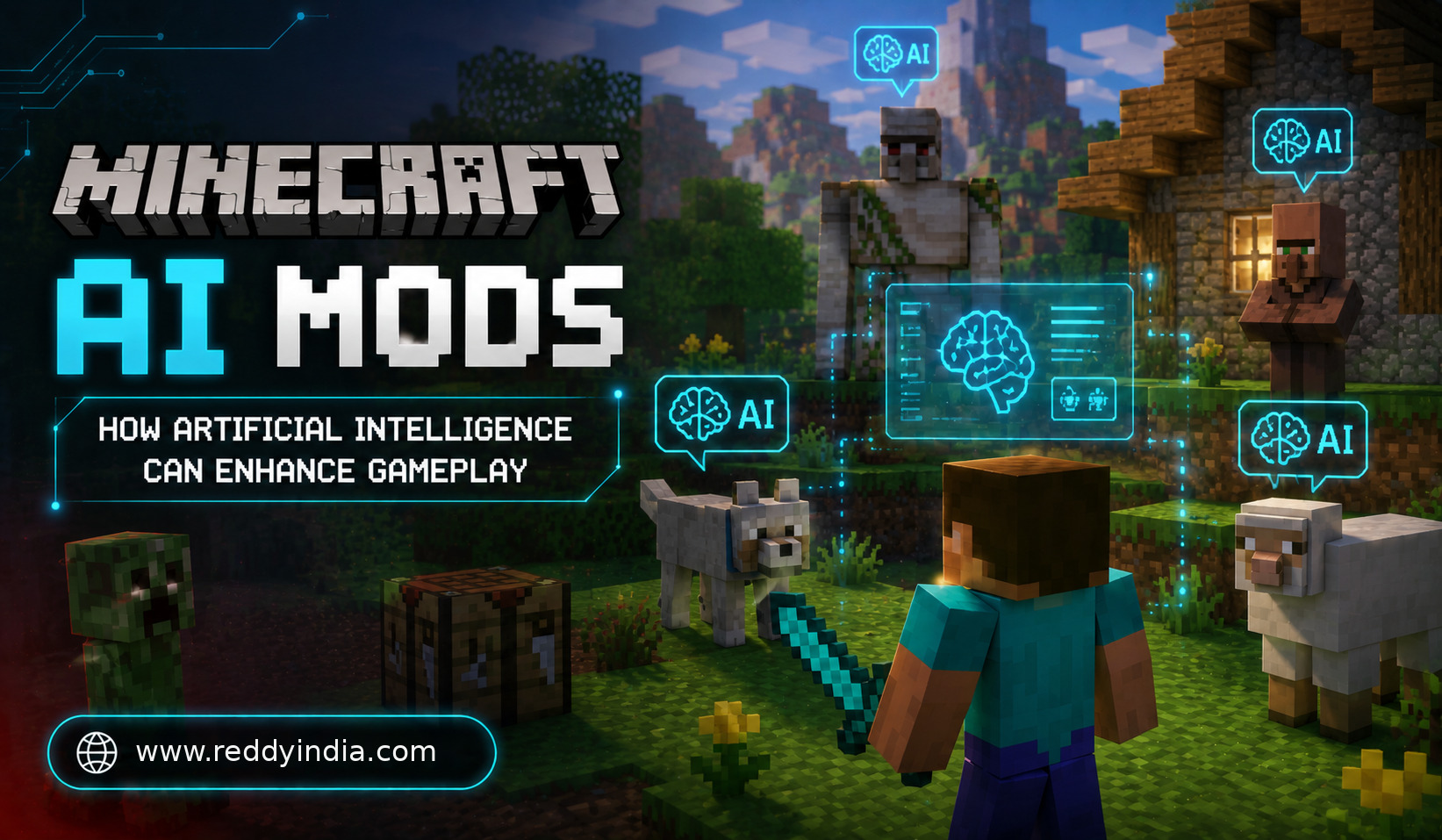
AI-powered Minecraft mods can introduce interactive companions, smarter NPCs, natural-language conversations, autonomous characters, and systems that allow virtual characters to perform tasks alongside the player. Current community projects already demonstrate companions that can gather resources, craft, build, fight, navigate, and respond to voice or text instructions.
This creates an interesting question: how could AI change the Minecraft experience?
The answer goes far beyond simply adding a chatbot to the game. AI could make Minecraft worlds feel more reactive, personalized, social, and unpredictable.
What Are Minecraft AI Mods?
Minecraft AI mods are modifications that use artificial intelligence to add new behaviors or interactions to the game.
Traditional mods normally rely on rules written by developers. An NPC may attack a particular mob, follow the player, or perform a specific task because the mod author programmed those actions.
AI-powered mods can add another layer by connecting game characters to large language models or other intelligent systems.
For example, the AI Companion mod offers an interactive AI character that can observe player behavior, react to movement, combat, building, exploration, and other activities, and communicate using voice.
Other projects go further. AI Companion Fabric describes an autonomous companion capable of navigation, gathering, crafting, building on request, and fighting alongside the player, with support for locally run models as well as hosted APIs.
These examples show how AI can become part of gameplay rather than simply an additional information tool.
AI Companions Can Become Digital Teammates
One of the most obvious applications is the AI companion.
Minecraft already has animals, villagers, and other entities that can accompany players in limited ways. An AI companion could make that relationship significantly more interactive.
Instead of simply following the player, a companion could understand instructions such as:
“Gather wood while I build the house.”
“Stay here and defend the entrance.”
“Help me find iron.”
“Come with me and explore the cave.”
Some current mods are already attempting versions of these features. Player2 AI NPC, for example, describes companions that can chop wood, mine ores, defend the player, respond to natural-language commands, and interact with the world.
This could make solo Minecraft feel more like cooperative play.
Natural-Language Commands Could Simplify Gameplay
Minecraft contains hundreds of items, crafting recipes, blocks, systems, and mechanics. New players can sometimes feel overwhelmed by how much there is to learn.
AI could make interaction more natural.
Instead of remembering a complicated command or searching through an external guide, players could simply ask an intelligent companion for help.
A player might ask:
“How do I make a shield?”
“Where should we build our base?”
“What materials do I need for this farm?”
“Can you help me prepare for the Nether?”
The AI could respond conversationally and, in more advanced systems, even perform some of the requested actions.
This creates a more accessible interface between the player and the game’s complex systems.
Smarter NPCs Could Transform Villages
Minecraft villages are useful, but their inhabitants have relatively structured behaviors.
AI could create more dynamic virtual communities.
Imagine villagers with individual personalities, goals, memories, and occupations. A farmer could discuss crop production, a blacksmith could recommend equipment, and a librarian could help the player find information.
Over time, villagers could remember the player’s actions.
Helping protect a settlement could improve relationships. Stealing resources might make certain characters distrust the player. Regular trading could make a merchant more familiar with a returning customer.
This would give Minecraft villages a stronger sense of identity.
The goal would not necessarily be to turn every villager into a completely autonomous human-like character. Even limited contextual behavior could make settlements feel much more alive.
AI Can Create More Dynamic Stories
Minecraft is naturally suited to emergent storytelling because players already create their own objectives.
AI could build on this strength by creating characters and events that respond to what players do.
For example, a player might discover a remote village and become its protector. An AI system could generate missions involving nearby threats, resource shortages, exploration, or relationships with other settlements.
The story could adapt according to the player’s decisions.
Choose to help one faction, and future events might change.
Ignore a problem, and it could become more serious.
This would make storytelling feel less like completing a fixed quest list and more like participating in an evolving world.
AI Could Act as a Building Assistant
Minecraft’s building system gives players tremendous creative freedom, but large projects can be difficult to plan.
An AI building assistant could help players turn ideas into practical plans.
A player could describe a project such as a medieval castle, futuristic laboratory, underground city, or coastal village. The AI could suggest materials, dimensions, layouts, and construction stages.
Advanced AI systems could potentially interact directly with the game world and build portions of a structure.
Some experimental Minecraft AI projects are already exploring agents that can build structures when instructed. AI Companion Fabric, for example, advertises building on request as one of its capabilities.
This could be especially helpful for players who enjoy the creative side of Minecraft but struggle with planning large-scale projects.
AI Could Improve Exploration
Exploration is one of Minecraft’s greatest strengths, but AI could make it more personalized.
An intelligent companion could understand what a player enjoys and adjust its recommendations.
A player interested in rare resources might receive suggestions about where to search.
Someone who enjoys discovering structures could receive exploration ideas.
A builder could receive recommendations for scenic locations.
AI could also help with navigation by remembering places the player has visited and suggesting routes.
Instead of simply giving directions, a companion could explain why a particular route is useful or warn the player about potential dangers.
That makes exploration feel more like an adventure with a knowledgeable partner.
AI Can Help With Resource Management
Minecraft involves constant resource decisions.
Players collect materials, organize inventories, maintain tools, gather food, and prepare for different environments.
An AI assistant could help manage some of that complexity.
For example, a player could ask what materials are missing for a planned project. The AI could inspect available resources, identify shortages, and help create a collection plan.
A more advanced companion could also gather resources itself.
Current AI companion projects are already experimenting with autonomous gathering and crafting.
This could save time while still leaving the player in control of the larger project.
AI Could Make Combat More Tactical
Combat is another area where intelligent companions could make a difference.
Instead of having a companion attack the nearest hostile mob, an AI character could potentially understand broader instructions.
A player might tell it to protect a specific area, attack only certain enemies, retreat when health is low, or stay behind while the player scouts ahead.
With better perception and planning, AI companions could become tactical partners.
They could notice threats, react to changing situations, and adjust their behavior instead of repeatedly using the same attack pattern.
That would make combat more strategic, especially during exploration or large-scale battles.
Local AI Can Offer More Privacy
Not every AI-powered mod requires a cloud service.
Some modern projects support local language models that run on the player’s own computer. AI Companion Fabric, for example, supports local setups using tools such as llama.cpp, Ollama, and LM Studio, alongside hosted OpenAI-compatible APIs.
Local AI can reduce dependence on external servers and may provide greater privacy because information does not necessarily need to leave the player’s machine.
However, local models also require sufficient hardware and may produce different levels of quality depending on the system being used.
For players interested in experimenting with AI mods, choosing between local and cloud-based processing can therefore be an important consideration.
AI Could Make Multiplayer Worlds More Interesting
AI does not have to be limited to single-player Minecraft.
Intelligent NPCs could potentially become part of multiplayer servers, helping manage communities, running shops, supporting players, or creating interactive quests.
Imagine a multiplayer town where AI characters operate businesses, provide information, and respond to the actions of players.
This could help server owners create more immersive role-playing environments without manually writing every interaction.
However, multiplayer AI introduces additional challenges involving server performance, moderation, security, and fairness.
Not every experimental AI mod is designed for public servers. Some current projects specifically warn that they are intended for single-player or trusted LAN environments rather than public multiplayer use.
AI Could Help Players Learn Minecraft
AI mods could also act as personalized teachers.
Instead of reading long guides, beginners could ask questions while playing.
A companion could explain crafting, farming, mining, enchantments, exploration strategies, or redstone concepts based on what the player is currently doing.
Because the advice can be contextual, it may be more useful than a generic tutorial.
For example, if a new player enters a cave without enough torches, the AI could recognize the situation and explain why lighting matters.
This could make Minecraft easier to learn without removing its depth.
AI Can Create More Personalized Worlds
One of the most exciting possibilities is personalization.
Different players enjoy Minecraft in completely different ways.
Some focus on building. Others explore, fight, farm, automate, or create elaborate role-playing stories.
An AI system could learn a player’s preferences and adjust its assistance accordingly.
A builder might get architecture suggestions.
An explorer could receive travel recommendations.
A survival-focused player might receive tactical advice.
A role-player might interact with characters that remember previous events.
Over time, the world could feel increasingly tailored to the person playing it.
AI Can Also Produce Unexpected Moments
Minecraft is already famous for unexpected situations, and AI can amplify that unpredictability.
An AI companion could misunderstand a harmless instruction, suggest an unusual strategy, discover something while exploring, or react humorously to a player’s actions.
Some current AI companion mods specifically focus on contextual reactions, allowing characters to comment on building, combat, exploration, and idle behavior.
These moments can make a playthrough feel personal because the player experiences interactions that are not completely predetermined.
The Technology Still Has Limitations
AI-powered Minecraft mods are exciting, but they are still developing rapidly.
AI characters can misunderstand instructions, make inefficient decisions, become repetitive, or behave unpredictably.
Performance can also become an issue, especially when AI processing is combined with Minecraft’s already demanding worlds.
Cloud-based systems may introduce latency or require API keys and paid services. For example, some current AI companion mods require an API key from a supported provider.
There are also important security and privacy considerations. Players should check where data is processed, whether conversations are sent to external services, and whether a mod is appropriate for multiplayer use.
That makes careful mod selection important.
The Future of Minecraft AI Mods
The current generation of AI mods may only be the beginning.
Future systems could combine language models with better world perception, memory, navigation, planning, and autonomous action.
An AI companion might remember an entire Minecraft adventure over months of gameplay. It could recognize old locations, understand long-term projects, manage resources, and develop a relationship with the player.
Entire villages could potentially become AI-driven communities.
Quest systems could generate stories based on what players build.
Creative assistants could turn natural-language ideas into functioning structures.
And AI agents could potentially work together with human players on increasingly complex projects.
Conclusion
Minecraft AI mods are beginning to change the way players interact with the sandbox.
Current projects already demonstrate AI companions that can communicate naturally, observe player behavior, gather resources, craft items, build structures, navigate environments, and fight alongside players.
The biggest potential is not simply making Minecraft’s NPCs smarter. AI could make the entire experience more responsive.
Players could have digital teammates that understand their goals, villages populated by more dynamic characters, personalized adventures, intelligent building assistants, and worlds that react more naturally to individual decisions.
There are still challenges involving performance, reliability, privacy, compatibility, and multiplayer safety. But Minecraft’s open-ended design makes it an ideal environment for experimenting with AI.
The future of Minecraft modding may therefore be less about adding another block or weapon and more about adding something that can actually think, communicate, and participate in the world.
When that happens, Minecraft’s sandbox could become not only a place where players build their own worlds—but a world that can increasingly build, react, and adventure alongside them.