AI in GTA: How Artificial Intelligence Could Transform Open-World Games
Open-world games have always tried to create the feeling of living inside another world. Instead of moving through a fixed sequence of levels, players can explore cities, interact with characters, discover unexpected events, and create their own stories.
The Grand Theft Auto series has pushed this idea forward by combining large environments with traffic systems, pedestrians, missions, police responses, businesses, vehicles, and countless interactive elements.
Artificial intelligence could take this concept much further.
The future of AI in GTA could involve characters that react more naturally, traffic that behaves more realistically, police systems that adapt to player behavior, and worlds that generate more dynamic events. Instead of simply following predetermined rules, game systems could become more responsive to what players actually do.
While AI would not necessarily replace traditional game design, it could become an important tool for creating more believable and unpredictable open-world experiences.
What Does AI Mean in GTA?
Artificial intelligence in games does not necessarily mean advanced generative AI or ChatGPT-style characters.
GTA already uses different forms of game AI to control pedestrians, vehicles, enemies, police officers, and other systems.
These systems allow NPCs to navigate environments, respond to threats, drive vehicles, participate in missions, and react to the player’s actions.
The next stage could involve combining traditional game AI with more advanced machine learning and generative technologies.
This could allow characters and systems to respond to a much wider range of situations.
The goal would not simply be to make NPCs “smarter.” It would be to make the entire game world feel more reactive.
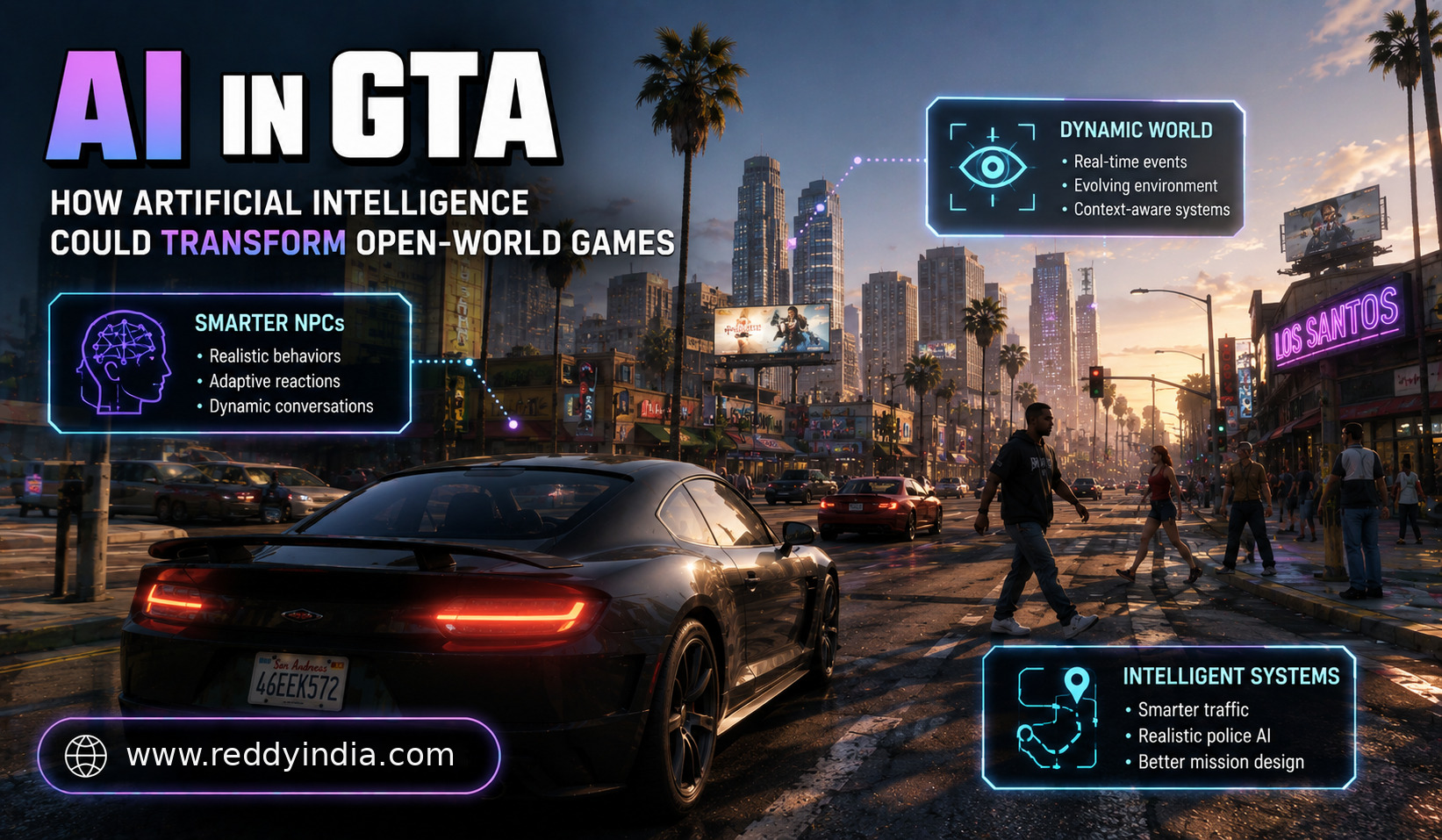
Smarter NPCs Could Make Cities Feel Alive
Pedestrians are an essential part of any GTA city.
They walk through streets, interact with their surroundings, react to accidents, and respond when the player causes trouble. However, their behavior is generally limited by predefined game systems.
AI could make these characters more dynamic.
Instead of following predictable routines, pedestrians could respond differently depending on the situation.
One character might run away from danger, another could call the police, while another might continue walking because they are unaware of what is happening.
Different personalities could make these reactions even more varied.
This would help create the impression that every character is part of a larger living population rather than simply an object placed in the environment.
AI Could Improve Conversations
One of the most exciting possibilities is more natural NPC dialogue.
Traditional video game characters generally follow scripted conversations. Developers write specific lines for specific situations.
Generative AI could potentially allow characters to respond more dynamically.
Imagine approaching an NPC and asking about a nearby location. Instead of selecting from a fixed dialogue menu, the character could provide an answer based on the game’s world.
Characters could also react to recent events.
If a major event occurred nearby, NPC conversations could reference it. If the player had previously interacted with a character, future conversations could potentially reflect that history.
This could make the city feel more connected.
AI Could Create More Dynamic Missions
Missions are usually designed carefully by developers. This ensures that objectives, dialogue, locations, and rewards work as intended.
AI could potentially help create variations without requiring developers to manually script every possibility.
For example, a mission involving a vehicle delivery could change depending on traffic, police activity, weather, or the player’s previous actions.
A character might ask for a different approach based on what happened earlier in the story.
This could increase replayability.
Instead of completing exactly the same mission sequence every time, players could experience variations within a structured framework.
Human developers would still need to establish the rules and boundaries to ensure the missions remain fun and coherent.
Smarter Police AI Could Change Chases
Police chases are one of the most recognizable parts of GTA.
AI could make these encounters more sophisticated.
Instead of simply sending more police vehicles after the player, an advanced system could analyze the player’s behavior and adjust the response.
Police units could potentially coordinate roadblocks, search likely escape routes, monitor major roads, or change strategies depending on the player’s vehicle and location.
For example, escaping through a crowded urban area might create a different challenge than driving into a remote countryside.
The objective would be to create more believable pursuit behavior rather than simply increasing the number of enemies.
AI Could Improve Traffic Systems
Traffic is another major part of an open-world city.
Modern AI could potentially help vehicles behave in more realistic ways.
Drivers could respond differently to traffic jams, accidents, emergency vehicles, road closures, and dangerous driving.
Instead of every vehicle following nearly identical rules, AI systems could introduce different driving styles.
Some drivers might be cautious, others impatient, while some could react aggressively when the player causes problems.
These small differences could make city streets feel more natural.
AI Could Make the World React to Players
A truly dynamic open world would not simply reset after every event.
AI could help game systems remember and react to player behavior.
For example, if a player repeatedly causes trouble in a particular neighborhood, certain NPCs could become more cautious when they see the player’s character or vehicle.
Businesses, gangs, police, or other groups could potentially respond differently based on the player’s reputation.
This could create a stronger connection between player actions and the game world.
AI Could Create More Believable Characters
Open-world games often contain hundreds or thousands of NPCs.
Developers cannot manually create unique behavior for every character.
AI could help give NPCs different characteristics.
Characters might have different priorities, personalities, routines, and reactions.
One NPC could be highly cautious, while another might be adventurous. Some might avoid conflict, while others could become involved in unusual situations.
These differences could make repeated exploration more interesting.
AI Could Improve Enemy Behavior
Combat AI is another area where technology could have a major impact.
Enemies could potentially coordinate more effectively, adapt to the player’s preferred tactics, use cover intelligently, and change their strategies when previous approaches fail.
For example, if the player frequently attacks from rooftops, enemies could start paying more attention to elevated positions.
If the player relies heavily on vehicles, enemies could focus on blocking escape routes.
This could make combat feel more responsive without simply giving enemies better aim or more health.
AI Could Transform Side Activities
Open-world games are often filled with optional activities.
AI could make these activities more dynamic.
Sports, races, random encounters, business activities, street events, and mini-games could potentially adapt to player behavior.
For example, opponents in a racing activity could adjust their strategies based on how the player drives.
Random encounters could also become more varied, creating situations that feel less repetitive.
This could make exploration more rewarding because players would not always know what they might encounter.
AI Could Help Generate Dynamic Cities
The biggest long-term possibility could be AI-assisted world generation.
Instead of designing every small detail manually, developers could use AI tools to assist with environmental creation.
AI could potentially help generate variations in buildings, interior layouts, traffic patterns, pedestrian activities, and environmental events.
However, procedural generation would still need strong creative direction.
A completely AI-generated city could feel repetitive or incoherent if it lacks careful design.
The strongest approach would likely combine human-created environments with AI-generated variations and behaviors.
AI Could Personalize Player Experiences
Different players approach GTA differently.
Some enjoy missions, some prefer exploration, while others spend hours experimenting with vehicles or causing chaos.
AI could potentially adapt the world to different play styles.
A player who frequently explores might encounter more exploration-focused events. Someone who spends more time driving could experience different traffic situations or challenges.
This type of personalization could make open-world games feel more responsive without forcing every player through the same experience.
The Role of Generative AI
Generative AI could add another layer to these systems.
It could potentially assist with dialogue, mission concepts, character personalities, environmental details, and other content.
However, unrestricted generation would not necessarily be appropriate for a major game.
Developers would need to control what AI systems can say and do.
A carefully designed system could combine AI-generated variation with strict rules, ensuring that characters remain consistent with the game’s world and tone.
Challenges of AI in GTA
Despite its potential, AI introduces serious challenges.
More sophisticated systems could require significant computing resources. Developers would also need to prevent unpredictable behavior from breaking missions or creating frustrating gameplay.
There are also questions around moderation, privacy, content generation, and player safety.
Generative AI can produce unexpected outputs, so any system that allows NPCs to generate dialogue would require strong safeguards.
Game developers would also need to balance realism with entertainment.
Sometimes unrealistic behavior is fun. Making everything perfectly realistic could actually make a game less enjoyable.
Could AI Replace Human Game Designers?
AI is unlikely to eliminate the need for human game designers.
Open-world games require creative direction, storytelling, level design, animation, art, sound, programming, and countless other disciplines.
AI can assist with certain tasks, but human developers remain responsible for deciding what kind of experience players should have.
The most promising future is likely to involve collaboration.
Developers could use AI to handle repetitive tasks, analyze complex systems, generate variations, and test possible scenarios while humans focus on creativity and overall design.
The Future of AI in GTA and Open-World Games
AI could eventually transform open-world games from highly scripted environments into more adaptive worlds.
Characters might remember player interactions. Police could respond more intelligently. Traffic could react naturally. Missions could change based on circumstances. Random events could become less predictable.
The city itself could feel like a system that continues operating even when the player is not directly involved.
That could represent the next major step in open-world gaming.
The most exciting part is not simply having smarter NPCs. It is the possibility of creating worlds where player actions genuinely influence what happens next.
Conclusion
AI in GTA could transform open-world games by making characters, missions, traffic, police systems, and environments more responsive.
The technology could help create cities that feel less scripted and more alive, where NPCs react to events, missions adapt to circumstances, and players experience different situations based on their behavior.
However, AI should support good game design rather than replace it. Human creativity, storytelling, and careful development will remain essential for creating enjoyable experiences.
If developers successfully combine traditional game design with advanced AI, future open-world games could become far more dynamic than today’s experiences.
Instead of simply exploring a virtual city, players could enter a world that learns from their actions, reacts to their decisions, and continuously creates new possibilities.