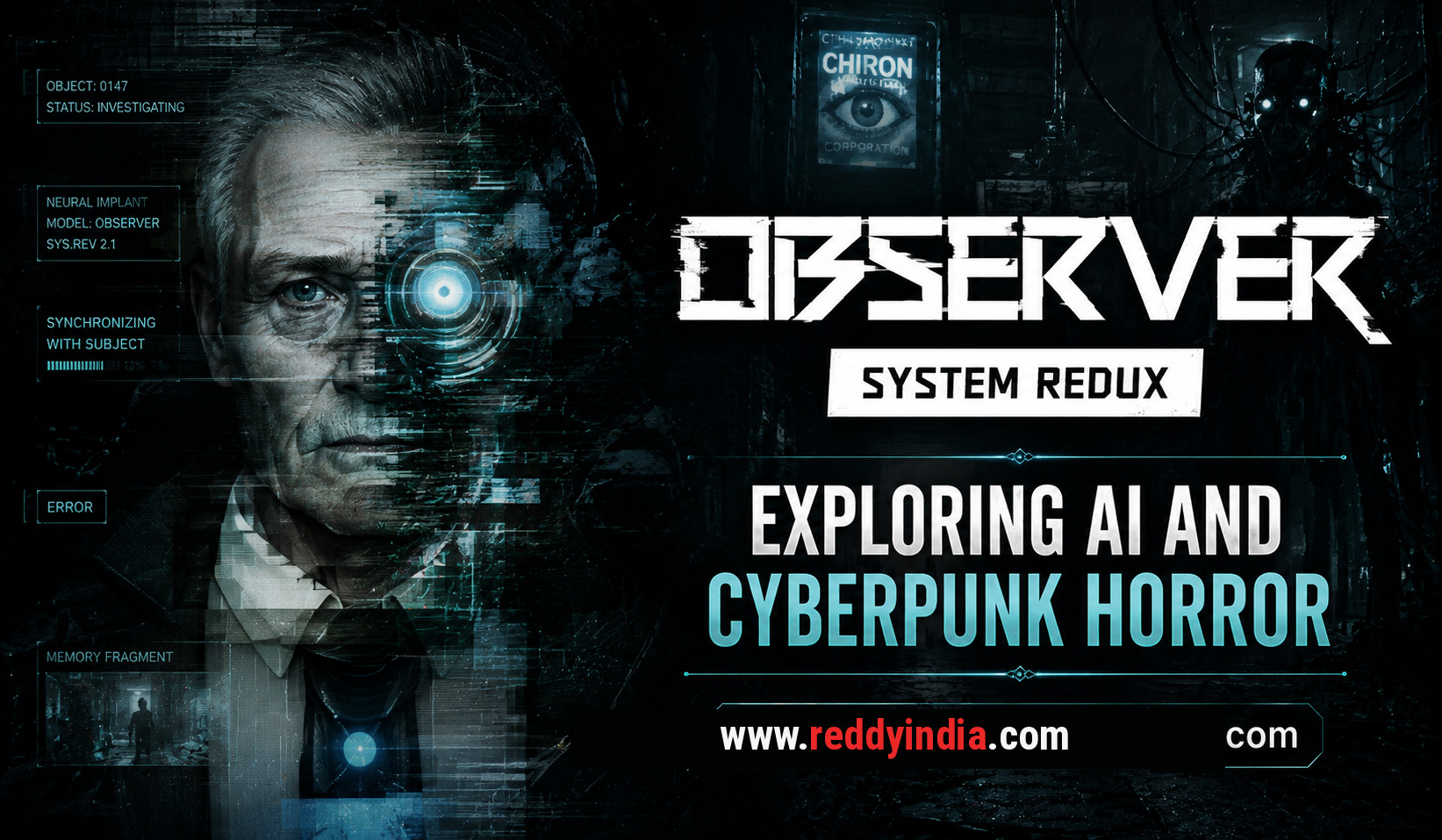
Observer: System Redux: Exploring AI and Cyberpunk Horror
Observer: System Redux is a psychological cyberpunk horror game that combines futuristic technology, artificial intelligence, digital consciousness, and disturbing psychological experiences. Set in a dystopian future, the game places players in the role of Daniel Lazarski, an elite neural detective who investigates the minds and memories of others.
Unlike traditional horror games that depend primarily on monsters or supernatural threats, Observer: System Redux creates fear through technology. Computers, neural implants, artificial intelligence, surveillance systems, and digital memories become sources of uncertainty.
The result is a world where technology does not simply make life easier. It can expose private thoughts, manipulate perception, and blur the boundary between reality and artificial experiences.
A Future Where Technology Controls Daily Life
Observer: System Redux is set in a future where humanity has experienced enormous technological change.
People can connect their minds to digital systems, use neural implants, and interact with advanced computer networks. Technology has become deeply integrated into everyday life.
However, society is far from perfect.
The world is damaged by disease, social inequality, addiction, corporate power, and technological dependence. Many people rely on cybernetic enhancements simply to survive.
This creates the foundation for the game’s horror.
Technology is everywhere, but people no longer have complete control over it.
What Makes Observer: System Redux a Cyberpunk Horror Game?
Cyberpunk stories often focus on advanced technology existing alongside social problems.
Observer combines this idea with psychological horror.
Instead of simply asking what technology can accomplish, the game asks what could happen when technology becomes connected directly to the human mind.
This creates a disturbing possibility.
If a person’s memories can be accessed digitally, can they still be considered private?
If a person’s thoughts can be manipulated, can they trust their own perception?
If an artificial system can enter someone’s mind, where does the human identity end?
These questions create much of the game’s tension.
AI Is a Source of Fear
Artificial intelligence plays an important role in the atmosphere of Observer.
The game presents advanced digital systems as powerful technologies that humans may not completely understand.
AI can process information, analyze minds, and interact with digital environments.
But its capabilities also create uncertainty.
When technology becomes intelligent enough to interpret human thoughts and memories, it becomes difficult to know whether people are controlling machines or machines are beginning to influence people.
This uncertainty is one of the game’s strongest horror elements.
Neural Technology Changes the Meaning of Reality
The neural interfaces in Observer are particularly important.
Players encounter technology that allows the protagonist to investigate people’s memories and mental experiences.
This mechanic creates an unusual form of horror because the player cannot always trust what they see.
A digital memory may look real.
A hallucination may feel real.
A distorted environment may contain clues, even though it does not follow normal physical rules.
This makes the player’s understanding of reality part of the mystery.
Psychological Horror Instead of Traditional Monsters
Observer does not need a monster around every corner to create fear.
Much of its horror comes from uncertainty.
Players may enter a strange digital environment and have no idea what is real.
The atmosphere becomes increasingly uncomfortable as familiar spaces transform into disturbing visions.
This approach is especially effective because technology provides an explanation for experiences that would otherwise seem impossible.
The horror is not simply supernatural.
It is technological.
Artificial Intelligence and Human Memory
Memory is one of the most important themes in Observer.
The game presents memories as something that can potentially be accessed, examined, and manipulated through technology.
This creates philosophical questions about identity.
If memories can be copied or changed, what happens to the person who owns them?
If two versions of the same memory exist, which one is authentic?
And if technology can reconstruct experiences from someone’s mind, does that reconstruction represent the person themselves?
These questions make the game’s technology more than a visual feature.
They are part of its central narrative.
Technology Can Become an Invasion of Privacy
Modern technology already allows organizations to collect enormous amounts of information about people.
Observer takes this concept to an extreme.
Imagine a world where technology could directly examine someone’s thoughts.
Traditional privacy would become almost meaningless.
The game uses this idea to explore the dangers of technological surveillance.
A neural detective can investigate someone’s mind, but that ability raises serious ethical questions.
Just because technology makes something possible does not necessarily mean it should be allowed.
The Cyberpunk City Creates Isolation
The game’s environment reinforces its themes.
The world is dark, crowded, industrial, and heavily connected to technology.
Buildings contain aging infrastructure, electronic equipment, surveillance systems, and signs of social decline.
The contrast between advanced technology and deteriorating living conditions creates a classic cyberpunk atmosphere.
People have access to incredible technological capabilities, yet their lives remain difficult.
This suggests that technological advancement alone cannot solve social problems.
System Redux Expands the Original Experience
Observer: System Redux builds on the original Observer with enhanced visuals, gameplay improvements, and additional content.
The updated version makes the game’s environments more detailed and immersive while expanding aspects of the story.
This is important because atmosphere plays a major role in psychological horror.
Lighting, sound, environmental details, and visual effects all contribute to the player’s sense of uncertainty.
The stronger the environment feels, the more convincing the game’s disturbing digital experiences become.
AI and the Uncertainty of Control
One of the most interesting themes in Observer is control.
Humans build technology to serve specific purposes.
But increasingly complex systems can produce outcomes that designers may not anticipate.
This idea has become particularly relevant in modern discussions about AI.
As AI systems become more capable, researchers and developers increasingly consider questions about reliability, control, and alignment.
Observer takes these concerns into science fiction and turns them into horror.
The fear comes from the possibility that humans may create systems that they cannot fully control.
The Human-Machine Boundary
Cyberpunk fiction frequently explores the relationship between humans and machines.
Observer takes this concept into the mind itself.
Cybernetic technology can change what humans are capable of doing, but it also makes the body and brain more dependent on machines.
The more technology becomes integrated into a person’s identity, the harder it becomes to define where the human ends and the machine begins.
This is one of the reasons the game’s world feels unsettling.
Technology is not something characters simply carry.
It has become part of them.
AI Could Change Horror Games in the Future
Observer’s ideas could become even more interesting as AI technology develops.
Future horror games could potentially use AI to create more adaptive environments and characters.
An AI system might analyze how a player behaves and adjust certain elements of the experience.
For example, a game could change the timing of events, dialogue, environmental details, or psychological effects based on player actions.
This could make horror experiences feel less predictable.
However, developers would need to carefully control these systems to ensure that the experience remains coherent and enjoyable.
AI-Generated Characters Could Increase Psychological Horror
Artificial intelligence could also make horror characters more dynamic.
Instead of repeating the same dialogue, an AI-driven character could respond differently based on the player’s previous actions.
A character might appear helpful at first and become increasingly suspicious later.
Another might remember what the player said earlier.
This could create stronger psychological tension.
However, unrestricted AI dialogue could also break immersion if characters say things that do not fit the story.
Human writers and designers would still need to establish boundaries.
Technology as Both Tool and Threat
Observer presents technology in a complicated way.
Technology helps the protagonist investigate mysteries.
At the same time, that same technology creates many of the dangers he encounters.
This dual role makes the game’s cyberpunk world more believable.
Technology is neither completely good nor completely evil.
Its consequences depend on how people use it and who controls it.
That idea is particularly relevant to artificial intelligence.
AI can help people solve problems, automate tasks, and process information.
But poorly designed or misused systems can also create new risks.
Why Observer Still Feels Relevant
Observer: System Redux remains interesting because its central fears are not limited to futuristic machines.
The game is really about trust.
Can you trust your memories?
Can you trust technology?
Can you trust artificial intelligence?
Can you trust your own perception?
These questions remain relevant as digital technology becomes increasingly integrated into everyday life.
Modern AI cannot read minds or manipulate human memories in the way shown in the game, but the fictional scenario encourages players to think about what privacy and identity might mean in a technologically advanced future.
The Future of Cyberpunk Horror
AI could become an increasingly important storytelling tool for cyberpunk horror.
Future games may explore digital identities, virtual worlds, autonomous systems, brain-computer interfaces, and machine consciousness.
Instead of using technology simply as a backdrop, developers could make it central to the horror.
A game might create fear by questioning whether an experience is real, whether a digital personality is authentic, or whether an intelligent system understands more about the player than expected.
Observer provides an early example of how effective this approach can be.
Conclusion
Observer: System Redux demonstrates how AI and futuristic technology can become powerful tools for psychological horror.
Its world combines neural interfaces, artificial intelligence, digital memories, cybernetic enhancements, and surveillance to create an unsettling vision of the future.
Rather than relying entirely on traditional horror elements, the game makes technology itself a source of fear.
Its most interesting questions involve privacy, identity, memory, consciousness, and control. These themes make the game more than a cyberpunk thriller because they encourage players to think about how technological progress could affect humanity.
As AI continues to evolve, games may explore these questions in increasingly creative ways.
Observer: System Redux ultimately suggests that the scariest future may not be one where machines destroy humanity.
It may be one where technology becomes so deeply connected to the human mind that we can no longer tell where the machine ends and the person begins.