Roblox and Generative AI: What Could Change for Players?
Roblox has grown from a platform for simple user-created games into a massive digital ecosystem where people can play, build, socialize, and experiment with virtual experiences. Much of its success comes from giving creators powerful tools to turn their ideas into interactive worlds.
Generative AI could take this concept even further.
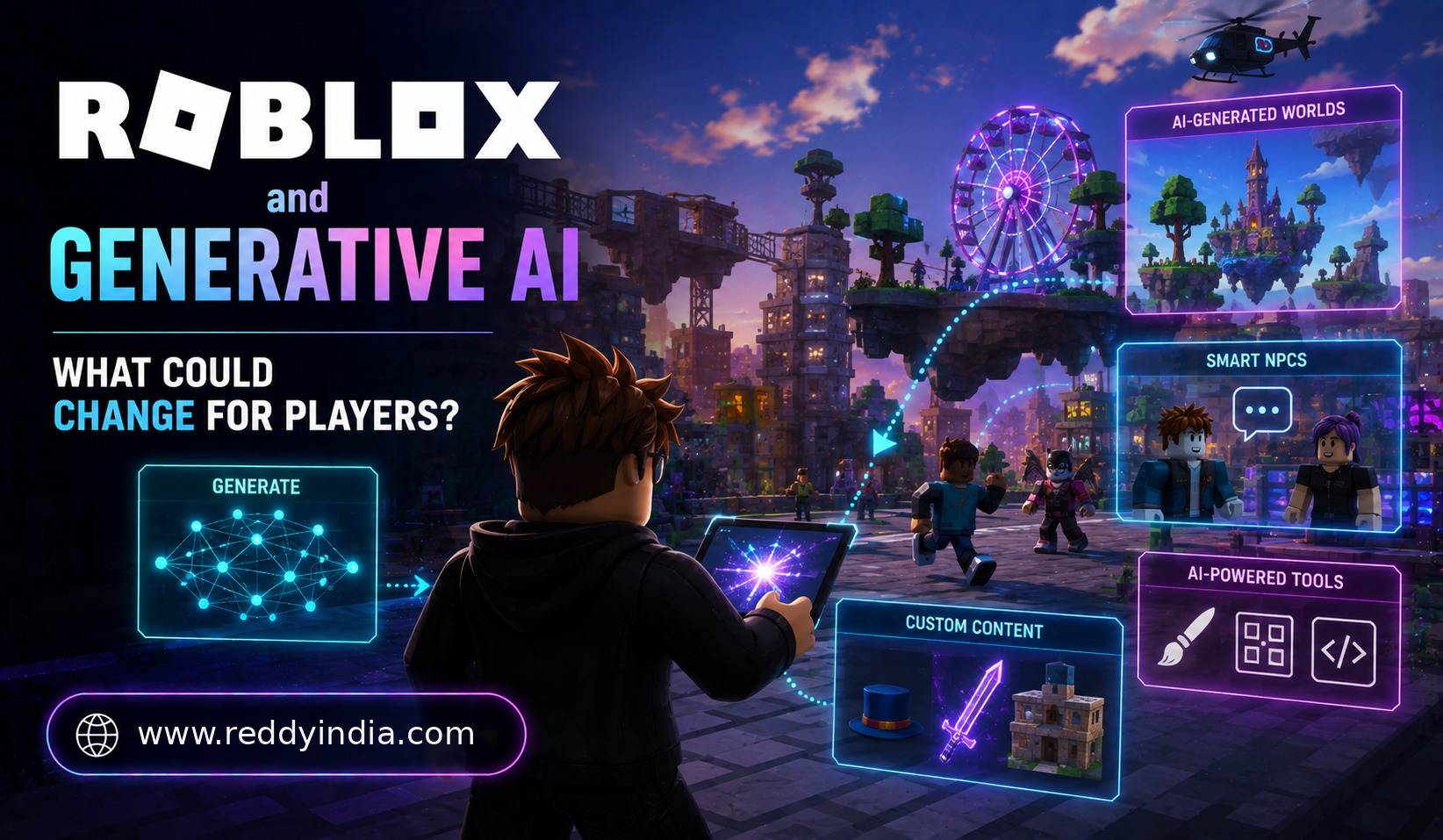
Instead of requiring creators to manually design every object, write every line of code, or build every piece of dialogue, AI could help transform simple instructions into game elements. For players, this could mean more varied experiences, smarter characters, personalized gameplay, and worlds that change in response to individual choices.
The relationship between Roblox and generative AI could therefore influence not only how games are created but also how players experience them.
What Is Generative AI?
Generative AI refers to artificial intelligence systems capable of producing new content from instructions or prompts. Depending on the technology, these systems can generate text, images, code, audio, 3D assets, animations, and other forms of digital content.
For a platform such as Roblox, this technology has many possible applications.
A developer could describe an object they want to create, ask AI for a programming solution, or use AI to generate ideas for a game mechanic. In the future, increasingly advanced systems could help create more complicated interactive environments.
Roblox has already been exploring generative AI through tools intended to assist creators, including AI-based coding assistance and technologies designed to make creation more accessible.
The larger question is what happens when these tools become powerful enough to influence the player experience directly.
AI Could Make Game Creation Faster
One of the biggest potential changes is the speed at which Roblox experiences can be developed.
Creating a game traditionally requires different skills. A developer may need to understand scripting, 3D design, animation, interface design, sound, and game mechanics.
Generative AI could reduce some of these barriers.
A creator could potentially describe a basic idea such as a futuristic racing game and use AI to generate an initial environment, vehicle concepts, interface elements, or gameplay scripts.
Human creators would still need to test, edit, and improve the result, but AI could handle some repetitive tasks.
This could encourage more people to experiment with game development.
Players Could Get More Diverse Experiences
If development becomes easier, Roblox could see an even larger number of experimental games.
Creators who previously had strong ideas but lacked programming or design skills could use AI-assisted tools to turn those concepts into playable experiences.
That could lead to unusual game genres, smaller experimental projects, and experiences designed around highly specific interests.
For players, this could mean discovering games that would have been too difficult or expensive to create using traditional development methods.
The platform could become even more diverse as AI lowers the technical barrier to entry.
AI Could Create Personalized Gameplay
Generative AI could also change how players experience individual games.
Today, most players enter the same game world and interact with broadly similar mechanics. Developers can offer different paths, quests, or difficulty settings, but these options are usually designed in advance.
AI could make experiences more adaptive.
Imagine a Roblox adventure game where the story changes based on your decisions. If you prefer exploration, the game could generate more discovery-focused objectives. If you enjoy combat, it could introduce more challenging encounters.
The game would not necessarily need to follow one fixed storyline.
Instead, AI could help generate variations based on how players interact with the world.
Smarter NPCs Could Become Common
Non-player characters could be among the biggest beneficiaries of generative AI.
Traditional NPCs generally operate using predefined dialogue and behavior. Generative AI could allow characters to respond more naturally to players.
Instead of selecting from a few dialogue options, players might be able to communicate with an NPC using ordinary language.
A character could answer questions, provide hints, react to events, or remember parts of a player’s interaction with it.
For example, a Roblox fantasy game could include an AI-powered guide who remembers that the player previously helped a village and changes future conversations accordingly.
This could make game worlds feel more dynamic.
Voice Interaction Could Become More Important
Generative AI combined with speech technology could also change how players communicate with virtual characters.
Rather than typing messages, players could potentially speak naturally to AI-powered characters.
A player might ask a companion where to find a particular location, request help with a puzzle, or discuss what to do next.
Voice-enabled characters could make certain Roblox experiences feel more like interactive stories.
However, voice AI would require strong safety systems, particularly because Roblox has a large and diverse younger audience. Moderation, privacy, age-appropriate interactions, and protection against harmful content would remain critical.
AI Could Help Creators Build 3D Assets
Creating 3D objects can be time-consuming.
Generative AI could potentially help creators produce models, textures, animations, and environmental elements from simple descriptions.
A developer might describe a futuristic laboratory, medieval weapon, or cartoon-style vehicle and use AI to generate an initial asset.
This would not necessarily eliminate the need for 3D artists. Instead, AI could function as a creative assistant that speeds up the early stages of development.
Creators could then customize the generated assets to fit their games.
Roblox Worlds Could Become More Dynamic
Another possibility is AI-generated environments.
Instead of designing every part of a world manually, developers could establish rules and allow AI systems to generate variations.
For example, an exploration game could create different landscapes, buildings, quests, or environmental events for different sessions.
This could make replayability much stronger.
Players might return to the same game but encounter different combinations of content each time.
The challenge would be maintaining quality. Randomly generated content is not automatically good content. Developers would still need systems that ensure generated environments remain fun, balanced, and appropriate.
Generative AI Could Help With Roblox Coding
Programming is another area where AI could have a major impact.
Roblox creators use scripting to build game mechanics, interfaces, interactions, and other systems. Beginners may find programming difficult, especially when debugging errors.
AI coding assistants could help explain scripts, identify potential problems, generate basic functions, or suggest improvements.
This could make game development easier for newcomers.
Instead of searching through documentation every time they encounter an unfamiliar programming concept, creators could receive explanations in simpler language.
However, creators would still benefit from learning the fundamentals. Depending entirely on AI-generated code can lead to errors that the developer does not understand.
Players Could See More Interactive Stories
Generative AI could blur the line between games and interactive storytelling.
A Roblox game could potentially create characters, quests, conversations, and events based on the player’s actions.
For example, two players could enter the same game but experience different storylines because they made different decisions.
One player might become friends with a particular character, while another might become its rival.
This kind of personalized storytelling could make Roblox experiences feel less like fixed games and more like evolving digital worlds.
AI Could Change Social Experiences
Roblox is also a social platform, so generative AI could influence how people communicate and collaborate.
AI could help players translate conversations between languages, summarize complicated instructions, provide accessibility features, or assist players who need guidance.
It could also help creators design social spaces where characters respond intelligently to visitors.
At the same time, AI-generated interactions create new moderation challenges. Systems must prevent inappropriate, manipulative, misleading, or unsafe content from reaching players.
For Roblox, responsible implementation would be just as important as technological progress.
What Could AI Mean for Roblox Creators?
Generative AI could increase competition among creators.
If producing a basic game becomes easier, more people may enter the Roblox development ecosystem. That could result in a much larger supply of experiences.
However, easier creation does not automatically guarantee success.
When more games become available, originality, game design, community building, and player retention could become even more important.
AI may make it easier to produce content, but human creativity could remain the key factor separating memorable experiences from generic ones.
Will AI Replace Roblox Developers?
It is unlikely that generative AI will completely replace human creators.
AI can generate code, images, ideas, and other content, but game development involves understanding players, creating enjoyable mechanics, balancing difficulty, building communities, and making creative decisions.
Those responsibilities require more than simply generating content.
The most realistic future is likely to involve collaboration between people and AI.
Creators could use AI for repetitive or technical tasks while spending more time on concepts, storytelling, design, testing, and community interaction.
Challenges Roblox Will Need to Address
Generative AI also introduces significant risks.
AI-generated content can contain errors, inappropriate material, copyright concerns, or unexpected behavior. If AI-generated characters can communicate freely with players, moderation becomes even more complicated.
There is also a concern that low-effort AI-generated games could flood the platform.
Roblox would need systems that maintain quality and safety while still giving creators room to experiment.
For players, transparency could become increasingly important. People may want to know when they are interacting with an AI-generated character or experiencing automatically generated content.
The Future of Roblox and Generative AI
The combination of Roblox and generative AI could eventually create a new type of gaming experience.
Players may be able to enter worlds where characters understand natural language, environments adapt to their actions, stories change dynamically, and game content is generated around individual preferences.
Creators could potentially build ambitious experiences with smaller teams and fewer technical barriers.
But the most successful Roblox games will probably not be the ones that use the most AI. They will be the ones that use AI in ways that genuinely improve creativity and player enjoyment.
Conclusion
Generative AI could change Roblox from both the creator’s side and the player’s side. Developers may gain faster tools for coding, modeling, storytelling, and world-building, while players could experience smarter NPCs, personalized stories, dynamic environments, and more interactive games.
The technology also brings challenges involving moderation, privacy, content quality, copyright, and platform safety. These issues will need careful attention as AI becomes more deeply integrated into user-generated gaming.
Ultimately, Roblox and generative AI could create a more flexible and personalized future for gaming. AI may provide the tools, but the ideas, creativity, and decisions of human creators will likely remain what makes the best Roblox experiences worth playing.