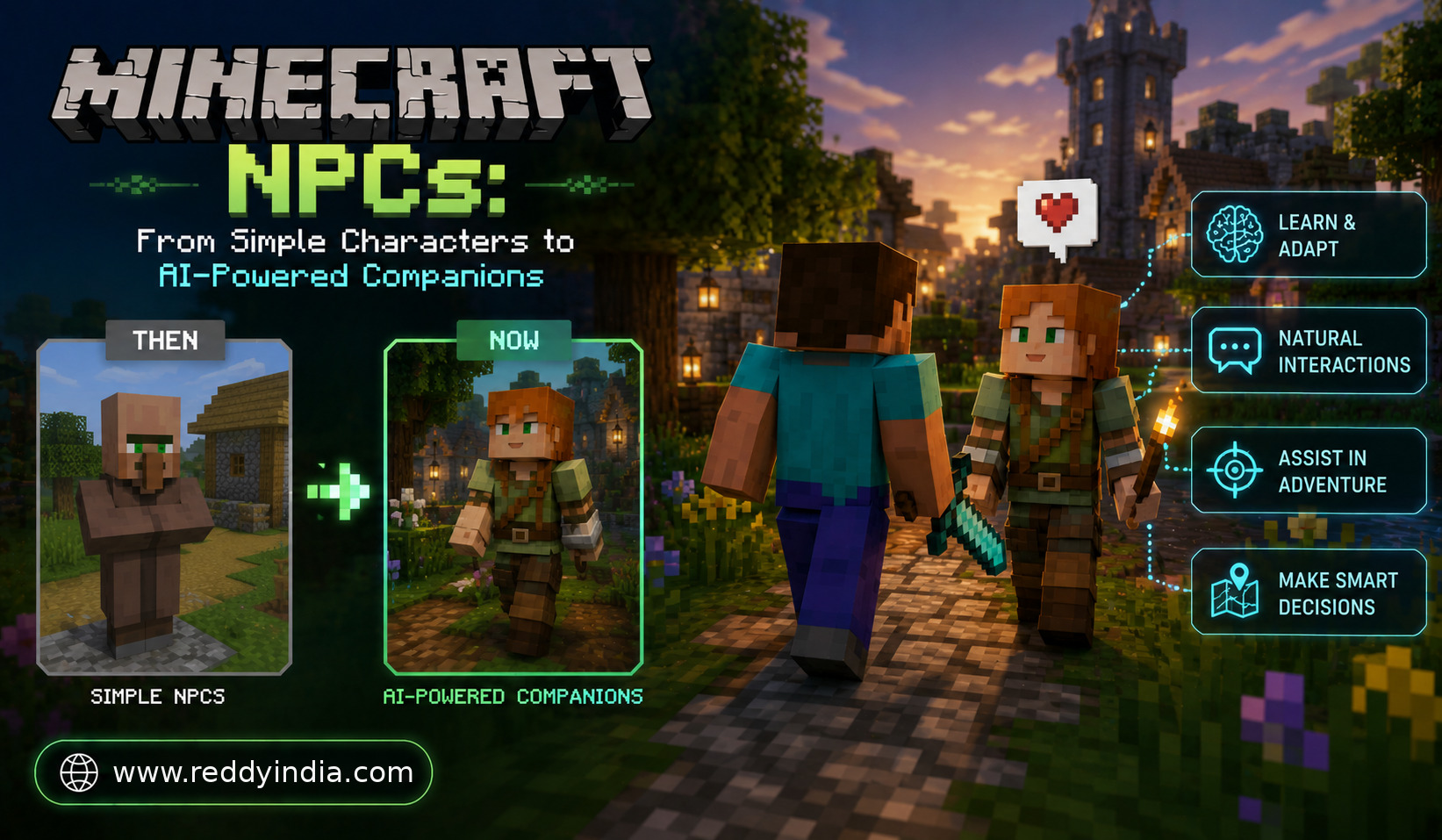
Minecraft NPCs: From Simple Characters to AI-Powered Companions
Minecraft has always been more than a game about mining blocks and building structures. Its open-ended world allows players to explore, create, fight, trade, and design their own experiences. One of the most important elements that makes this world feel alive is its collection of non-player characters, commonly known as NPCs.
From villagers who trade resources to wandering traders who appear unexpectedly, Minecraft NPCs have evolved significantly over the years. What began as relatively simple characters with predictable behaviors could become something much more advanced as artificial intelligence continues to develop.
The idea of AI-powered Minecraft companions is particularly interesting because it could transform how players interact with the game world. Instead of characters simply following predefined commands, future NPCs could understand conversations, remember previous interactions, assist with building, react to changing situations, and develop unique personalities.
What Are NPCs in Minecraft?
NPC stands for “non-player character.” These are characters controlled by the game rather than directly by the player.
Minecraft includes several types of characters that serve different purposes. Villagers can trade items and follow daily routines, while wandering traders provide access to certain resources. Hostile mobs and passive animals are technically also non-player entities, although they are generally discussed separately from traditional NPCs.
The behavior of these characters is based on programmed rules. A villager, for example, can search for a workstation, move around a village, interact with other villagers, sleep, and trade with players.
These systems can make Minecraft worlds feel active even when nobody else is playing.
However, traditional NPC behavior has limitations. Characters generally operate within predefined rules and cannot genuinely understand a player’s intentions or hold an open-ended conversation.
That is where AI could change the experience.
How Traditional Minecraft NPCs Work
Minecraft NPCs are designed around specific behaviors and game mechanics. Villagers have professions, schedules, trading systems, and relationships with different parts of the game world.
This approach works well because predictable behavior is important in a sandbox game. Players need to understand what an NPC is likely to do.
A farmer should behave differently from a librarian, while a wandering trader should have a different purpose from a villager working at a job site.
The limitation is that these characters cannot easily move beyond the behaviors programmed into them.
If a player asks a traditional NPC a complicated question, the character cannot understand it in the way a human would. Its responses and actions are limited by the systems created by the developers.
AI could potentially make NPC behavior much more flexible.
AI Could Give NPCs Better Conversations
One of the most obvious applications of artificial intelligence would be conversational NPCs.
Imagine entering a Minecraft village and speaking naturally with a villager.
Instead of selecting from a small number of predefined interactions, you could ask:
“Where can I find a village nearby?”
An AI-powered character could potentially respond based on information available in the game world.
You could also ask a companion to help plan a journey, explain where resources might be located, or discuss what happened during an earlier adventure.
Large language models could make these conversations feel much more natural. NPCs would not necessarily need to repeat the same dialogue every time the player interacts with them.
This could make Minecraft worlds feel more dynamic and personal.
AI Companions Could Remember Players
Memory could be one of the most interesting developments in AI-powered Minecraft NPCs.
Traditional characters usually have limited knowledge of previous interactions. An advanced AI companion could potentially remember important events and use them later.
For example, a companion might remember that a player built a large castle near a particular biome, helped defend a village, or previously asked for assistance finding diamonds.
That memory could influence future conversations and behavior.
A companion might say something like, “Last time we explored this cave, you nearly ran out of torches. Should we bring more this time?”
Such interactions could make the character feel less like a scripted game object and more like a persistent part of the player’s world.
AI NPCs Could Become Building Assistants
Minecraft’s building system offers another major opportunity for AI.
Players already use commands, mods, tools, and external applications to speed up construction. AI-powered companions could potentially make this process easier through natural language.
A player could describe an idea such as:
“Help me build a medieval watchtower beside this village.”
An advanced companion could interpret the request and help plan the structure.
Depending on how the technology is implemented, it could suggest materials, create a construction plan, gather available resources, or assist with placing blocks.
The important difference would be communication. Instead of learning complicated commands, players could describe what they want in ordinary language.
This could make complex Minecraft projects more accessible to beginners.
NPCs Could Help With Exploration
Minecraft’s worlds can be enormous, and exploration often involves uncertainty.
An AI companion could potentially act as a guide while exploring caves, villages, oceans, deserts, or other environments.
Instead of following a fixed path, the companion could analyze the surroundings and respond to changing conditions.
For example, it could suggest returning home before nightfall, recognize that the player lacks food, or recommend bringing additional equipment before entering a dangerous area.
The companion could also help players organize exploration goals.
For younger or inexperienced players, this kind of assistance could make Minecraft easier to understand without removing the freedom that makes the game enjoyable.
AI Could Make Villages Feel More Alive
Minecraft villages are already populated by villagers with jobs and routines, but AI could make these communities considerably more dynamic.
Imagine villagers discussing events happening in their settlement, reacting differently to the player’s reputation, requesting assistance, or adapting their behavior after major events.
A village could potentially develop its own evolving story.
If players defend a settlement from repeated attacks, villagers might become more trusting. If players repeatedly take resources without helping the community, relationships could change.
AI could make these interactions feel less mechanical by allowing characters to respond to circumstances rather than simply following fixed dialogue trees.
AI-Powered NPCs Could Create Stories
Minecraft does not require a traditional storyline. Players create their own adventures.
AI companions could strengthen this feature by generating personalized stories based on what happens in a world.
Suppose a player discovers an abandoned structure. An AI companion could help turn the discovery into a narrative.
The character might speculate about who built it, suggest searching for clues, or remember the location for future adventures.
Over time, the player’s actions could become part of an evolving story.
This could create experiences that feel different from one Minecraft world to another.
NPC Personalities Could Become More Diverse
Another potential improvement is personality.
Traditional NPCs are mostly defined by their profession and programmed behavior. AI could allow characters to have different personalities, preferences, and communication styles.
One companion could be adventurous and encourage exploration. Another might be cautious and constantly warn the player about danger. A third could focus heavily on building and resource management.
Different personalities could also affect how NPCs respond to decisions.
This would make having multiple companions more interesting because each character could feel different rather than simply being another copy of the same AI behavior.
AI NPCs Could Improve Multiplayer Experiences
AI companions could also have a role in multiplayer Minecraft.
When players are unable to find enough friends to fill a team, intelligent NPCs could potentially help fill certain roles.
For example, AI companions could assist with farming, exploration, construction, defense, or resource gathering.
However, multiplayer AI would need careful balancing. If AI characters become too powerful, they could remove some of the challenge and cooperation that make multiplayer Minecraft enjoyable.
The goal would likely be to support players rather than replace human teammates.
Minecraft Mods Could Accelerate AI NPC Development
The Minecraft community has a long history of creating mods that introduce new mechanics, creatures, dimensions, quests, and gameplay systems.
AI technology could expand this creativity.
Mod developers could create NPCs capable of conversations, personalized quests, advanced navigation, or more complex decision-making.
Some experimental projects could allow players to communicate with AI characters through voice or text, while others could focus on autonomous companions that perform specific tasks.
Because Minecraft provides such a flexible environment, it is an ideal platform for experimenting with new forms of interactive AI.
Challenges of AI-Powered Minecraft NPCs
Despite the possibilities, AI NPCs would also create challenges.
The first is reliability. AI systems can misunderstand instructions or generate responses that do not match the game world.
There is also the question of computing resources. Advanced AI behavior could require significantly more processing than traditional scripted NPCs.
Privacy and safety would also matter if players communicate with AI characters through online services.
Game balance is another concern. If an AI companion can gather resources, build structures, fight enemies, and solve problems too efficiently, it could reduce the need for players to participate.
Developers would need to design these systems carefully so that AI enhances creativity without taking over the experience.
The Future of Minecraft NPCs
The evolution of Minecraft NPCs could eventually move from simple scripted characters toward intelligent digital companions.
Future NPCs may be able to understand natural language, remember interactions, assist with projects, navigate environments, and respond to events in more believable ways.
The most exciting possibility is that these characters could become part of the player’s personal Minecraft story.
Instead of simply meeting a villager who trades emeralds for items, players could eventually encounter characters with memories, personalities, goals, and relationships.
Minecraft has always been about giving players freedom to create their own experiences. AI-powered NPCs could take that philosophy one step further by making the world itself more responsive.
Conclusion
Minecraft NPCs have come a long way from basic characters with limited interactions. Villagers, traders, and other game characters already contribute to the feeling that Minecraft worlds are alive, but artificial intelligence could dramatically expand what these characters are capable of.
AI-powered companions could hold natural conversations, remember previous adventures, assist with construction, guide exploration, create personalized stories, and react to players in more meaningful ways.
The technology is still developing, and there are important questions around performance, safety, game balance, and reliability. However, the potential is enormous.
The future of Minecraft may not simply involve building a world filled with blocks. It could involve building a world filled with characters that understand, remember, and participate in the adventure alongside you.