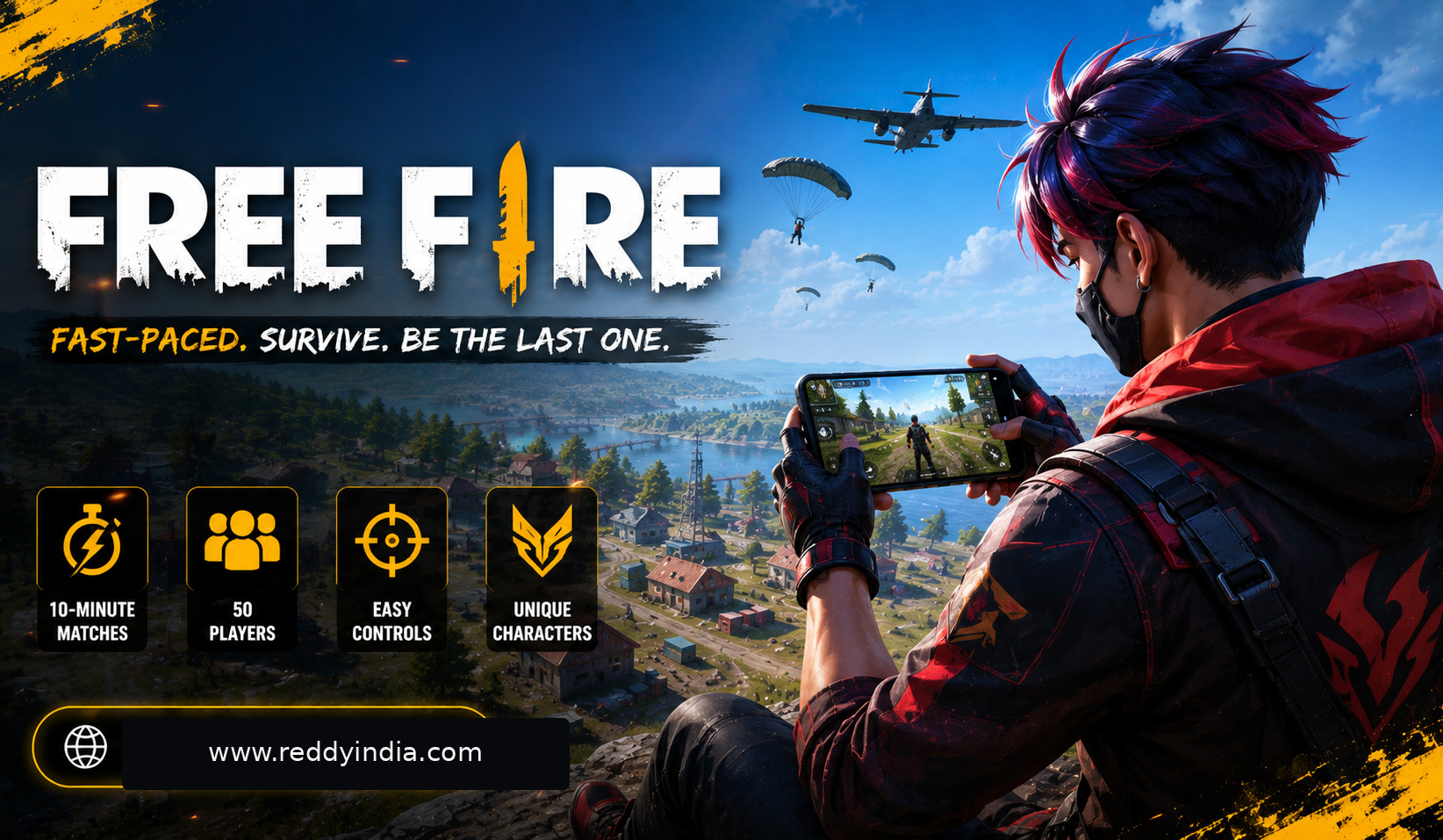
Free Fire: Features That Make It Popular on Mobile
Mobile gaming has become one of the biggest parts of the global gaming industry, and Free Fire has played an important role in that growth. Garena’s battle royale title became especially popular by offering fast matches, accessible controls, colorful characters, and gameplay designed around smartphones.
Unlike some large-scale battle royale games that require powerful hardware and lengthy matches, Free Fire focuses heavily on quick entertainment. Players can jump into a match, collect equipment, fight opponents, and compete for survival without committing to a very long session.
That simple formula, combined with character abilities, customization, social features, and regular content updates, has helped Free Fire maintain a large mobile audience.
Fast Matches Fit Mobile Gaming
One of Free Fire’s strongest advantages is its focus on shorter matches.
Mobile players do not always have the time to spend 30 or 40 minutes in a single game. A shorter battle royale experience makes it easier to play during breaks, commutes, or short periods of free time.
Free Fire’s match structure is designed around quick action.
Players land on a map, search for weapons and equipment, fight opponents, and try to remain the last survivor or team standing. Because the game moves quickly, players can experience the excitement of a complete battle royale match without a long time commitment.
This makes the game particularly suitable for mobile audiences.
Easy-to-Learn Controls
Touchscreen controls can be challenging for games that require complicated inputs.
Free Fire addresses this by keeping its basic control structure relatively accessible. Movement, aiming, shooting, jumping, crouching, and other actions are designed for touchscreen interaction.
Players can also customize aspects of the control layout to suit their preferences.
For beginners, simple controls make it easier to understand the fundamentals quickly.
As players improve, they can refine their sensitivity settings, button positions, and movement techniques to become more effective.
This creates a progression from casual play toward more competitive skill.
Designed for Mobile Hardware
Another important reason for Free Fire’s popularity is its emphasis on mobile accessibility.
A game intended for smartphones needs to consider hardware differences. Not every player owns a high-end device with the latest processor or graphics capabilities.
Free Fire has historically focused on being accessible across a broad range of mobile devices, helping it reach players who may not be able to run more demanding games smoothly.
This wider compatibility is particularly important in markets where affordable smartphones are much more common than expensive gaming devices.
The result is a larger potential player base.
Battle Royale Gameplay Creates Replayability
The battle royale format naturally encourages repeated play.
Every match begins with a fresh opportunity.
Players land in different locations, find different equipment, encounter different opponents, and make different decisions.
Even if the map remains familiar, the human behavior inside it changes constantly.
That unpredictability keeps Free Fire from feeling identical every time.
A player may win one match through aggressive combat and another through careful positioning and survival.
This variety encourages players to start another match even after they have just finished one.
Characters Add Personality to the Gameplay
Free Fire also stands out through its character system.
Rather than making every player behave identically, the game includes characters with distinct abilities and styles. These abilities can influence how players approach combat, movement, recovery, or teamwork.
This creates a layer of strategy beyond weapons.
Players may choose characters based on their preferred playstyle.
Someone who enjoys aggressive combat may select a character suited to direct engagements, while another player may prefer abilities that support survival or team coordination.
Character abilities also help Free Fire develop its own identity within the battle royale genre.
Abilities Add Strategic Choices
Character abilities can significantly influence decision-making.
The right ability may provide an advantage in a particular situation, but using it effectively requires timing.
Players must decide when an ability is most valuable.
Should it be used during an early fight?
Should it be saved for the final zone?
Would it be more useful for helping teammates?
These decisions make matches more dynamic.
Over time, experienced players learn how different abilities interact with weapons, positions, and team strategies.
Weapons Offer Different Playstyles
Free Fire includes a wide variety of weapons that support different types of combat.
Players can use assault rifles, submachine guns, sniper rifles, shotguns, pistols, and other options depending on what they find.
The choice of weapon can affect how a player approaches a fight.
A sniper encourages distance and careful positioning.
A shotgun is useful for close-range encounters.
An assault rifle provides greater flexibility across different situations.
Learning which weapons work best with a particular playstyle is part of the game’s progression.
Looting Keeps Players Moving
Looting is a key part of Free Fire’s gameplay loop.
Players need to search buildings and other locations for weapons, ammunition, armor, healing items, and useful equipment.
The search creates a strategic trade-off.
Staying longer in one area can help you collect better equipment, but it may also expose you to enemies.
Moving too quickly may leave you poorly equipped.
Players therefore need to balance preparation with survival.
That decision-making starts almost immediately after landing.
The Safe Zone Builds Pressure
Like other battle royale games, Free Fire uses a shrinking safe area to keep players moving toward one another.
The safe zone prevents players from remaining hidden in one location throughout the entire match.
As the playable area becomes smaller, encounters become more frequent and intense.
The shrinking zone also creates strategic decisions.
Players need to decide when to rotate, which route to take, and where to establish a strong position.
A player who reaches a favorable location early can gain an advantage.
Someone caught outside the safe area may be forced into a dangerous movement.
Team Modes Encourage Social Gameplay
Free Fire is not only about solo survival.
Team-based modes encourage players to cooperate with friends or other players.
Squad gameplay creates opportunities for communication, reviving teammates, sharing resources, and coordinating attacks.
A strong team can divide responsibilities.
One player may focus on aggressive combat while another provides support.
Others may prioritize positioning and information.
This teamwork gives Free Fire a social dimension that helps keep players connected to the game.
Customization Helps Players Stand Out
Customization is another major part of Free Fire’s appeal.
Players can personalize their characters, outfits, weapon appearances, and other cosmetic elements.
This gives players a way to express their identity.
In a multiplayer environment, visual customization is particularly valuable because players want their characters to feel different from everyone else’s.
Events and limited-time items can also create a sense of collecting.
Players may return regularly not only to compete but also to unlock or obtain new cosmetic content.
Events Keep the Game Fresh
Live-service games need regular updates to remain interesting.
Free Fire has used events, collaborations, seasonal content, rewards, and gameplay changes to keep its audience engaged.
Events can provide temporary activities that feel different from ordinary matches.
Collaborations can introduce new themes, characters, cosmetics, or special content.
This creates a constantly changing environment.
Players who return after a break can often find something new rather than exactly the same experience they left.
Free Fire Has a Strong Social Identity
Free Fire has developed a large community around its mobile gameplay.
Players create teams, compete in tournaments, share gameplay clips, follow professional players, participate in online communities, and watch creators.
This community layer helps the game remain relevant beyond the app itself.
A popular mobile game becomes more powerful when players talk about it, stream it, create videos, and compete around it.
That creates a cycle where gameplay drives community activity and community activity encourages more gameplay.
Esports Adds a Competitive Dimension
Competitive gaming has also helped Free Fire build a serious identity.
Tournaments give skilled players a chance to compete at a high level while allowing fans to watch professional teams.
Esports can also improve the game’s long-term appeal because players have examples of advanced strategies to study.
Casual players can watch professional matches and learn about positioning, teamwork, weapon choices, and tactical decision-making.
That creates an aspirational layer to the game.
Free Fire Encourages Quick Decision-Making
Because matches move quickly, players often have very little time to make decisions.
Should you attack an opponent immediately?
Should you hide and wait?
Is it safe to loot another building?
Should the team rotate toward the next zone?
These choices create a constant sense of pressure.
The game therefore rewards players who can make reasonable decisions quickly rather than spending too much time analyzing every situation.
The Game Is Accessible but Still Has a Skill Ceiling
Accessibility does not mean that Free Fire lacks depth.
Beginners can learn the basic controls fairly quickly, but advanced gameplay requires considerably more skill.
Experienced players learn recoil control, movement techniques, positioning, character combinations, weapon selection, and timing.
This creates a useful balance.
The game can be easy to start while still offering room for improvement.
That is an important quality for a successful competitive mobile game.
Free Fire Fits the Mobile Lifestyle
Perhaps Free Fire’s biggest strength is that it is designed around how many people use smartphones.
Mobile gamers may play in shorter sessions.
They may have different types of devices.
They may want quick access to multiplayer games.
They may prefer touch controls rather than complicated setups.
Free Fire’s fast-paced matches, accessible controls, and mobile-oriented design align well with those habits.
This makes the game feel natural on a smartphone rather than like a PC game simply transferred to mobile.
Why Players Keep Returning
The strongest reason players continue playing Free Fire is the combination of progression and unpredictability.
Every match offers a new opportunity to improve.
Players can get better at aiming, movement, positioning, character selection, and team coordination.
At the same time, no match follows exactly the same path.
New events and cosmetic rewards provide additional reasons to return.
This creates a long-term gameplay loop:
Play → Improve → Unlock → Compete → Return.
That loop is simple but highly effective.
The Future of Free Fire
Mobile gaming continues to evolve, and Free Fire has room to grow alongside it.
Improved smartphones can support better visuals and more complex systems. Faster networks can make online multiplayer smoother. New gameplay mechanics can expand the traditional battle royale formula.
Artificial intelligence could also influence future mobile games through smarter opponents, personalized recommendations, improved matchmaking, or AI-powered characters.
Whatever direction the game takes, maintaining its accessibility will likely remain important.
Its biggest advantage is the ability to deliver a competitive multiplayer experience to a broad mobile audience.
Conclusion
Free Fire’s popularity comes from a combination of accessibility, speed, personality, and replayability.
Short matches make the game convenient for mobile players, while simple controls make it easy for newcomers to understand. Character abilities add strategic depth, weapons encourage different playstyles, and the shrinking safe zone keeps matches tense.
Customization, events, team modes, community content, and esports provide additional reasons to keep playing.
Most importantly, Free Fire understands that mobile gaming is different from traditional console or PC gaming. Players want an experience that is quick to access, easy to learn, enjoyable with friends, and capable of providing hundreds of different matches.
That combination explains why Free Fire has remained one of the most recognizable names in mobile battle royale gaming.
It is not just the fast matches that keep players coming back.
It is the feeling that every new match offers another chance to survive, improve, compete, and create a different story.