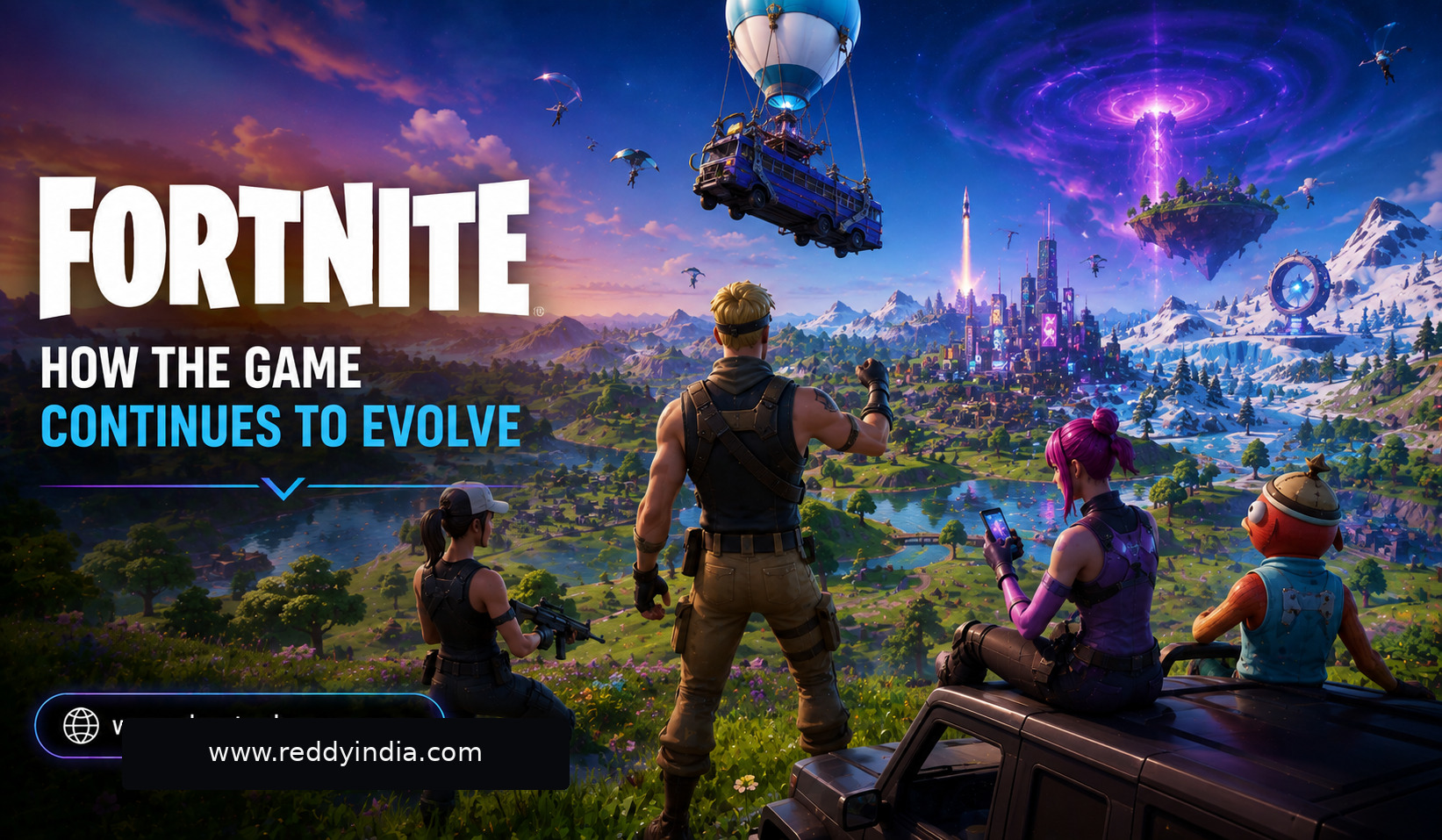
Fortnite: How the Game Continues to Evolve
Fortnite has changed dramatically since it first became a global battle royale phenomenon. What began as a game focused primarily on building, shooting, and surviving has gradually transformed into a much larger entertainment platform.
Today, Fortnite includes competitive Battle Royale, creator-made islands, music experiences, LEGO adventures, live events, social features, and tools that allow developers to build entirely new games inside the Fortnite ecosystem. Epic Games continues to add features that push the platform beyond its original identity.
The latest developments make that evolution especially clear. Fortnite Chapter 7 Season 4, Override, launched on August 20, 2026, introducing Match Overrides that allow players to activate changes to the rules of a match, along with new content and collaborations. At the same time, Unreal Editor for Fortnite (UEFN) is becoming more sophisticated, with Unreal MCP now available for connecting agentic coding tools directly to the editor.
So how did Fortnite become so much more than a battle royale game?
From Battle Royale to a Gaming Platform
Fortnite’s early success came from its battle royale mode, where 100 players competed to become the last player or team standing. The combination of shooting, building, a shrinking storm, colorful visuals, and frequent updates helped the game stand apart.
But Epic Games did not stop at the original formula.
Over time, Fortnite expanded into a platform where players can discover different types of experiences. Epic’s current ecosystem includes Battle Royale, Reload, Fortnite OG, LEGO Fortnite, Festival, Save the World, and creator-made islands.
This shift is important because Fortnite is no longer defined by one mode.
Instead, the game provides a common digital space where different forms of entertainment can exist.
Seasonal Updates Keep Fortnite Fresh
One of Fortnite’s biggest strengths has always been its ability to change.
Epic regularly introduces new seasons, weapons, locations, characters, mechanics, events, and limited-time experiences. This means players rarely return to exactly the same version of Fortnite they played months earlier.
The August 2026 launch of Fortnite Override illustrates that approach. The season introduces Override Consoles that can change rules across a match, along with new items, locations, gaming-themed collaborations, and the return of familiar Fortnite systems in new forms.
This constant reinvention helps prevent the game from becoming static.
Instead of asking players to remain interested in one fixed experience, Fortnite continually gives them reasons to return.
Crossovers Have Become Part of Fortnite’s Identity
Fortnite has also turned collaborations into a major part of its evolution.
The game has featured characters, music, themes, and content inspired by major entertainment and gaming brands. These collaborations help Fortnite remain connected to popular culture rather than existing as a completely isolated game.
Recent updates have continued this approach, with the Override season featuring Sonic the Hedgehog elements and other gaming-related content.
This strategy has an important benefit.
Players may discover Fortnite because they are fans of another franchise, while existing Fortnite players gain access to experiences outside the game’s traditional universe.
As a result, Fortnite increasingly functions as a meeting point between gaming, entertainment, and popular culture.
User-Generated Content Is Changing Fortnite
Perhaps the most important evolution is the rise of creator-made experiences.
Through Unreal Editor for Fortnite, creators can develop their own islands and gameplay systems rather than simply playing Epic’s official modes. Epic provides tools, documentation, publishing systems, discovery features, and monetization opportunities for developers.
This has changed Fortnite’s relationship with its community.
Players are no longer only consumers. Many can become creators themselves.
Someone can design an obstacle course, racing experience, horror game, role-playing adventure, social hangout, survival challenge, or completely different concept.
That turns Fortnite into a platform for experimentation.
UEFN Is Becoming More Powerful
Unreal Editor for Fortnite has become one of the biggest reasons behind Fortnite’s continued evolution.
The tools available to creators increasingly resemble professional game-development technology while still being connected to the Fortnite ecosystem.
The latest version, released on August 20, 2026, added Unreal MCP, allowing agentic coding tools such as Claude Code, Codex, and Cursor to connect directly to UEFN. Epic says this can reduce technical friction and help creators build and iterate faster.
This could eventually change how Fortnite experiences are created.
Developers may be able to use AI-assisted workflows to prototype gameplay mechanics, write code, test ideas, and iterate more quickly.
In other words, artificial intelligence may influence not only what players experience in Fortnite but also how Fortnite content is produced.
AI Is Becoming Part of the Creator Ecosystem
Fortnite’s evolution is increasingly connected to AI.
Epic has already introduced LLM-powered conversations for creator-made islands, allowing developers to create characters that can interact with players through more flexible conversations. Epic’s ecosystem news also highlights new AI-related development capabilities inside UEFN.
This could lead to a new generation of Fortnite experiences.
Imagine entering an island where characters can respond naturally to questions, provide information, react to player behavior, or influence the story.
Instead of every NPC using a fixed dialogue tree, AI could help make interactions more dynamic.
That creates possibilities for role-playing, mystery, adventure, educational, and social experiences.
Fortnite Is Becoming More Social
Another important change is the increasing emphasis on social experiences.
Fortnite is no longer simply a place to compete. Players can attend concerts, explore creative islands, interact with friends, participate in events, and experience entertainment together.
Fortnite Festival, LEGO Fortnite, and community-created islands all demonstrate how the ecosystem is expanding into different forms of shared activity. Epic’s current Fortnite channels continue to feature updates across Battle Royale, LEGO Fortnite, Festival, OG, and other experiences.
This wider social focus could become increasingly important as players spend more time inside virtual spaces.
Competitive Fortnite Is Evolving Too
While Fortnite has expanded dramatically, competitive play remains an important part of the ecosystem.
Epic continues to organize Fortnite Championship Series events and update its competitive structure. The 2026 FNCS Global Championship has been scheduled for September 26–27 in Antwerp, Belgium, with additional competitive events planned later in the year.
This shows how Fortnite manages two very different audiences at the same time.
Competitive players want balance, consistency, and skill-based competition.
Casual players often want experimentation, entertainment, and new surprises.
Epic’s challenge is maintaining both sides without allowing one to overwhelm the other.
Fortnite’s Identity Is No Longer Fixed
Perhaps the biggest change is that Fortnite no longer has one clear identity.
It can be a competitive shooter in one session, a racing game in another, a music experience later, and a social world after that.
This flexibility has become one of its greatest advantages.
Instead of forcing the audience to enjoy one style of gameplay, Fortnite provides multiple ways to participate.
That means the future of Fortnite does not necessarily depend on inventing one new blockbuster mode. It can evolve through dozens of smaller systems and experiences.
New Features Can Change the Rules
Fortnite’s latest developments also show that Epic is increasingly willing to experiment with the fundamental structure of gameplay.
The Override season is a good example. Override Consoles allow players to rewrite certain rules for an entire server after reaching the console first.
This idea goes beyond adding another weapon or location.
It changes the rules themselves.
That kind of experimentation could become more common as Fortnite evolves. Instead of simply introducing new content, Epic can introduce new ways of playing.
The Creator Economy Is Growing
Fortnite’s creator ecosystem is also becoming a major business platform.
Epic says more than $900 million has been paid to third-party Fortnite developers, supported by discovery, growth, publishing, and monetization tools.
This demonstrates the scale of the creator economy surrounding the game.
The more successful creator-made experiences become, the less Fortnite depends entirely on Epic for new ideas. Thousands of developers and creators can contribute to the ecosystem.
That makes Fortnite more difficult to predict—and potentially much harder to become outdated.
Accessibility Is Expanding
Another part of Fortnite’s evolution is broader device and input support.
Epic’s current developer documentation highlights mobile development, input tools, custom abilities, and other systems designed to help creators reach different audiences and build different types of experiences.
As gaming becomes increasingly cross-platform, flexibility will matter.
Fortnite’s future is likely to involve not just more content but more ways to access and interact with that content.
What Could Fortnite Become Next?
The most interesting question is what happens next.
Fortnite could increasingly blend traditional game modes with user-generated worlds, AI characters, social experiences, live entertainment, and AI-assisted development.
Creators may build experiences where AI generates or modifies parts of the gameplay. Players could interact with more advanced virtual characters. New tools could make sophisticated game creation accessible to smaller teams.
At the same time, Epic can continue using seasonal updates and major events to keep the main Fortnite experience changing.
The result could be a platform that feels less like one video game and more like a continuously evolving digital entertainment ecosystem.
Conclusion
Fortnite’s greatest achievement may not be its success as a battle royale game. It may be its ability to continually reinvent itself.
From Battle Royale and competitive esports to LEGO adventures, music experiences, creator-made islands, AI-powered interactions, and advanced UEFN development tools, Fortnite has expanded into a much broader gaming platform.
The latest 2026 updates show that this evolution is continuing. The Override season is experimenting with match-wide rule changes, while UEFN is becoming more connected to AI-assisted development through Unreal MCP.
That constant change is likely to remain Fortnite’s biggest advantage.
For players, it means there is always something new to discover. For creators, it means the tools keep becoming more powerful. And for the gaming industry, Fortnite offers a glimpse of a future where a game is no longer a fixed product released once and left largely unchanged.
Instead, it can become a living platform—one that evolves alongside its players.