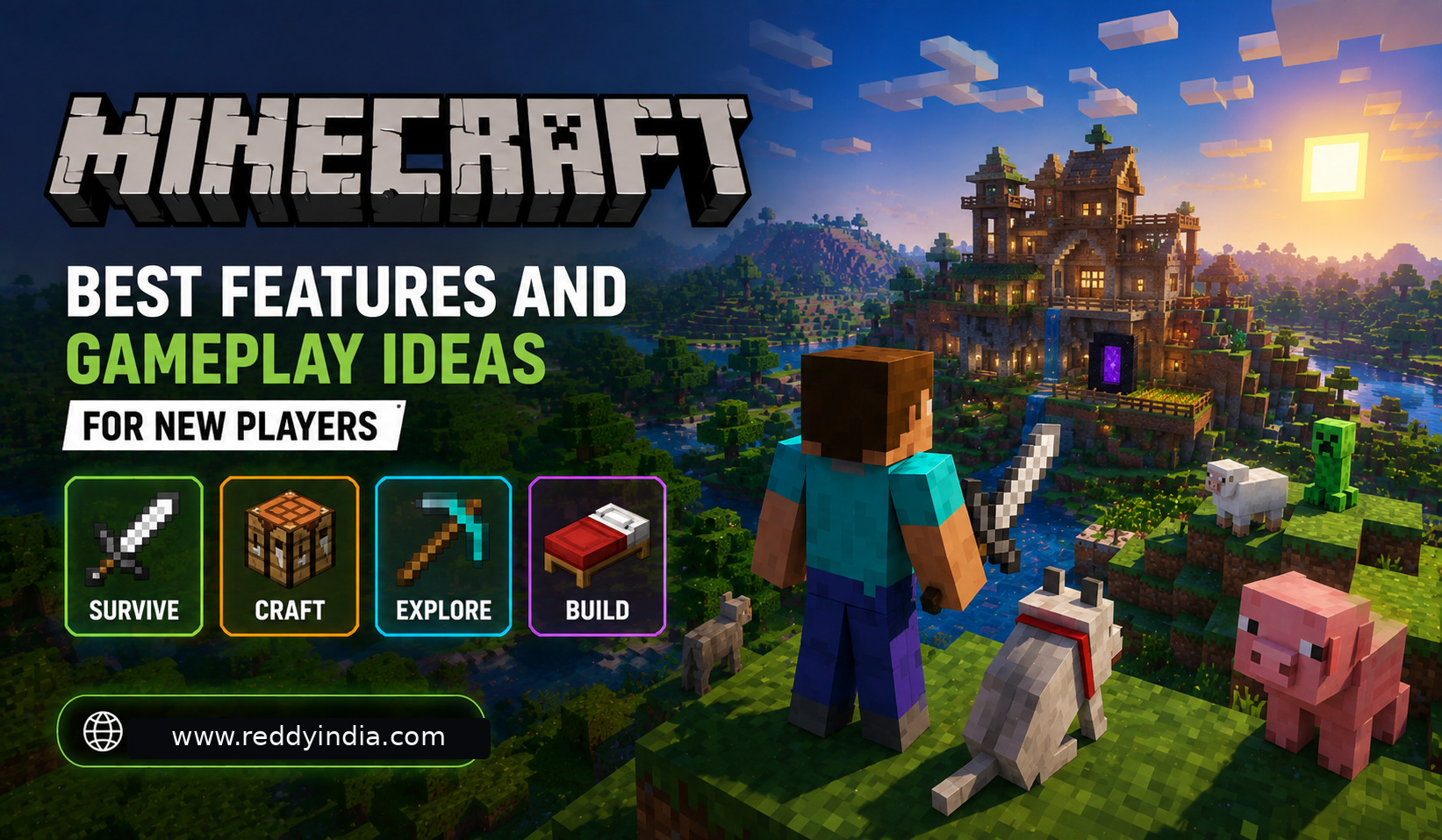
Minecraft: Best Features and Gameplay Ideas for New Players
Minecraft can look simple when you first start playing. You break blocks, collect resources, build structures, and explore a colorful world made entirely of cubes. But behind that simple design is an enormous sandbox with survival mechanics, crafting, exploration, farming, combat, automation, and countless creative possibilities.
For new players, the biggest challenge is often knowing where to begin. Minecraft does not force you to follow one specific path, so you are free to choose your own goals. That freedom is one of the game’s greatest strengths, but it can also feel overwhelming during the first few hours.
The good news is that you do not need to understand everything immediately. Learning a few essential features and trying different gameplay ideas can help you quickly become comfortable with the world.
Start by Learning the Basic Survival System
For most beginners, Survival mode is the best way to understand how Minecraft works.
When you enter a new world, your first priority should be gathering basic materials. Wood is especially important because it allows you to craft tools, a crafting table, and other early items.
As you explore, collect materials such as stone, coal, food, and eventually iron. These resources become the foundation for better tools, armor, weapons, and useful blocks.
The day-night cycle is also important. Hostile creatures can appear in dark areas, particularly at night, so creating a basic shelter before your first night is a smart goal.
Your first home does not need to be impressive. A small wooden or stone shelter with a door, torches, a bed, and storage is enough to get started.
Crafting Is One of Minecraft’s Most Important Features
Crafting is at the heart of Minecraft.
Almost everything useful is created by combining materials in different ways. Tools, weapons, armor, storage blocks, furnaces, decorative items, and countless other objects can be crafted.
New players should spend some time learning the basic crafting system instead of trying to memorize every recipe at once.
Start with essential items such as wooden or stone tools, torches, a furnace, chests, and a bed. Once these become familiar, gradually explore more advanced recipes.
The crafting system rewards experimentation. When you discover a new material, think about what it might be used for rather than simply storing it away.
Food and Farming Make Survival Easier
Food is essential in Survival mode because hunger affects your ability to recover health and maintain stamina.
Early in the game, you can collect food from animals or find crops in villages. Eventually, creating your own farm is a much more reliable solution.
Wheat, carrots, potatoes, and other crops can provide renewable food sources. You can also create animal farms for items such as meat, leather, wool, and eggs.
Farming becomes especially useful when you build a permanent base.
Instead of constantly searching for food, you can create a reliable supply nearby. This gives you more time to focus on exploration, building, and other activities.
Mining Introduces You to Minecraft’s Resource System
Mining is one of the classic Minecraft activities.
The underground world contains valuable resources that are needed for better equipment and construction. Coal can provide fuel and light, while iron is essential for many tools, weapons, armor, and utility blocks.
As you progress, you can search for rarer resources and experiment with different mining techniques.
Always carry torches, food, tools, and enough storage when going underground. It is also smart to avoid carrying every valuable item you own during risky expeditions.
Mining is not simply about finding rare materials. It teaches you how Minecraft’s underground environments work and encourages careful planning.
Exploration Can Be Just as Important as Building
Minecraft is not only about creating structures.
The world is filled with different landscapes, including forests, mountains, oceans, deserts, caves, and other environments. Exploring these areas can help you discover useful resources and interesting locations.
New players should make exploration a regular part of their gameplay.
A nearby village can provide food, shelter, and trading opportunities. Different environments may contain resources that are difficult to find elsewhere.
Bring a map or other navigation tools when traveling far from home. Losing your base can be one of the most frustrating experiences for a beginner.
Creating recognizable landmarks near your home can also make navigation easier.
Villages Are Great for Beginners
Villages can be extremely useful early in a Minecraft world.
They provide houses, farms, beds, and villagers who can participate in the game’s trading system. Finding a village can save a new player a significant amount of time.
Instead of building everything from nothing, you can use the village as a temporary base while learning the game.
You can also improve the settlement by adding walls, lighting, farms, roads, or additional buildings.
Over time, the village can become a larger project of its own.
Building Is Where Minecraft Really Opens Up
Once you understand basic survival, building becomes one of the most rewarding things to explore.
You do not need to create a huge castle immediately. Start with small projects that help you practice shapes, proportions, and materials.
Try building a better house, a bridge, a watchtower, a farm, or a storage room.
Once you become comfortable, you can experiment with larger ideas such as castles, cities, ports, underground bases, or fantasy villages.
A useful tip for beginners is to collect materials before starting a major construction project. Running out of blocks halfway through a build can interrupt your creative flow.
Redstone Opens the Door to Automation
Redstone is one of Minecraft’s most advanced systems, but beginners can still experiment with simple projects.
Redstone allows players to create mechanisms, switches, doors, traps, farms, transportation systems, and automated machines.
You do not need to understand complex circuits immediately.
Start with basic redstone doors, automatic lighting, simple farms, or item-sorting systems.
As you learn how components interact, you can build increasingly complicated machines.
Redstone is especially interesting because it introduces an engineering element into Minecraft. You are not simply placing blocks; you are designing systems that perform actions.
Try Creative Mode When You Want to Experiment
Creative mode is an excellent way for new players to learn building without worrying about survival.
You can access blocks and items without collecting them, fly around the world, and experiment freely.
This is particularly useful when you want to practice large structures or test an idea before attempting it in Survival mode.
Creative mode also helps beginners understand what different blocks look like and how they fit together.
There is nothing wrong with switching between Survival and Creative depending on what you want to accomplish.
Minecraft is designed around freedom, and you can choose the style of play that is most enjoyable for you.
Try Setting Your Own Goals
One of Minecraft’s most important features is that it does not require you to follow a single objective.
This can be confusing at first, but it is also what makes the game so replayable.
Instead of asking, “What am I supposed to do?” try asking, “What do I want to accomplish?”
You could set goals such as building your first proper house, creating a large farm, finding a specific resource, exploring a new biome, improving a village, or building a long-distance railway.
Personal goals make the sandbox feel much more structured.
Experiment With Different Playstyles
There is no single correct way to play Minecraft.
Some players spend most of their time building. Others enjoy mining, exploration, combat, farming, automation, or collecting rare items.
You can try several playstyles before deciding what you enjoy most.
A player who starts by building a house may eventually discover a passion for redstone. Another might begin with survival but become more interested in exploration.
The game is flexible enough to accommodate all of these approaches.
Multiplayer Can Add a Completely Different Experience
Playing Minecraft with friends introduces another layer of gameplay.
Instead of building everything alone, players can divide responsibilities. One person can gather materials while another builds. Someone else might explore or manage farms.
Multiplayer also creates opportunities for shared projects.
You could create an entire town, amusement park, castle, trading center, or transportation network together.
Playing with friends can also make difficult survival situations more enjoyable because players can support one another during exploration and combat.
Try Creative Challenges
Once you understand the basics, create challenges for yourself.
Build a house using only a specific type of block. Create a base inside a mountain. Build a bridge across an ocean. Recreate a real-world building. Construct an underground city.
Challenges keep Minecraft fresh because they provide a clear objective without limiting creativity.
You can even give yourself time limits or material restrictions to make projects more difficult.
Explore the Nether and Other Dangerous Areas Later
Minecraft eventually introduces much more dangerous environments.
The Nether is one of the most important areas to explore after you have established a strong base and obtained reliable equipment. It provides unique resources, structures, enemies, and materials that cannot be found in the normal Overworld.
Do not rush into dangerous areas without preparation.
Bring strong armor, food, weapons, tools, and a clear plan for returning safely.
Learning when to prepare and when to take risks is an important part of becoming a better Minecraft player.
Don’t Be Afraid to Lose Items
One of the hardest lessons for new Survival players is accepting that mistakes happen.
You may fall into a cave, get surprised by enemies, or lose valuable equipment far from home.
Instead of becoming frustrated, treat failures as part of learning the game.
Over time, you will become better at preparing for dangerous trips, protecting valuable items, and finding your way home.
Minecraft rewards experience more than perfection.
Keep Improving Your Base
Your first shelter is unlikely to become your permanent home.
That is completely normal.
As you collect better materials and learn new building techniques, upgrade your base.
Add storage rooms, farms, workshops, decoration, libraries, underground areas, or defensive structures.
Your base can become a visual record of your progress.
A simple wooden shelter at the beginning of the game can eventually turn into a huge settlement that reflects everything you have learned.
Minecraft’s Biggest Strength Is Freedom
The most important feature for new players may be the freedom to experiment.
Minecraft does not require you to follow a strict story or complete every available activity. You can ignore certain mechanics entirely and focus on what you enjoy.
Want to build? Build.
Want to explore? Explore.
Want to automate farms? Learn redstone.
Want to create stories with friends? Build a shared world.
That freedom is what makes Minecraft different from many traditional games.
Conclusion
Minecraft offers an enormous range of features and gameplay possibilities, but new players do not need to learn everything at once. Start with basic survival, learn crafting, collect reliable food, explore nearby areas, and create a simple base.
Once you are comfortable, experiment with villages, farming, building, redstone, exploration, multiplayer, and creative projects.
The best way to learn Minecraft is by playing with curiosity. Make mistakes, test ideas, build strange structures, explore unfamiliar places, and slowly discover the parts of the game you enjoy most.
There is no single correct way to play Minecraft. Its greatest feature is the freedom to create your own experience.
For a new player, the goal is not to master the entire game immediately. It is to start small, experiment often, and gradually turn a simple block-filled world into something that feels like your own.