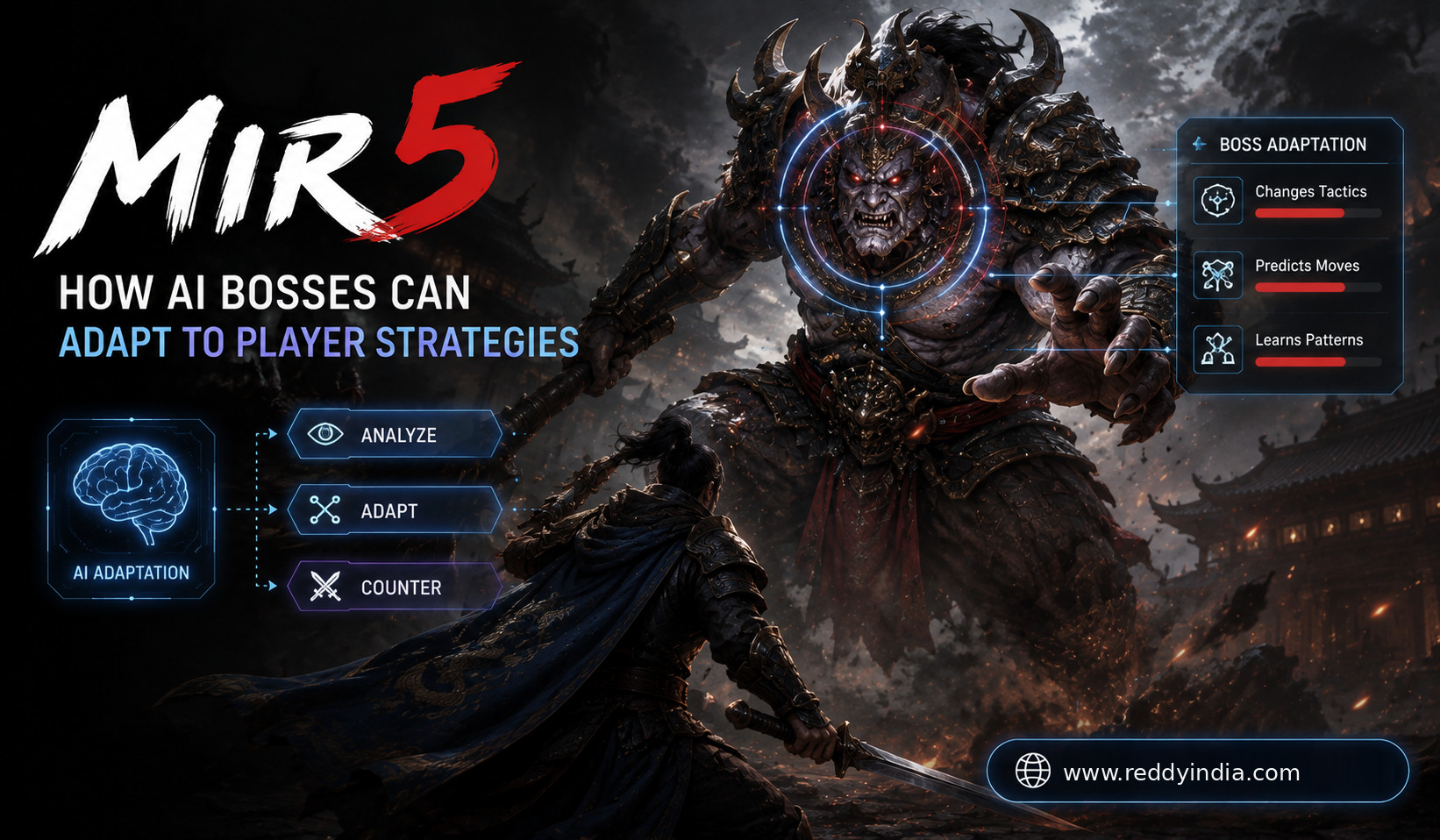
MIR5: How AI Bosses Can Adapt to Player Strategies
Boss battles have always been some of the most memorable moments in video games. Players learn attack patterns, recognize weaknesses, coordinate with teammates, and eventually develop strategies to defeat powerful enemies. But what happens when the boss can learn from the player too?
That is the idea behind MIR5, an upcoming MMORPG from Wemade Next that is being developed with NVIDIA. The game has attracted attention for Asterion, an AI-powered boss designed to analyze player behavior and adapt its combat strategies. Rather than relying entirely on fixed attack patterns, the AI boss is intended to learn from previous encounters and respond to the tactics used against it.
This approach could change one of the oldest formulas in gaming. Instead of players memorizing a boss’s behavior until they find the perfect counter, the fight becomes a two-way battle of adaptation.
What Is MIR5?
MIR5 is a PC open-world MMORPG based on Wemade’s Legend of Mir franchise. Wemade Next is developing the game with a focus on new technology and large-scale combat experiences. In January 2025, the studio announced a collaboration with NVIDIA to develop Asterion, an AI boss powered by NVIDIA ACE technologies.
According to the developers, Asterion is designed to use machine learning and small language models tailored to the game. The system can perceive combat situations, record information from previous battles, and use that information when determining future actions.
The goal is straightforward: make boss fights less predictable and more responsive.
The Problem With Traditional Boss Battles
Traditional MMORPG bosses usually follow carefully designed behavior patterns.
A boss might use one ability after another:
Attack → Area Attack → Defensive Phase → Special Attack → Repeat.
Players learn this sequence by repeatedly fighting the boss. Once they understand the pattern, they can prepare defensive abilities, position themselves correctly, and coordinate their team around known mechanics.
This design is not necessarily bad. Predictable mechanics can reward practice and teamwork.
However, repeated encounters can eventually become routine.
Once players know exactly what will happen, farming the same boss can become more about executing a checklist than reacting to an evolving opponent.
MIR5’s AI boss concept attempts to change that dynamic.
How Asterion Is Designed to Adapt
Asterion is being developed to analyze information about the players it is fighting. NVIDIA says the system can evaluate player loadouts and setups, compare them with information from previous encounters, and choose strategies intended to improve its chances of winning.
Wemade has also described the system as analyzing player composition, attributes, skills, and positioning. The boss can use information from past battles to adjust its attack strategy in real time.
That means the boss is not simply asking, “What attack comes next?”
It is effectively trying to answer, “What are these players doing, and what should I do about it?”
That difference could fundamentally change how players approach combat.
Players May No Longer Be Able to Rely on One Strategy
Consider a team that repeatedly uses ranged attacks from a safe distance.
A traditional boss may behave exactly the same way every time. Eventually, players discover the optimal positioning and repeat it.
An adaptive AI boss could instead recognize that pattern and adjust its own behavior.
It might prioritize certain targets, alter its positioning, change the timing of attacks, or use abilities that make the team’s preferred strategy less effective.
The exact implementation will depend on the final game, but the core concept described by NVIDIA and Wemade is that Asterion can respond to player tactics rather than simply following a fixed sequence.
This encourages players to keep changing their approach.
Learning From Previous Battles
One of the most interesting aspects of MIR5’s AI boss is its use of information from earlier encounters.
The developers have described Asterion as being capable of recording previous battles and using relevant experience when deciding what to do in later fights.
Imagine a guild defeating a boss several times using a particular combination of skills. Under a conventional system, the boss may remain identical.
With an adaptive system, previous battles can become part of the boss’s strategic information.
This creates the possibility that farming the same encounter repeatedly will not necessarily produce identical results.
NVIDIA says that even returning to a previously defeated boss could result in the encounter playing out differently because the AI evaluates the current setup and prior encounters.
AI Can Target Different Players
Another important possibility is more intelligent target selection.
In a multiplayer encounter, players usually have different roles. A tank may absorb damage, healers support the group, and damage dealers focus on attacking the boss.
An adaptive boss can potentially analyze those roles and decide who represents the greatest threat in a particular situation.
For example, if a team relies heavily on healing, the boss could prioritize disrupting that support structure. If one player is responsible for most of the damage, the AI could react to that player’s position and abilities.
Wemade and NVIDIA have specifically highlighted the AI’s ability to analyze player composition and determine how to respond to the group it is facing.
This could make teamwork more complicated—and potentially more rewarding.
The Importance of Positioning
Strategy in MMORPG combat is often about more than equipment. Positioning matters too.
Where players stand can determine whether they avoid an area attack, protect another teammate, maintain a damage advantage, or control the battlefield.
AI can potentially use positioning information when selecting its next action.
NVIDIA has said that the MIR5 system considers battle information such as positions, health, resources, skills, and other combat data when shaping AI behavior.
That could allow bosses to respond to how a team occupies the battlefield rather than simply checking whether a scripted trigger has been activated.
Every Fight Could Feel More Dynamic
The biggest benefit of adaptive AI is variety.
If a boss always uses the same mechanics in the same order, experienced players eventually optimize the encounter.
But if the boss can vary its strategy based on the players, combat becomes harder to solve permanently.
This does not necessarily mean the boss should become impossibly difficult. The purpose is to make the encounter require continued decision-making.
A successful fight could involve players adapting to the boss just as much as the boss adapts to them.
That creates a strategic feedback loop:
Players change their tactics → the AI responds → players recognize the response → players change again.
This can make combat feel much closer to an actual competition.
AI Could Change MMORPG Boss Farming
MMORPGs often rely heavily on repeated boss encounters. Players defeat the same enemies again and again to obtain rewards, improve equipment, or help guild members.
This creates a challenge for developers: how do you make repeated content remain interesting?
Adaptive AI may provide one answer.
Instead of rebuilding the boss encounter every week, developers could allow the AI to vary its behavior within defined parameters.
The underlying battlefield and abilities can remain recognizable while the boss’s strategic decisions change.
That could make repeated encounters feel less mechanical.
The Difference Between Randomness and Intelligence
There is an important distinction between a random boss and an adaptive boss.
Randomness simply changes behavior unpredictably.
Intelligent adaptation should respond to what the player is doing.
For example, randomly selecting an attack is not necessarily intelligent. But recognizing that players are grouped together and selecting a response that takes advantage of their formation is more meaningful.
The goal of AI combat systems is therefore not to make every attack surprising. It is to make the boss’s decisions feel connected to the situation.
That is what could make an AI boss more engaging than a boss that simply shuffles its abilities.
AI Does Not Eliminate Game Design
Even a highly adaptive boss needs boundaries.
Developers still need to determine the boss’s abilities, difficulty range, available strategies, and rules. Without those limits, an AI system could potentially produce behavior that is frustrating, unfair, or inconsistent with the game’s design.
This is why adaptive game AI works best as part of a controlled system.
NVIDIA has emphasized that Asterion is designed to use AI technologies to improve boss behavior rather than simply replacing conventional game design. The system evaluates available game information and selects actions within the game’s combat framework.
The developers remain responsible for defining what the boss can actually do.
What This Means for Players
For players, the most significant change could be psychological.
Traditional boss encounters encourage memorization:
“After this attack, the boss always does that.”
AI-driven encounters encourage observation:
“What is the boss reacting to, and what is it likely to do next?”
That changes the skill being tested.
Instead of mastering one fixed pattern, players may need to understand combat systems more deeply. They may have to recognize when a strategy is becoming predictable and switch tactics before the boss successfully counters it.
The Future of AI Boss Battles
MIR5’s Asterion could be an early example of a much larger trend in gaming.
Future AI bosses might remember thousands of encounters, recognize specific team compositions, identify common player habits, and develop increasingly sophisticated counterstrategies.
This technology could eventually spread beyond MMORPGs.
Action games could feature enemies that learn how aggressively a player fights. Strategy games could create opponents that adapt to preferred unit compositions. Horror games could generate enemies that react to how players explore their environments.
The common idea would be the same: the game responds to the person playing it.
Conclusion
MIR5’s AI boss concept demonstrates how artificial intelligence could fundamentally change MMORPG combat. Asterion is being designed to analyze player behavior, remember information from earlier encounters, evaluate player composition and positioning, and adapt its strategy accordingly.
The biggest potential advantage is replayability. A boss that adapts cannot be solved as easily through memorization alone. Players may have to experiment, communicate, change their tactics, and continually react to the battlefield.
There are still challenges around fairness, consistency, performance, and balancing AI behavior. But the concept points toward a future where bosses are not simply obstacles waiting for players to learn their patterns.
They can become opponents that learn too.
That could make the next generation of boss battles less about memorizing what happens next—and more about proving that you can adapt faster than the enemy.