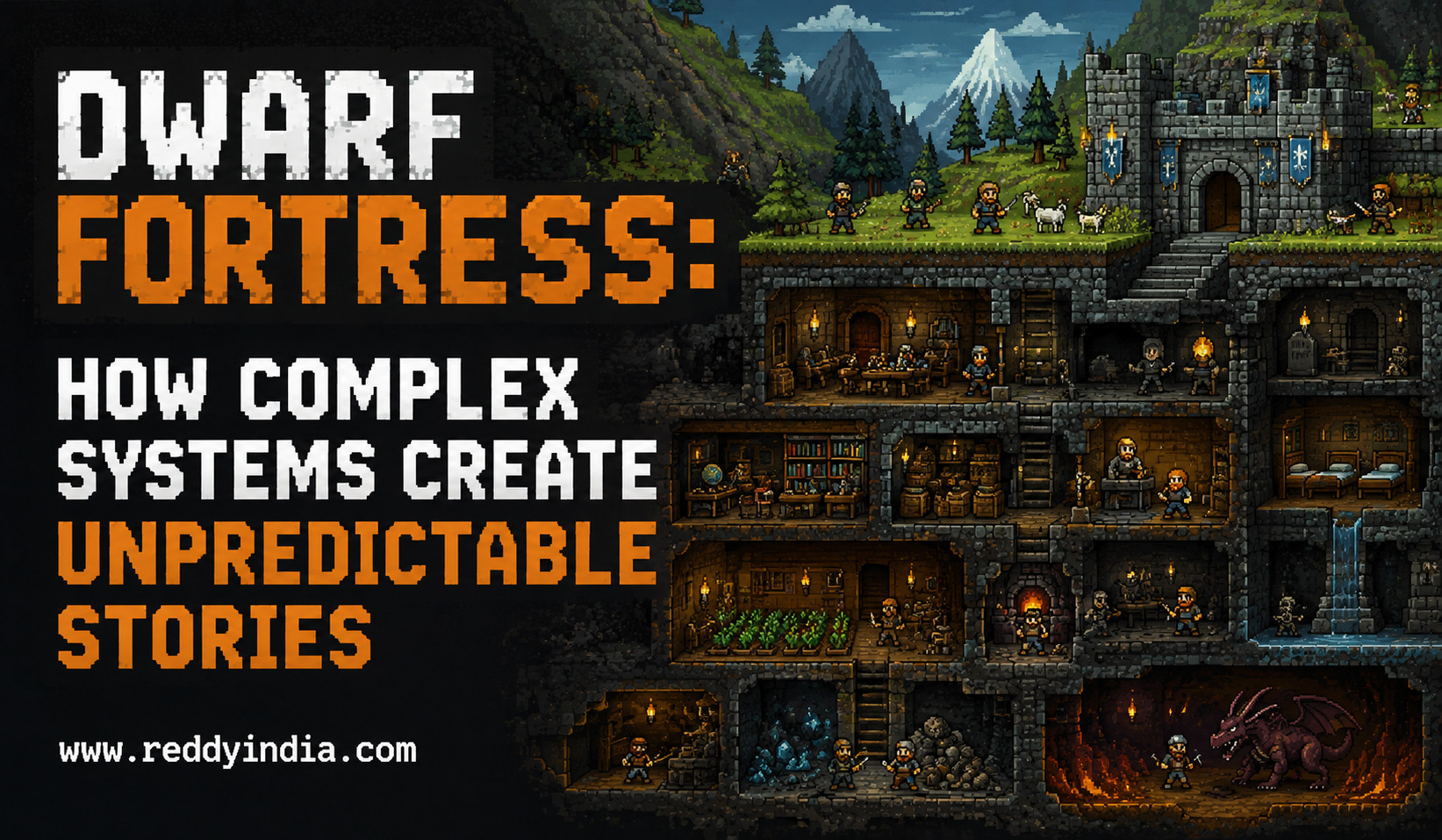
Dwarf Fortress: How Complex Systems Create Unpredictable Stories
Some video games tell stories through carefully written scripts, cinematic scenes, and predetermined character arcs. Dwarf Fortress takes a radically different approach. Instead of giving players a fixed narrative, it creates a world filled with interconnected systems and allows stories to emerge from the interaction between characters, environments, resources, creatures, weather, civilizations, and player decisions.
Developed by Bay 12 Games, Dwarf Fortress is famous for its extraordinary level of simulation. A fortress can begin as a simple settlement and eventually become a sprawling underground civilization filled with skilled workers, complicated relationships, economic systems, military conflicts, and unexpected disasters.
The technology behind this simulation is what makes the game so unusual. Events do not always happen because a developer specifically scripted them. They can emerge naturally from the systems interacting with each other.
A World Designed to Simulate Rather Than Script
Traditional games often have a clear distinction between gameplay and story. Developers write the main plot, create characters, and decide when important events occur.
Dwarf Fortress works differently.
The game generates a world with its own history, civilizations, geography, resources, creatures, and conflicts. Players then enter that world and begin making decisions.
There may be no predetermined story waiting for the player.
Instead, the simulation creates the conditions for stories to happen.
A dwarf might become an important military leader after surviving several battles. Another might develop a strong friendship with a fellow worker. A fortress could become wealthy before suddenly facing a food shortage.
These events can emerge from the simulation itself.
Complex Systems Working Together
The defining feature of Dwarf Fortress is its interconnected systems.
Dwarves have skills, personalities, needs, relationships, memories, preferences, and emotional responses. The fortress has food supplies, workshops, bedrooms, farms, defenses, stockpiles, and economic structures.
All these systems influence one another.
If a fortress expands quickly, more food may be required.
If there are not enough bedrooms, residents may become unhappy.
If a valuable resource is discovered, the settlement may become wealthier.
If defenses are weak, an enemy invasion can create chaos.
The player is constantly managing relationships between systems rather than simply completing objectives.
Individual Dwarves Make the World Feel Alive
Dwarf Fortress does not treat its population as a single group.
Individual dwarves have their own characteristics and histories.
They can develop preferences for particular foods, materials, environments, or activities. Their personalities can influence how they respond to events.
This creates an important distinction between a fortress and a collection of anonymous units.
When a dwarf survives a dangerous situation, the player may remember that character.
When another dwarf dies unexpectedly, the loss can affect the rest of the community.
These personal details give the simulation an emotional dimension.
Emergent Storytelling
Emergent storytelling is perhaps Dwarf Fortress’s most famous feature.
An emergent story is not necessarily written in advance. Instead, it develops because different systems interact in unexpected ways.
Imagine a fortress where a miner discovers a valuable underground resource.
The discovery could lead to increased wealth.
Greater wealth could attract traders.
More trade could encourage population growth.
Population growth could increase demand for food and housing.
The larger fortress could eventually attract enemies.
A single mining decision could therefore contribute to a much larger chain of events.
The player may never experience the same sequence twice.
Procedural Generation Creates Variety
Procedural generation is another important part of the game’s technology.
Dwarf Fortress can create large worlds with different landscapes, civilizations, histories, and resources.
Instead of placing every mountain, river, settlement, and historical event manually, the game uses algorithms to generate them.
This gives each world a distinctive identity.
The generated world can contain its own history before the player even begins.
Ancient wars, kingdoms, creatures, heroes, and disasters can become part of the background.
Players therefore enter a world that feels as though it existed before them.
A Simulation of History
One of Dwarf Fortress’s most fascinating characteristics is its approach to history.
The game can generate historical events that shape the world.
Civilizations rise and fall.
Wars take place.
Important figures gain influence.
Settlements expand or disappear.
These events create a sense of continuity.
When players begin building a fortress, they are not creating civilization from nothing. They are becoming participants in a world with an existing past.
This makes exploration especially interesting because discovering a location can also mean discovering its history.
The Importance of Resources
Resources play a central role in the simulation.
Wood, stone, metal, food, water, clothing, weapons, and other materials all have practical uses.
The availability of resources can influence how a fortress develops.
A location rich in minerals may encourage metalworking and military development.
A fertile area may support agriculture.
A region with limited resources may force players to trade or explore.
This means geography can influence the story.
The location chosen by the player is not simply a backdrop. It becomes one of the forces shaping the fortress’s future.
Economy and Social Structure
Dwarf Fortress also simulates economic relationships.
Dwarves perform different jobs, produce goods, consume resources, and contribute to the fortress economy.
Workshops allow the creation of increasingly complex products.
Trade can bring new resources into the settlement.
Wealth can influence social status and development.
These systems make the fortress feel like an actual community rather than a collection of buildings.
Economic decisions can also produce unexpected consequences.
Producing too many luxury goods may consume valuable resources, while failing to produce basic necessities can create serious problems.
Stress and Emotional Systems
One of the reasons Dwarf Fortress stories can become so unpredictable is that characters are affected by their experiences.
Dwarves can experience emotional reactions to events around them.
Death, violence, hunger, social conflicts, and other situations can affect their mental state.
This means that a single event can have consequences long after it happens.
A disaster may not end when the immediate danger is gone.
Survivors can carry emotional consequences forward, potentially influencing future behavior.
The simulation therefore connects events across time.
Disasters Become Stories
Dwarf Fortress is famous for disasters, but these disasters are often memorable precisely because they emerge from ordinary systems.
A fortress may experience a flood, fire, invasion, food shortage, cave-in, or creature attack.
The player may have planned carefully, but complex systems can still produce unexpected outcomes.
A disaster can destroy infrastructure, kill important characters, or force the remaining population to change how the fortress operates.
Instead of simply being failures, these events often become the most memorable stories.
Combat Is Part of the Simulation
Combat in Dwarf Fortress is also connected to the game’s broader simulation.
Characters have physical characteristics, equipment, skills, and injuries.
Battles can produce consequences that extend beyond a simple health bar.
A character may suffer an injury that affects future activities.
A warrior who survives repeated battles may develop a reputation.
A military victory may change relationships with neighboring civilizations.
Combat therefore contributes to the history of the fortress rather than existing as a completely separate gameplay system.
Why Complexity Creates Unpredictability
The more systems interact, the harder it becomes to predict exactly what will happen.
This is one of Dwarf Fortress’s greatest strengths.
Players can understand individual systems, but predicting the entire world is much more difficult.
For example, building a new workshop may appear to be a simple economic decision. However, it could change employment, resource consumption, wealth, production, and social behavior.
The outcome depends on the current state of the entire fortress.
This creates a form of unpredictability that feels organic.
Technology and Simulation Depth
Dwarf Fortress demonstrates what is possible when game technology focuses heavily on simulation.
Its systems are designed to represent relationships rather than simply provide scripted events.
This requires a different approach to game development.
Instead of creating every possible story manually, developers create systems capable of producing many possible situations.
The player then becomes an observer, manager, and participant in the resulting world.
That philosophy has influenced conversations about procedural generation, emergent storytelling, and simulation-based game design.
Why Players Remember Their Fortresses
Players often remember Dwarf Fortress stories because they feel personal.
A scripted game can deliver an emotional scene created by its writers.
Dwarf Fortress can produce an emotional event that happened because of the player’s decisions and the simulation’s reactions.
A dwarf might become a hero because the player sent them into danger.
A fortress might collapse because of a mistake.
A seemingly ordinary character might become central to the community after surviving a series of disasters.
These stories belong to the player.
They are not identical experiences shared by everyone.
Final Thoughts
Dwarf Fortress demonstrates how complex simulation systems can create unpredictable stories that feel genuinely unique to each player.
Its procedural worlds, individual characters, economies, resources, emotions, combat systems, and historical simulations interact continuously.
The result is a game where developers do not need to write every story themselves.
Instead, they create the systems that make stories possible.
That is the real power of Dwarf Fortress. A fortress can succeed, fail, grow, collapse, or transform in ways the player never expected. The most memorable moments often come from situations that nobody deliberately scripted.
By combining procedural generation with deep simulation, Dwarf Fortress shows that the future of interactive storytelling does not always have to involve more cinematic narratives. Sometimes, the most compelling stories can emerge when technology creates a world, players make decisions, and the systems are allowed to determine what happens next.