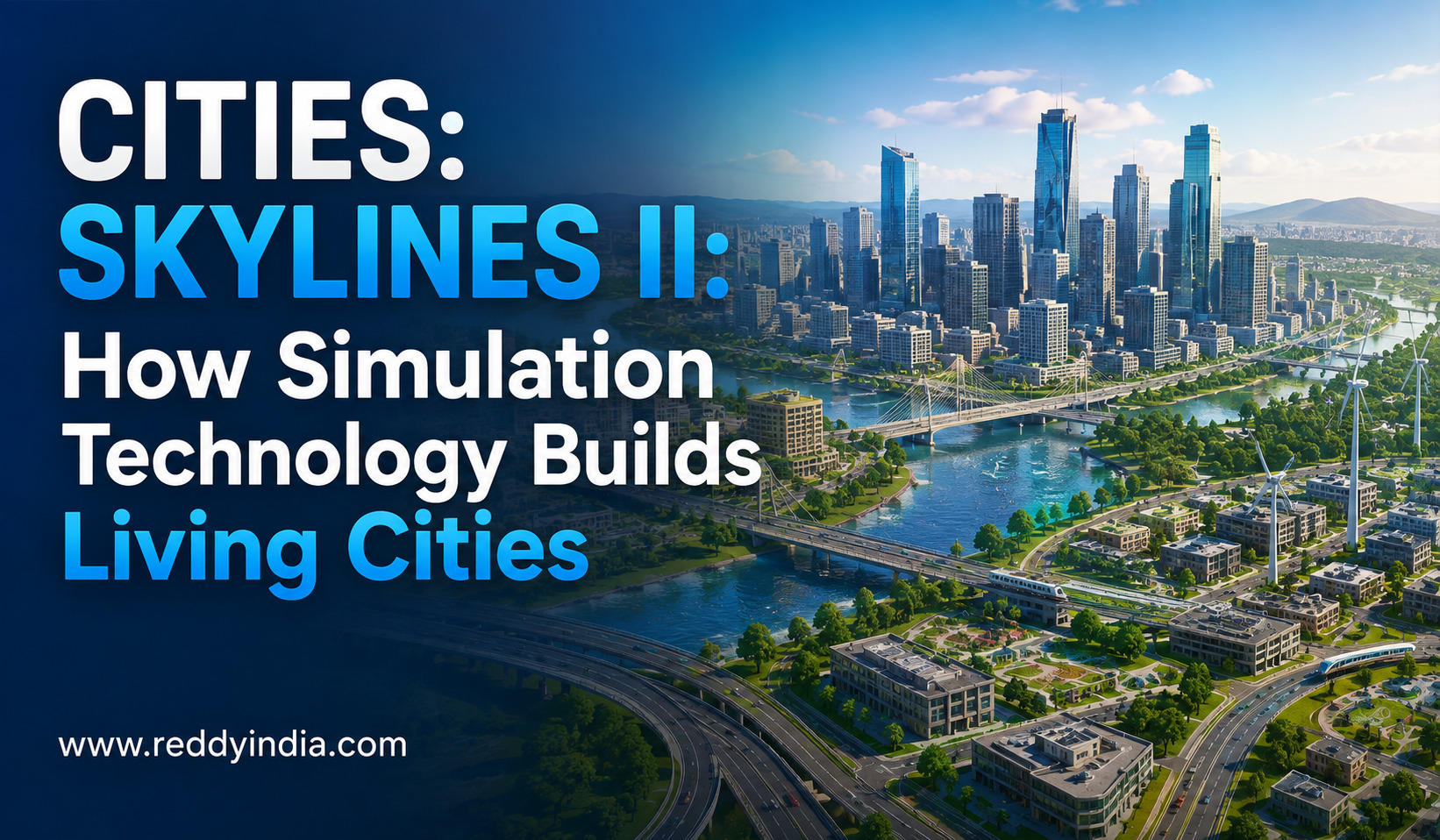
Cities: Skylines II: How Simulation Technology Builds Living Cities
City-building games have evolved far beyond simply placing roads and constructing buildings. Modern simulation technology can model traffic, public services, economies, population movement, weather, and countless other systems to create virtual cities that feel increasingly alive. Cities: Skylines II is a strong example of this evolution.
Developed by Colossal Order and published by Paradox Interactive, Cities: Skylines II gives players the responsibility of planning and managing a growing city. From the first road to large residential districts, players make decisions that influence how their cities develop.
What makes the game particularly interesting is the technology behind its simulation systems. The virtual city is not simply a collection of buildings. It is a network of interconnected systems where decisions in one area can create consequences somewhere else.
A City Built From Interconnected Systems
The foundation of Cities: Skylines II is its simulation.
Players begin with a relatively small area and gradually transform it into a complex urban environment. Roads connect neighborhoods, buildings provide homes and workplaces, businesses serve residents, and public services support the population.
Each part of the city depends on other parts.
A new residential district can increase traffic. More residents can increase demand for schools and healthcare. New businesses can create employment while requiring better transportation infrastructure.
This interconnected structure is what makes city simulation different from a simple construction game.
The player is not only building a city. They are managing a system.
Simulation Technology Behind the City
A modern city contains thousands of individual activities happening at the same time. Cities: Skylines II attempts to represent many of these activities through simulation.
Citizens have homes, jobs, transportation needs, and daily routines. Vehicles move through the road network. Businesses require resources and customers. Public services respond to the needs of residents.
These systems operate together.
When the player changes the city’s infrastructure, the simulation responds.
Building a new highway can change traffic patterns. Expanding public transportation can reduce pressure on roads. Creating a new commercial district can change where citizens travel for shopping.
The technology behind the game therefore turns player decisions into dynamic consequences.
Traffic Simulation and Intelligent Transportation
Traffic is one of the most visible parts of a city simulation.
Cities: Skylines II uses detailed transportation systems to represent how vehicles move through urban areas. Cars, buses, trucks, emergency vehicles, and other forms of transportation interact with the road network.
This makes road planning an important part of city development.
A poorly designed intersection can create congestion far beyond the immediate area. A highway connection can influence traffic across multiple neighborhoods.
Public transportation can also change how citizens move around the city.
The result is a system where transportation decisions become long-term planning decisions rather than simple construction choices.
Citizens as Individual Participants
Another important feature of Cities: Skylines II is the role of individual citizens.
Instead of treating population as a single number, the game represents residents as participants in the city’s economy and transportation systems.
Citizens live in homes, travel to workplaces, use services, and move through the city.
This helps create the feeling that the city is populated by people rather than abstract statistics.
The simulation becomes more convincing when citizens respond to changes in their environment.
If a new district provides jobs and housing, population can grow. If services become inadequate, the city can face problems.
This creates a continuous feedback loop between urban planning and population behavior.
Economy and Urban Development
Economic simulation is another major part of Cities: Skylines II.
A city needs money to construct roads, schools, hospitals, transportation systems, utilities, and other infrastructure.
At the same time, residents and businesses contribute to the city’s economy through taxes and economic activity.
This creates difficult decisions for players.
Spending heavily on infrastructure may improve the quality of life but create financial pressure. Raising taxes may generate additional revenue but potentially affect residents and businesses.
Economic decisions therefore become connected to population growth and urban development.
A city’s financial health can influence how quickly it expands.
Zoning and the Growth of Neighborhoods
Zoning systems help determine how different parts of the city develop.
Residential areas provide housing, commercial zones support businesses, and industrial areas create economic activity.
Players can influence where these zones are located, but the simulation determines how development responds to demand and surrounding conditions.
This creates an important balance between planning and unpredictability.
The player establishes the framework, while the simulation determines how the city grows within that framework.
This is one of the reasons city-building games can produce very different results from similar starting conditions.
Public Services and Quality of Life
A functioning city needs more than roads and buildings.
Cities: Skylines II includes systems for healthcare, education, emergency services, waste management, electricity, water, and other essential infrastructure.
These services interact with the population.
Building a new residential area without providing enough schools or healthcare facilities can create problems.
Similarly, expanding the city without improving utilities can place additional pressure on infrastructure.
This demonstrates a basic principle of urban planning: growth creates new demands.
The simulation technology allows players to experience this relationship directly.
Weather and Environmental Simulation
Environmental systems add another layer to the city’s behavior.
Weather can affect transportation, infrastructure, energy use, and daily life.
Rain, snow, temperature changes, and seasonal patterns can influence how the city operates.
These effects make the environment feel less static.
A city that looks perfectly organized during one season may face different challenges under another set of conditions.
This adds unpredictability and encourages players to design infrastructure that can handle changing circumstances.
The Importance of Electricity and Utilities
Utilities are another example of interconnected simulation.
Electricity and water systems need to support the city’s population and development.
As the city grows, demand increases.
Players must expand production and distribution systems to keep up.
This creates another planning challenge because infrastructure must often be built before demand reaches critical levels.
The player is therefore encouraged to think ahead rather than reacting only after problems occur.
Technology Creates Emergent Stories
One of the most interesting aspects of Cities: Skylines II is its ability to create stories without requiring a traditional narrative.
A city can experience unexpected events simply because different simulation systems interact.
A new highway might bring economic growth but create congestion in another neighborhood.
A rapidly growing population might increase tax revenue while putting pressure on schools and healthcare.
An industrial area might create jobs while generating environmental challenges.
These situations are not necessarily scripted stories.
They emerge from the simulation.
This is where technology becomes especially important to the game’s storytelling potential.
AI and Decision-Making in City Simulation
Although Cities: Skylines II is not primarily an AI game, intelligent simulation systems influence how residents and traffic behave.
The game must process large numbers of interactions to create a believable urban environment.
Citizens need to determine where they live, work, shop, and travel. Vehicles need to navigate roads and respond to changing traffic conditions.
These behaviors contribute to the sense that the city has its own momentum.
The player makes major decisions, but the simulated population reacts.
That relationship between player decisions and autonomous behavior is central to the game’s appeal.
Building Cities That Adapt
Successful city planning requires adaptation.
Players cannot simply create one plan and expect it to work forever.
As population increases, old roads may become insufficient. New neighborhoods may require additional services. Businesses may demand better transportation. Infrastructure may need upgrades.
The simulation constantly provides feedback.
This makes Cities: Skylines II an interesting digital model of urban planning because it encourages players to think about both immediate needs and long-term consequences.
Technology and the Future of City Planning
City-building simulations can also provide a simplified way to think about real-world urban challenges.
Real cities are vastly more complicated, but the basic concepts are familiar.
Transportation affects economic activity. Housing affects population growth. Public services influence quality of life. Infrastructure decisions can create long-term consequences.
Games such as Cities: Skylines II turn these relationships into interactive systems.
Players can experiment with different approaches and observe what happens.
This makes simulation technology useful not only for entertainment but also as a way to encourage interest in urban planning and systems thinking.
Why Cities: Skylines II Feels Like a Living City
The game’s biggest strength is the way different systems interact.
Traffic affects citizens.
Citizens affect businesses.
Businesses affect employment and tax revenue.
Population growth increases demand for services.
Services influence the quality of life.
Infrastructure supports all of these systems.
Because everything is connected, the city can develop in ways that the player does not completely control.
That unpredictability creates the feeling of a living environment.
Final Thoughts
Cities: Skylines II demonstrates how simulation technology can transform city-building games into dynamic digital environments where thousands of interconnected decisions shape urban life.
Its transportation systems, citizens, economy, public services, utilities, zoning, and environmental features work together to create cities that respond to player decisions.
The game is not simply about placing buildings on a map. It is about understanding relationships between systems and adapting to the consequences of urban growth.
That is what makes simulation technology so powerful in modern gaming. Instead of following a fixed storyline, players can create their own stories through decisions and unexpected outcomes.
Cities: Skylines II shows that a virtual city can feel alive when technology gives its residents, infrastructure, economy, and environment the ability to respond to one another. The result is an experience where every road, building, neighborhood, and policy can influence the future of the city.