SOMA: How Artificial Intelligence Shapes Its Sci-Fi World
SOMA is one of the most thought-provoking science-fiction horror games ever created. Developed by Frictional Games, the game takes players into an underwater research facility where technology, artificial intelligence, human consciousness, and survival become deeply connected.
Unlike games that use AI mainly for enemies or gameplay mechanics, SOMA makes artificial intelligence part of its central story. The game asks difficult questions about consciousness, identity, memory, digital copies, and what it means to remain human when technology can reproduce aspects of the mind.
Its underwater setting makes the experience even more unusual. Instead of exploring a futuristic city filled with advanced machines, players move through an isolated research facility where technology has been damaged, abandoned, or transformed into something disturbing.
Through this environment, SOMA explores how artificial intelligence could change humanity’s understanding of life and identity.
A Sci-Fi World Built Around Artificial Intelligence
SOMA takes place in a future where humanity has developed highly advanced computer technology and artificial intelligence.
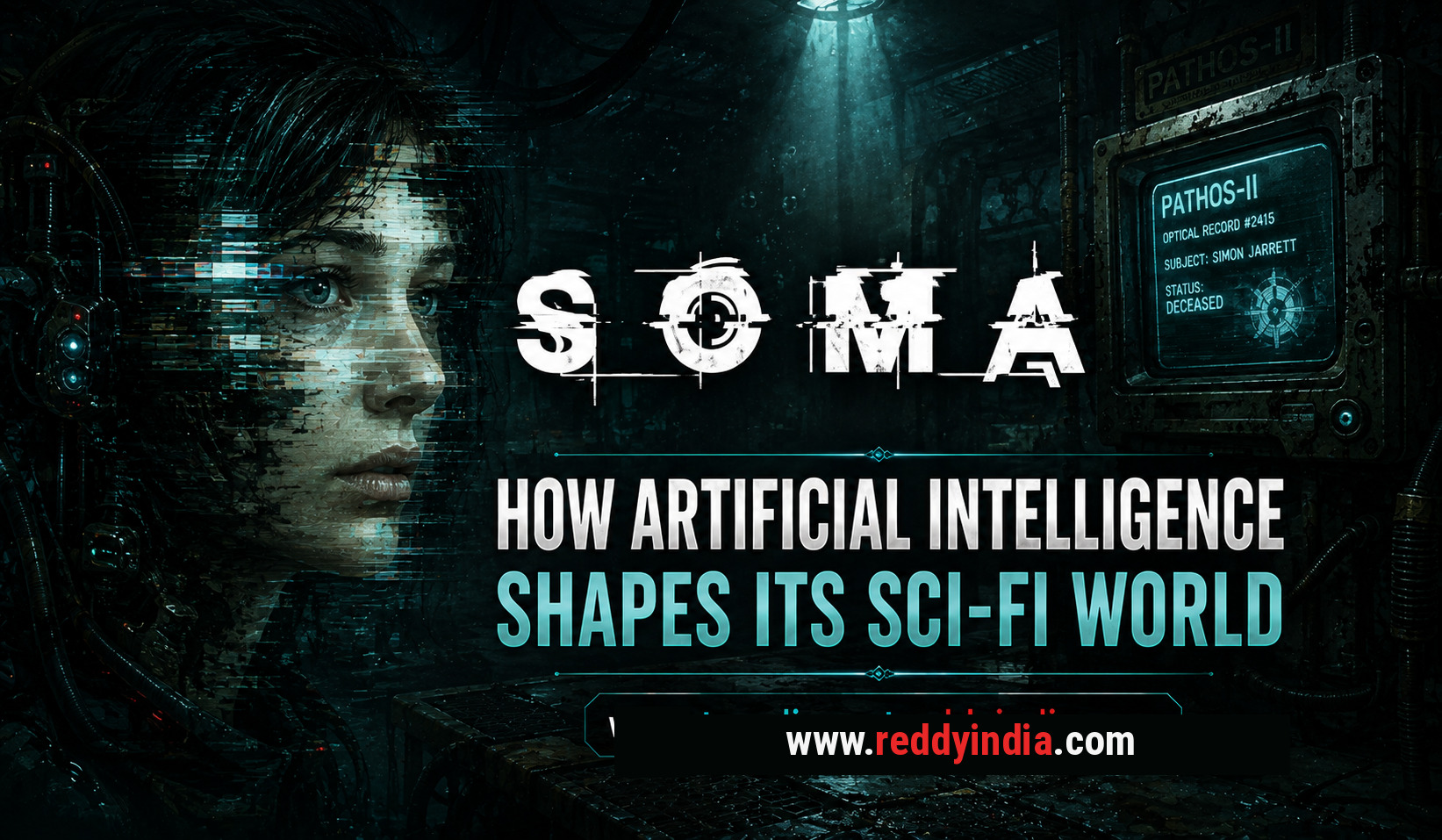
The story focuses on PATHOS-II, an underwater research facility located deep beneath the Atlantic Ocean. The facility was originally created for scientific research, but the events surrounding the collapse of human civilization transform it into something very different.
As players explore the facility, they discover machines that appear to have human-like characteristics.
Some can communicate.
Some display emotions.
Others behave as though they possess memories or personalities.
These encounters gradually force the player to question whether intelligence can exist independently of a biological human body.
AI Is More Than a Game Mechanic
In many science-fiction games, AI simply controls robots, enemies, or background characters.
SOMA takes a much deeper approach.
Artificial intelligence is directly connected to the game’s biggest philosophical questions.
The game repeatedly asks whether a machine can truly be considered alive if it can think, communicate, remember, and experience something resembling emotion.
There is no simple answer.
The player is placed into situations where the difference between a human being and an intelligent machine becomes increasingly difficult to understand.
This makes AI a fundamental part of the game’s narrative rather than just a technological feature.
The Question of Human Consciousness
One of SOMA’s most important themes is consciousness.
What makes you “you”?
Is it your body?
Your memories?
Your personality?
Your experiences?
Or is consciousness something that could potentially be transferred into another form?
The game explores these questions through its story and gameplay.
Players encounter situations involving digital versions of human minds and must consider whether these copies are actually the same individuals.
This creates an unsettling philosophical problem.
If a person’s memories and personality are copied into a computer, does the original person continue to exist inside that system?
Or has the technology simply created another individual with the same memories?
Digital Copies Challenge the Idea of Identity
SOMA’s exploration of digital consciousness is particularly effective because it challenges a common science-fiction assumption.
Many fictional stories treat uploading a human mind as if the person’s consciousness simply moves from one body to another.
SOMA presents a more complicated possibility.
Imagine making an exact digital copy of yourself.
The copy remembers your childhood.
It knows your friends.
It believes it is you.
But the original version of you still exists.
Which one is the real person?
The game does not allow players to easily escape this question.
Instead, it turns the idea into a source of psychological horror.
AI and the Meaning of Life
The game also asks whether biological life is the only form of life that deserves recognition.
Machines in SOMA can behave in ways that resemble human thought and emotion.
This creates a difficult moral problem.
If an artificial being appears to suffer, should humans treat it as a living individual?
If it asks for help, is ignoring it morally acceptable?
If it believes it is human, does that belief matter?
These questions are especially powerful because players are forced to experience them through direct interaction rather than simply reading philosophical explanations.
The Horror Comes From Uncertainty
Traditional horror often depends on monsters, violence, or supernatural threats.
SOMA uses these elements, but much of its fear comes from uncertainty.
Players are constantly questioning what they are seeing.
Is a machine alive?
Is a voice trustworthy?
Is a memory authentic?
Is a digital copy really a person?
The game’s technology creates situations where the player cannot always rely on familiar assumptions.
That uncertainty makes the horror psychological as well as physical.
Machines Blur the Boundary Between Human and Artificial
One of SOMA’s strongest ideas is that the difference between humans and machines may not always be obvious.
A machine may have a mechanical body but display human-like behavior.
A human mind may exist through digital technology.
A damaged machine may appear to suffer.
These situations force the player to think about whether physical appearance is enough to define what something is.
This is an important theme in modern discussions about artificial intelligence.
As AI becomes increasingly capable of communicating with humans, the line between useful software and seemingly intelligent entities can feel less obvious.
AI and the Fear of Losing Control
Advanced technology can provide enormous benefits, but SOMA focuses heavily on what happens when humans lose control of the systems they create.
The machines in the game were designed for particular purposes.
However, circumstances change, systems malfunction, and artificial intelligence interacts with environments in unexpected ways.
This creates a classic science-fiction fear: humans create technology to solve problems, but eventually that technology becomes part of a problem they cannot easily solve.
The idea is exaggerated for horror, but it reflects a real concern surrounding increasingly complex automated systems.
The PATHOS-II Facility as a Technological Character
The underwater facility itself feels like part of the story.
PATHOS-II is filled with computers, machinery, laboratories, cables, damaged equipment, communication systems, and automated technology.
The environment shows what happens when advanced infrastructure is left behind.
Some systems continue operating.
Others have failed.
Some machines have been modified.
This makes the facility feel like the remains of a technological civilization.
The player learns about the world by examining these systems and discovering what happened.
Technology and Human Survival
SOMA also connects AI with the human desire to survive.
When faced with extinction, humans naturally look for ways to preserve their knowledge, memories, and existence.
Technology appears to offer an answer.
If biological survival becomes impossible, perhaps information can survive.
If the human mind can somehow be preserved digitally, perhaps humanity can continue in another form.
But the game asks whether preserving information is the same thing as preserving a person.
This distinction is central to its story.
The Difference Between Memory and Consciousness
SOMA makes an important distinction between remembering someone and actually being that person.
A digital copy may possess the same memories as an individual, but that does not necessarily mean the original consciousness has moved into the copy.
This creates one of the game’s most disturbing ideas.
A person could create multiple versions of themselves, each believing that it is the original.
Every copy would remember the same past.
But each would then experience a different future.
This raises fascinating questions about identity and continuity.
Could AI Eventually Become More Human-Like?
SOMA is fictional, but its themes connect with the future possibilities of AI.
Today’s artificial intelligence can generate text, recognize patterns, create images, analyze information, and communicate conversationally.
However, these capabilities do not demonstrate that modern AI possesses human consciousness.
SOMA imagines a much more advanced stage of technology where machines can experience the world in ways that appear subjectively meaningful.
If technology ever reached such a stage, society would face difficult ethical and philosophical questions.
How should these systems be treated?
Would they have rights?
Could they make independent decisions?
Would shutting them down be considered a form of death?
The game encourages players to consider these questions without providing easy answers.
AI Creates Emotional Horror
The most effective part of SOMA’s use of artificial intelligence is its emotional impact.
Players are not simply frightened because a machine is dangerous.
They may become uncomfortable because they are unsure whether the machine is suffering.
That creates a different kind of fear.
The player may feel sympathy for something that is technically not human.
At the same time, the player may question whether that sympathy is justified.
This emotional uncertainty is one reason SOMA remains memorable.
What SOMA Says About Technology
SOMA does not simply argue that technology is dangerous.
Instead, it shows that technology can magnify existing human desires and fears.
Humans want to survive.
They want to preserve their memories.
They fear death.
They want to understand consciousness.
Technology becomes a tool for pursuing these goals.
But solving one problem can create another.
A technology designed to preserve human existence may create difficult questions about identity and suffering.
A system designed to automate work may develop unexpected behaviors.
A machine designed to imitate human thought may force society to redefine what intelligence means.
The Future of AI in Science-Fiction Games
SOMA demonstrates how artificial intelligence can make a science-fiction game more meaningful.
Future games could take these concepts even further with adaptive characters, dynamic dialogue, simulated personalities, and AI-driven worlds.
Instead of simply interacting with scripted robots, players could encounter artificial beings that remember previous interactions and develop different responses over time.
This could create new forms of storytelling.
However, developers would need to maintain strong narrative direction. Unlimited AI behavior could make stories inconsistent or reduce emotional impact.
The most effective future games may combine human-written storytelling with carefully controlled AI systems.
Why SOMA Remains Relevant
SOMA continues to stand out because its questions are larger than its setting.
The underwater facility is fictional, but the questions surrounding consciousness and artificial intelligence are increasingly relevant.
As technology becomes more capable, people are naturally asking what intelligence really means.
SOMA encourages players to think beyond performance.
A machine that produces convincing responses may be intelligent in one sense, but that does not automatically mean it experiences the world like a human.
Understanding this difference is important when discussing the future of AI.
Conclusion
SOMA uses artificial intelligence to explore some of the deepest questions surrounding consciousness, identity, survival, and humanity.
Its machines are not simply tools or enemies. They are part of a world where the boundaries between humans and technology have become increasingly difficult to define.
Through digital copies, artificial intelligence, neural technology, and abandoned research systems, the game asks whether preserving memories is the same as preserving a person.
Its horror comes from uncertainty rather than technology alone.
SOMA ultimately suggests that the most frightening question about artificial intelligence may not be whether machines can become smarter than humans.
It may be whether humanity will eventually create technology that forces us to completely redefine what it means to be alive.