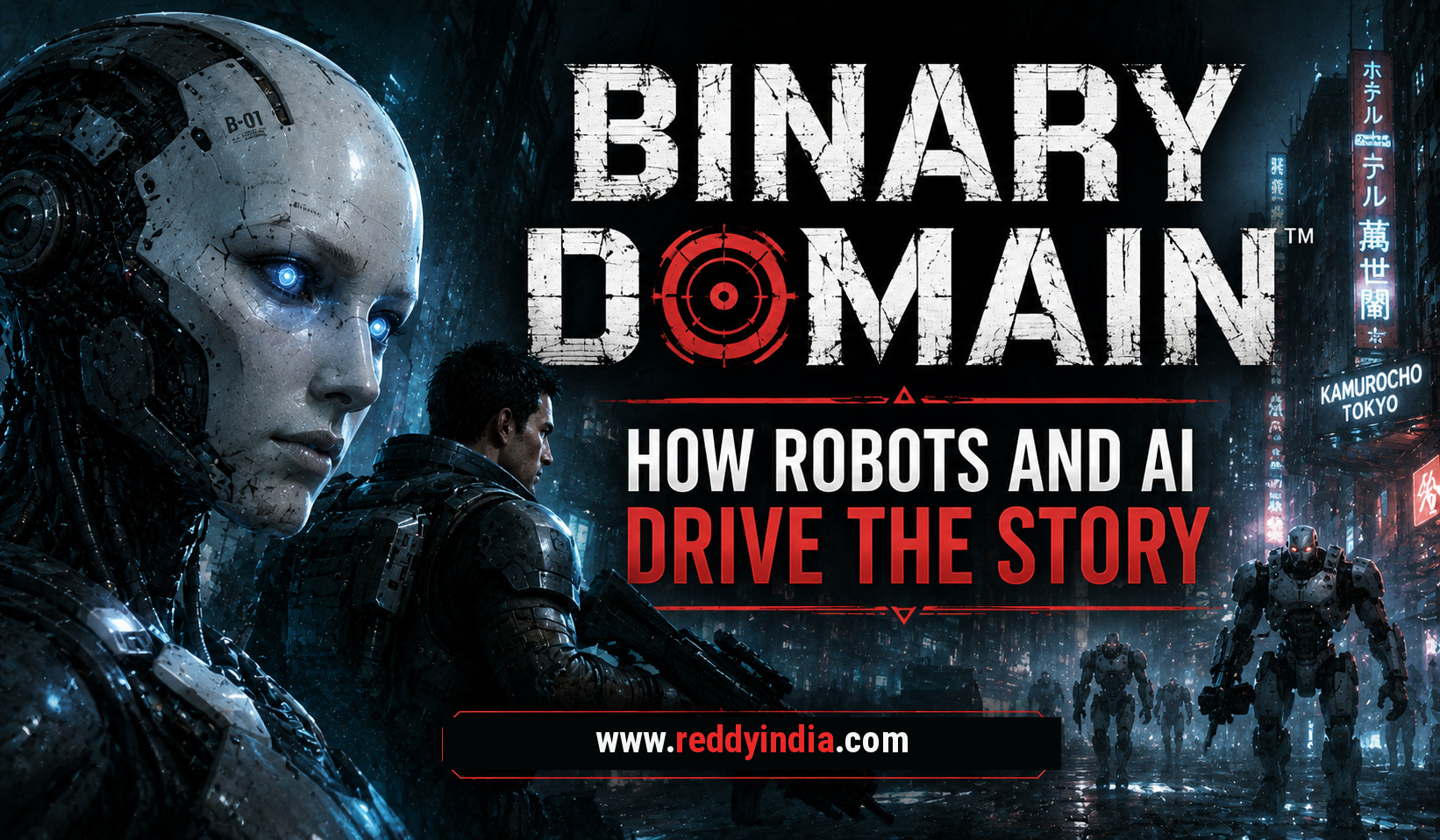
Binary Domain: How Robots and AI Drive the Story
Science-fiction games often use robots and artificial intelligence to imagine what the future might look like, but some go further by asking what happens when machines begin to challenge the boundaries between human and artificial life. Binary Domain is one such game. Developed by Ryu Ga Gotoku Studio and released by Sega, the third-person shooter combines intense combat with a story centered on robots, artificial intelligence, identity, and humanity’s relationship with advanced machines.
Set in a futuristic version of Tokyo, Binary Domain presents a world where robots have become an important part of society. They are designed to serve humans, perform dangerous work, and support technological progress. However, the arrival of increasingly sophisticated machines creates a much bigger question: what happens when robots become capable of thinking, feeling, and behaving like people?
The answer forms the foundation of the game’s story.
A Future Built Around Robots
Binary Domain takes place in 2080, in a world where climate change and rising sea levels have dramatically changed the planet. Tokyo has also transformed into a heavily controlled technological environment.
Robots are everywhere.
They perform industrial tasks, assist humans, and take on jobs that would otherwise require significant human labor. At first glance, this seems like the logical result of technological advancement.
But the game’s world contains a deeper problem.
A new generation of robots begins to appear that looks increasingly human. These machines are not simply metal workers or military equipment. They can resemble humans closely enough to create uncertainty about who is actually a person.
This technological development becomes the foundation of the game’s central mystery.
The Human-Looking Robot Problem
One of Binary Domain’s most important ideas is the concept of robots that can pass as humans.
This creates a major philosophical problem.
If a machine looks like a human, communicates like a human, and behaves like a human, what separates it from an actual person?
The game uses this question to create tension between its characters and the robotic enemies they encounter.
The distinction between human and machine gradually becomes less obvious. Players are encouraged to think beyond the physical appearance of robots and consider their behavior, memories, emotions, and ability to make decisions.
This gives the game’s action-heavy story a surprisingly thoughtful foundation.
Artificial Intelligence Becomes a Story Driver
Artificial intelligence is not simply an explanation for why robots are dangerous. It actively drives the narrative.
As robots become more advanced, questions emerge about who created them, how they are programmed, and whether they are capable of independent thought.
The story revolves around an investigation into these developments.
Players gradually discover that the robot problem is connected to larger technological and political issues. What initially looks like a straightforward conflict between humans and machines becomes a much more complicated situation involving the nature of artificial intelligence itself.
The result is a story where every technological discovery can change the player’s understanding of what is happening.
The “Hollow Child” Concept
One of the game’s most important technological ideas is the concept of the “Hollow Child.”
These advanced robots are designed to closely resemble humans, making them difficult to distinguish from ordinary people.
The concept creates a disturbing possibility: a robot could exist among humans without anyone realizing it.
This adds a psychological dimension to the story.
Instead of asking only whether robots can defeat humans physically, Binary Domain asks whether machines could eventually become indistinguishable from the people who created them.
That question becomes increasingly important as the story develops.
Robots Are More Than Disposable Enemies
Binary Domain features plenty of robot combat, but its machines serve a larger purpose than simply providing targets.
Different robots demonstrate different levels of technological sophistication.
Some resemble traditional industrial machines, while others are heavily armed combat units. More advanced enemies can communicate, adapt to situations, and behave in ways that make them feel less like simple machines.
This variety helps demonstrate the evolution of robotics within the game’s world.
The player sees how machines can move from performing repetitive tasks to becoming complex autonomous entities.
AI and the Question of Free Will
One of the strongest themes in Binary Domain is free will.
If a robot is programmed to behave in a certain way, can its actions truly be considered its own?
And if an artificial intelligence becomes capable of making decisions outside its original programming, does that mean it has developed independence?
The game does not provide simple answers.
Instead, it places characters in situations where these questions become increasingly difficult to ignore.
This is one reason the story remains interesting beyond its action sequences. The robots are connected to questions about responsibility, identity, and autonomy.
Technology Changes Human Society
Binary Domain also explores how widespread robotics can affect society.
When machines can perform large numbers of jobs, human workers may become less important in certain industries. This creates economic and social consequences.
The game presents a future where technological advancement has not eliminated inequality or political conflict.
Instead, robotics have become another source of tension.
This is an important aspect of the story because it shows that technology does not exist separately from society. The introduction of advanced machines can change employment, politics, warfare, and everyday life.
Robotics and Warfare
Military technology is another major part of Binary Domain.
Robots can be used in combat without exposing human soldiers to the same physical risks. From a military perspective, autonomous machines could appear highly attractive.
But this also creates ethical questions.
If machines can make decisions on a battlefield, who is responsible when something goes wrong?
Can an autonomous weapon understand the consequences of its actions?
Should humans allow artificial intelligence to determine life-or-death decisions?
Binary Domain incorporates these ideas into its futuristic setting without turning the entire game into a lecture. The questions emerge naturally from the conflict between humans and machines.
Human Relationships in a Technological Conflict
Despite its focus on robotics, Binary Domain remains heavily centered on human characters.
The player’s squad includes people from different backgrounds, personalities, and cultures. Their interactions create an important contrast with the game’s machines.
Humans argue, trust one another, misunderstand each other, and develop relationships.
Machines are increasingly capable of imitating these behaviors.
That creates an interesting comparison.
If robots can eventually display human-like characteristics, what makes human relationships unique?
The game uses its characters to explore this question indirectly, making the emotional side of the story just as important as its technological elements.
Technology and Trust
Trust becomes increasingly important as the story progresses.
When humans cannot always tell whether a machine is genuinely a machine, suspicion becomes unavoidable.
A person who appears completely normal could potentially be something else.
This creates a powerful narrative device because it changes how players interpret characters and events.
Technology is no longer just a tool. It becomes a reason to question what is real.
This idea connects Binary Domain with a long tradition of science fiction that explores artificial beings hiding within human society.
The Game’s Approach to Artificial Intelligence
Binary Domain presents AI as a technology with enormous potential but equally significant risks.
Artificial intelligence can make robots more useful, efficient, and adaptable. At the same time, greater intelligence creates the possibility that machines may eventually develop goals or behaviors their creators did not anticipate.
This is the central tension.
The more capable machines become, the harder it becomes to treat them as simple tools.
The game uses this concept to explore the consequences of technological progress without sufficient understanding of its long-term effects.
Why Binary Domain Still Stands Out
Binary Domain may be remembered primarily as a third-person shooter, but its story offers considerably more than robot battles.
Its futuristic setting combines robotics, AI, climate change, military technology, social inequality, and questions about human identity.
The game’s most interesting moments occur when these themes overlap.
A robot is not simply an enemy. It can represent automation.
An AI system is not merely a piece of software. It can represent the question of control.
A human-looking machine is not just a technological invention. It can challenge the definition of humanity itself.
Final Thoughts
Binary Domain uses robots and artificial intelligence as the foundation of its story, turning a futuristic action game into an exploration of identity, autonomy, and technological progress.
Its futuristic Tokyo shows how deeply robotics could become integrated into society, while the Hollow Child concept raises uncomfortable questions about what separates humans from machines.
The game also explores the consequences of using robots for labor and warfare, showing that technological advancement can create new social and ethical problems alongside its benefits.
Ultimately, Binary Domain suggests that the most important question about artificial intelligence may not be how intelligent machines can become. It may be what humans will do once machines become intelligent enough to challenge the boundaries we have created between technology and ourselves.
That combination of action, robotics, AI, and philosophical storytelling makes Binary Domain an intriguing science-fiction game for anyone interested in how technology can shape the future of interactive storytelling.